
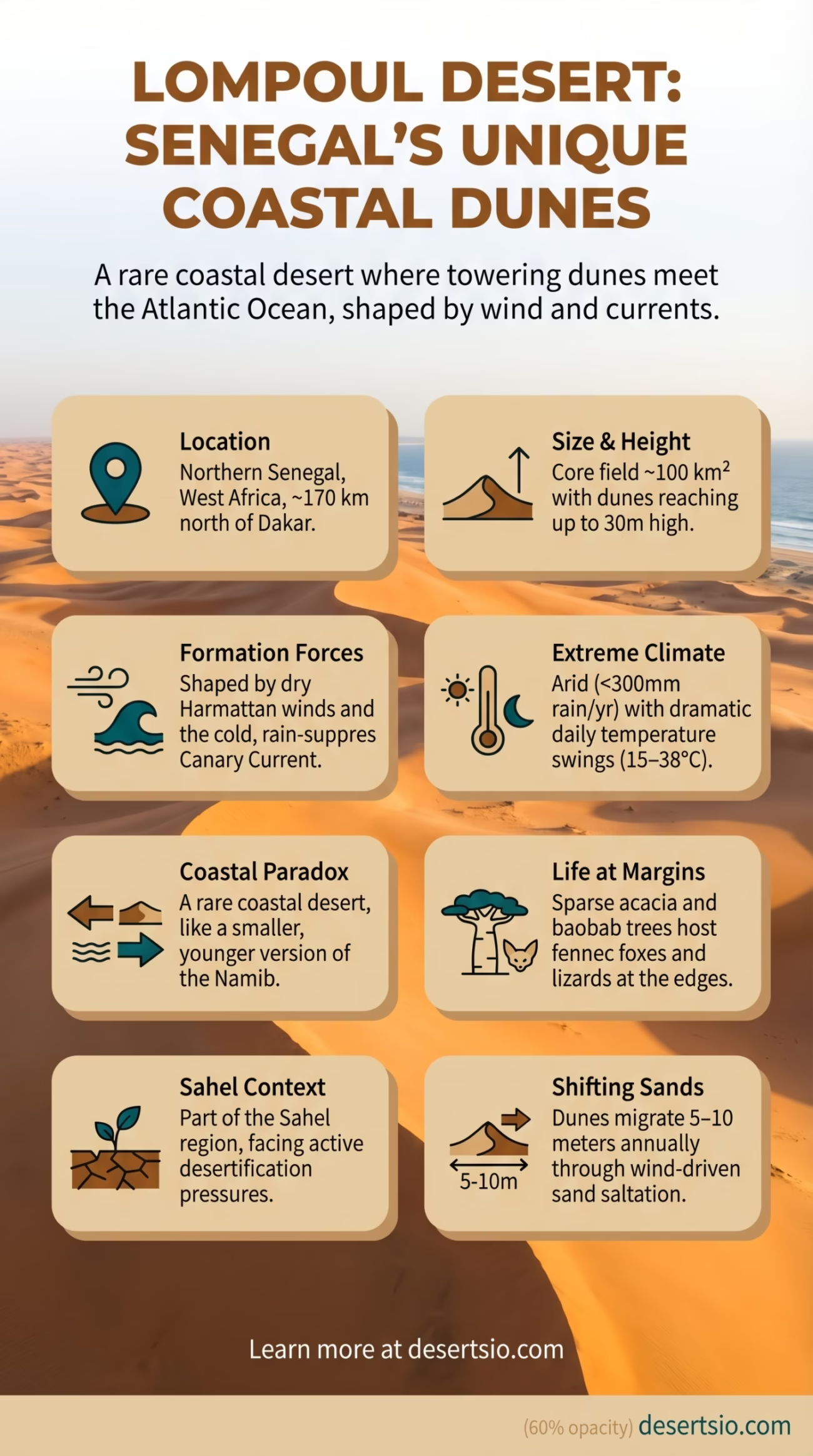
| Location | Northern Senegal, West Africa (near the Atlantic Coast) |
| Area | Approximately 100 km² of core dune field |
| Type | Sandy desert (erg) / semi-arid dune landscape |
| Dune Height | Up to 30 meters (some sources indicate peaks near 25–30 m) |
| Nearest City | Louga (~60 km southeast); Saint-Louis (~100 km north) |
| Average Daytime Temperature | 28–38°C (82–100°F) in dry season |
| Average Nighttime Temperature | 15–20°C (59–68°F) — a drop of up to 20°C |
| Annual Rainfall | Less than 300 mm per year |
| Wind System | Harmattan (dry northeastern trade wind from the Sahara) |
| Dominant Vegetation | Sparse acacia scrub, baobab trees at margins |
| Proximity to Sahara | Southern fringe of the Sahara’s Atlantic extension |
| Current Land Use | Dune tourism and local land use now overlap with the wider Grande Côte mineral-sands mining and rehabilitation corridor |
| Accessibility | ~170 km north of Dakar via RN 2 highway |
The Lompoul Desert sits roughly 170 kilometers north of Dakar — and yet most people outside West Africa have never heard of it. That gap between obscurity and reality is striking. This is a fully formed sandy desert, complete with towering orange dunes, bone-dry winds, and temperature swings that catch visitors completely off guard. It occupies a narrow stretch of northern Senegal between the Atlantic coastline and the southern edge of the Sahara Desert.
What makes Lompoul unusual is its geography. It sits just kilometers from the Atlantic Ocean, yet the landscape is distinctly arid. Today, that description needs one more layer: parts of the Lompoul dune area and the surrounding Grande Côte corridor are also undergoing mineral-sands mining, land reshaping, rehabilitation, and changes in tourism use. The dunes remain the feature that made Lompoul known, but the landscape is no longer explained by natural geography and tourism alone.
Lompoul Desert: Location and Map View
How Big Is the Lompoul Desert?
The core dune field of Lompoul covers roughly 100 square kilometers. That’s small by Saharan standards — the Sahara itself spans over 9 million km², making Lompoul about 0.001% of its size. A more relatable comparison: Lompoul’s dune area is approximately the size of the island of Manhattan, New York. Compact, concentrated, and intense.
But size can be misleading here. The dunes themselves rise up to 30 meters high, which is tall enough to disorient anyone standing at the base. The sand is fine-grained, iron-rich, and ranges from pale cream near the surface to deep amber at depth — the color shifts depending on moisture levels and the angle of light. In the late afternoon, the whole field can turn a burnt sienna.
Formation: Why Does a Desert Exist Here?
Lompoul’s existence is a product of two forces that both contribute to aridity. First: the Harmattan wind. This dry, dust-laden northeastern trade wind blows off the Sahara for much of the year, carrying low-humidity air toward the Atlantic. It suppresses moisture, dries soil, and transports fine sediment across the region.
Second: the Canary Current. Cold Atlantic waters running along Senegal’s coast can limit evaporation and atmospheric moisture compared with warmer tropical waters, contributing to the relatively dry coastal climate of northwestern Senegal.
Over long periods, wind-transported sediment accumulated in this low-lying coastal zone. The dunes at Lompoul include barchan and transverse forms associated with directional wind patterns. They’re not static. Wind continually moves individual grains and can reshape exposed dune surfaces over time.
Temperature: The Day-Night Divide
Sand holds heat — and releases it fast. That’s the core physics behind Lompoul’s pronounced temperature swings.
During the dry season (November through May), daytime temperatures regularly climb between 28°C and 38°C (82–100°F). By midnight, that same landscape can drop to 15–20°C (59–68°F). A swing of up to 20 degrees Celsius in a single day. Dry sand has relatively low thermal inertia, so the surface heats quickly in sunlight and cools rapidly after sunset.
The rainy season (July–September) brings higher humidity and somewhat moderated temperatures, though rainfall remains well below 300 mm annually. Even in these months, Lompoul stays semi-arid.
Flora and Fauna: What Actually Lives Here
The vegetation at Lompoul is sparse by design. The most mobile dune surfaces support little permanent plant cover because moving sand makes root establishment difficult. At the margins, however, the picture changes.
- Acacia trees — drought-resistant, deep-rooted plants suited to dry Sahelian environments
- Baobab trees (Adansonia digitata) — found in the wider Senegalese landscape and around more stable ground near the dune zone
- Euphorbia and succulent scrub — low-growing plants adapted to strong sun and limited moisture
- Sahelian grasses — seasonal grasses that appear after rainfall and retreat during prolonged dry periods
Animal life follows a similar pattern: much of it is small, mobile, nocturnal, or concentrated around more vegetated margins. Reptiles, insects, small mammals, and migratory birds use habitats across the wider coastal-Sahelian zone. Seasonal bird movements also connect this part of Senegal with the broader West African flyway.
Human Life: Who Lives in and Around Lompoul?
The Lompoul area is part of the Louga Region of Senegal — a largely rural zone where farming, fishing, livestock keeping, tourism, and other local activities overlap. Wolof is widely spoken, while Pulaar-speaking Fula (Fulani) communities are also present across the wider region.
The Fula — known locally as Peul in Senegal — have long practiced livestock herding in the Sahel. Seasonal movement with cattle and goats remains part of the wider pastoral system, with access to pasture and water changing through the year.
Permanent settlement directly within the most exposed dune field is limited. The village of Lompoul-sur-Mer lies toward the Atlantic coast, while farming communities occupy more stable ground around the dune system. Agriculture in the wider area includes groundnuts, millet, vegetables, and other crops suited to local soils and water availability.
Lompoul Today: Mining, Landscape Change and Rehabilitation
Lompoul’s modern landscape is tied to the Grande Côte mineral-sands operation run by Eramet Grande Côte. The wider concession follows a coastal dune strip about 106 kilometers long and roughly 4 kilometers wide. Unlike a fixed open pit, the mine is mobile: mineralized dune sand is dredged and passed through a floating Wet Concentration Plant (WCP), where denser minerals are separated from lighter sand.
The mining method changes the terrain as the extraction basin advances. According to Eramet Grande Côte, the lighter sand left after mineral concentration is deposited behind the operating basin and used to reshape the ground. Rehabilitation is designed to follow mining rather than wait until the entire concession has been worked: terrain is reprofiled, soils are stabilized, and vegetation is replanted after extraction moves onward.
Community Information Office in Lompoul-sur-Mer
On 25 March 2025, Eramet Grande Côte opened a Community Information Office in Lompoul-sur-Mer. The company describes it as a place where residents can obtain information about mining and industrial processes, impact management, and the environmental management plan.
The office also handles complaints and local dialogue, including questions connected with compensation and community matters. Its presence reflects how closely current mining activity and community land use now intersect in the Lompoul area.
Tourism has shifted as the mining corridor has reached areas associated with the well-known dune camps. During 2025, several tourism operators relocated from sections affected by the advancing operation, while compensation and relocation arrangements remained under discussion in some cases. That makes older descriptions of Lompoul as an unchanged cluster of desert camps incomplete. Tourism still forms part of Lompoul’s identity, but its location and relationship with the active dune corridor have changed.
Rehabilitation is the other side of the current land-use picture. In November 2025, Eramet Grande Côte returned 1,000 hectares of rehabilitated land to the State of Senegal across its wider Grande Côte operating area, in addition to 85 hectares returned in 2022. The company says former mining areas are reprofiled and revegetated as operations advance. Those figures describe the broader mining corridor and should not be read as meaning that 1,000 hectares of the Lompoul Desert itself were restored.
What Happened to the Mining Operation in 2026?
A fire occurred on 22 February 2026 at Eramet Grande Côte’s WCP at its Diogo mining site. The plant was evacuated, the fire was extinguished the same day, and the company reported no casualties or injuries. Mineral-sands production was suspended after the incident.
By the end of April 2026, Eramet had begun a partial restart of heavy mineral concentrate production using temporary arrangements. In its 27 May update, the company reported production at about 30% of nominal capacity. Reconstruction of the damaged WCP facilities is intended to bring the operation back to full nameplate capacity in the first quarter of 2027.
The 2026 interruption belongs to the wider Grande Côte mining system rather than being a measure of Lompoul’s natural condition. Still, it matters when describing Lompoul today because the desert sits within a coastal landscape whose land use now changes with the movement, rehabilitation, and operating status of the mineral-sands mine.
The most accurate description of Lompoul in 2026 is therefore neither an untouched tourism desert nor a landscape that can simply be described as gone. Parts of the dune corridor have been altered by mining, tourism activity has shifted, and rehabilitation follows worked sections according to the operator’s restoration program. Local questions around land, compensation, water, and future use remain part of the area’s changing geography.
Desertification in the Sahel
Lompoul doesn’t exist in isolation. It sits near the western edge of the Sahel — the semi-arid belt stretching across Africa south of the Sahara. Rainfall variability, vegetation loss, soil degradation, grazing pressure, and land management all influence how dryland conditions change across this zone. Senegal also participates in the Great Green Wall initiative, which supports land restoration across degraded parts of the Sahel.
Lompoul vs. the Namib: A Surprising Parallel
Lompoul and the Namib Desert (Namibia, southern Africa) both occupy Atlantic-facing dry landscapes influenced by regional wind and ocean conditions. The Namib — one of the oldest deserts on Earth — operates under the strong influence of the cold Benguela Current, while the Canary Current affects the Atlantic margin of northwestern Africa.
The Namib dwarfs Lompoul: it stretches over 81,000 km² along a long section of southwestern Africa. Lompoul is far smaller and belongs to a wetter Sahelian setting, so the two should not be treated as climatic equivalents. Their shared feature is the unusual meeting of Atlantic coastal processes with dry dune landscapes.
| Feature | Lompoul Desert | Namib Desert |
| Location | Northern Senegal, West Africa | Namibia / Angola, Southern Africa |
| Area | ~100 km² | ~81,000 km² |
| Cold Current Influence | Canary Current (Atlantic) | Benguela Current (Atlantic) |
| Dune Type | Barchan, transverse | Star, linear, transverse |
| Annual Rainfall | <300 mm | <25 mm (hyperarid core) |
| Age (Geological) | Relatively young dune system | Tens of millions of years |
Nearby Deserts and Arid Landscapes
Lompoul doesn’t stand alone in its regional context. The broader West African and North African geography around it includes much larger arid and semi-arid zones.
The Sahara Desert
The world’s largest hot desert — over 9 million km² — dominates North Africa north of the Sahel. Saharan air and dust carried southwest by the Harmattan influence Senegal during the dry season.
The Mauritanian Sahara
Directly north of Senegal lies Mauritania, where desert and semi-desert terrain covers most of the country. Its broad dune fields and gravel plains extend the Saharan environment much farther than Lompoul’s compact coastal dune zone.
The Ferlo Region (Senegal)
Within Senegal itself, the Ferlo region in the northeast represents a broad Sahelian dryland landscape dominated by seasonal grasses, thorn scrub, and pastoral land use. It lacks Lompoul’s compact orange dune scenery but covers a far greater area.
The Sand Science: What Makes Lompoul’s Dunes Move?
Dune migration is not random. Wind moves sand through several processes, the most recognizable being saltation: grains are lifted briefly, travel downwind, and strike the surface again, sometimes dislodging other grains. Repeated millions of times, that process changes the shape and position of exposed dunes.
The rate of movement depends on wind speed, grain size, moisture, vegetation, and the shape of the dune. Where plant roots stabilize the surface, movement slows. Where sand remains bare, reshaping can happen much faster. Human land use can also alter that pattern by removing vegetation, flattening dunes, rebuilding terrain, or establishing new plant cover.
Lompoul in the Context of Climate Data
The region around Lompoul falls broadly within a hot semi-arid Sahelian climate. Rainfall is low and concentrated mainly in the summer wet season, while the long dry season is shaped by northeast trade winds and periods of Harmattan dust.
- Mean annual precipitation: roughly 200–300 mm in the wider area, concentrated mainly in the wet season
- Mean annual temperature: approximately 27–29°C
- Peak dry-season heat: temperatures can rise above 40°C during hot spells
- Dry-season air: humidity can fall sharply during Harmattan episodes
- Dust transport: Harmattan winds can carry Saharan dust across Senegal and reduce visibility
The combination of a long dry season, short wet season, coastal influence, and periodic Saharan air explains why Lompoul can maintain such a dry dune landscape relatively close to the Atlantic.
Why Lompoul Is Scientifically Interesting
For geomorphologists and dryland researchers, Lompoul offers a compact example of how dunes respond to wind, vegetation, rainfall, coastal conditions, and human land use. Changes can be observed over relatively short distances, from bare sand to vegetated margins, farmland, settlements, mined ground, and rehabilitated terrain.
Remote sensing from Landsat and Sentinel satellites can help track changes in dune shape, vegetation cover, disturbed land, and rehabilitation over time. That matters more now because natural dune movement is no longer the only process reshaping the area. Mining and subsequent terrain reconstruction create additional, clearly human-driven changes in the surface.
Lompoul remains a distinctive coastal dune landscape, but its present-day geography is more complicated than older tourism descriptions suggest. Natural wind and sand processes continue, while mining, rehabilitation, farming, settlements, and relocated tourism activity now occupy the same wider corridor. Understanding Lompoul means looking at all of them together.