
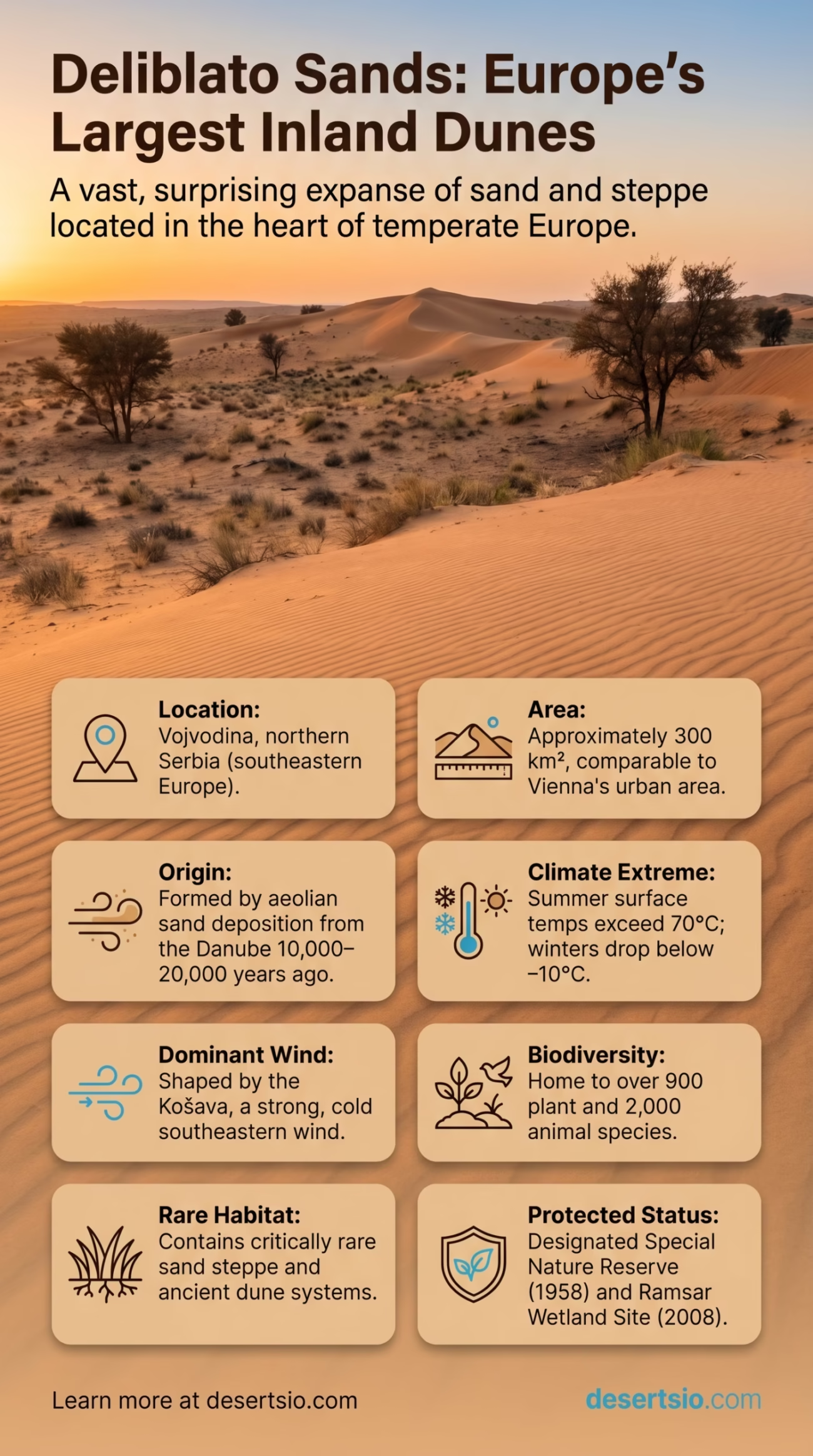
| Location | Vojvodina, northern Serbia (southeastern Europe) |
| Coordinates | ~45°N, 21°E |
| Area | Approximately 300 km² (30,000 hectares) |
| Type | Sandy terrain / inland aeolian sand deposit (not a true desert by climate) |
| Maximum Dune Height | Up to 10–12 meters above surrounding plain |
| Elevation | 80–192 meters above sea level |
| Annual Precipitation | ~550–600 mm/year |
| Average Summer Temperature | Daytime: 35–40°C | Nighttime: 15–18°C |
| Average Winter Temperature | Daytime: 0–5°C | Nighttime: −10°C or below |
| Protected Status | Special Nature Reserve (since 1958); Ramsar Wetland Site (2008) |
| Nearest City | Pančevo (~30 km northwest); Bela Crkva to the southeast |
| Dominant Wind | Košava — a strong southeastern wind unique to this region |
| Primary Forest Type | Planted black locust and oak; remnant steppe vegetation |
| Registered Plant Species | Over 900 vascular plant species |
| Registered Animal Species | Over 2,000 animal species including 200+ bird species |
Deliblato Sand — locally known as Deliblatska peščara — sits in the flat, windswept plains of Vojvodina in northern Serbia, and it immediately raises a question: what is a sand sea doing in the middle of temperate Europe? With annual rainfall around 550 mm and cold, snowy winters, this place defies the common image of desert landscapes. Yet the sand dunes are real, the dry steppe patches are real, and the ecological extremes are very real. It is the largest inland sand area in Europe, covering roughly 300 km² — an area comparable to the city of Chicago’s full municipal boundary.
Deliblato Sands: Location and Map View
How Did This Sand Get Here?
The origin story goes back roughly 10,000–20,000 years to the late Pleistocene and early Holocene. During glacial and post-glacial periods, the Danube and its tributaries deposited enormous quantities of alluvial sand across the Pannonian Basin. When the climate shifted and river courses changed, vast amounts of dry, unconsolidated sediment were left exposed. The košava — a fierce, cold, and dry southeastern wind that still defines the regional climate today — picked up that sand and moved it, shaped it, and piled it into dunes.
This aeolian (wind-driven) process is the same mechanism that builds true desert dunes in the Sahara or the Arabian Peninsula. The difference is that here, a more humid continental climate eventually slowed the migration. Vegetation took hold, partially stabilizing the dunes. What remains is a relic landscape — a frozen snapshot of a much more dynamic period in European geological history.
Size in Perspective
Three hundred square kilometers sounds modest next to the Sahara’s 9.2 million km². But for Europe, Deliblato Sand is unmatched. To put it plainly: it is larger than the entire urban area of Vienna. It stretches roughly 35 km in length and up to 15 km in width, forming an elongated oval that follows the dominant wind direction — northeast to southwest — almost like a geographic compass pointing toward the origin of the košava.
And within that area, the terrain is surprisingly varied. Open dune fields, dense forest plantations, wetland hollows, steppe grasslands, and shrub thickets all coexist within a few kilometers of each other. This diversity is, frankly, one of the most remarkable things about this place.
Temperature Extremes — More Desert-Like Than You’d Expect
The microclimate of Deliblato Sand is genuinely extreme by European standards. The sandy substrate heats and cools far faster than surrounding agricultural soil — a physical property called low thermal inertia. During summer, surface sand temperatures can exceed 70°C at midday. Daytime air temperatures regularly reach 35–40°C in July and August, while the same night might drop to 15°C — a diurnal swing of 20+ degrees that mirrors conditions in semi-arid zones.
Winters are the opposite extreme. January temperatures regularly fall below −10°C, and the exposed dune crests receive the full force of the košava, which blows at sustained speeds of 60–90 km/h and gusts above 120 km/h. This is not a gentle European countryside wind. Locals have described it as a wind that “gets into your bones.”
The Košava Wind — Deliblato’s Invisible Sculptor
The košava is a cold, dry, squally wind that originates in the Carpathian mountain passes and accelerates across the flat Pannonian Plain. It typically blows from the southeast and is most intense between October and March. Here is what makes it scientifically interesting for this landscape:
- It shaped the dunes — the northeast-to-southwest dune alignment directly reflects centuries of košava activity.
- It increases evapotranspiration — even with 550 mm of annual rainfall, the drying effect of the wind creates soil moisture deficits that resemble semi-arid conditions.
- It limits tree growth on exposed ridges, maintaining open steppe habitats that would otherwise be overgrown.
- It is a regional phenomenon — the košava also affects Belgrade, but Deliblato amplifies its impact due to open terrain and loose substrate.
Flora — Over 900 Species in a European Sand Sea
This is where Deliblato Sand genuinely surprises. For a landscape that most people haven’t heard of, the botanical richness is extraordinary. Over 900 vascular plant species have been recorded — a figure that reflects the mosaic of microhabitats compressed into a relatively small area.
The vegetation falls into several distinct communities:
- Sand steppe — the original, pre-forestation vegetation type; dominated by Festuca vaginata (sheathed fescue), sand sedge (Carex arenaria), and various drought-adapted forbs. This community is critically rare across Europe and survives only in fragmented patches at Deliblato.
- Planted forests — beginning in the late 18th century, the Habsburg administration initiated large-scale afforestation to stabilize the moving dunes. Black locust (Robinia pseudoacacia) and Scots pine were the primary species planted. Today, these forests cover a large part of the reserve.
- Riparian and wetland vegetation — shallow depressions between dunes collect water seasonally, supporting communities of reed (Phragmites australis), willowherb, and aquatic plants.
- Thermophilous shrub communities — blackthorn, hawthorn, and wild rose thickets form transition zones between open dunes and forest.
Several endemic and relict plant species survive here — plants that retreated from harsher post-glacial climates and found refuge in Deliblato’s warm, sandy microenvironments. Dianthus serotinus (late-flowering pink) is one example, found at very few locations in Europe outside of this region.
Fauna — 2,000+ Species and a Bird Migration Crossroads
The faunal diversity is notable. More than 2,000 animal species have been recorded, including over 200 bird species. The reserve sits on a major migratory flyway, and the mosaic of open ground and woodland attracts a wide range of raptors, waders, and passerines.
Notable species include:
- Imperial eagle (Aquila heliaca) — one of Europe’s rarest raptors; Deliblato is one of its few confirmed breeding sites in Serbia.
- Great bustard (Otis tarda) — the heaviest flying bird in the world; steppe habitat at Deliblato supports one of Europe’s easternmost populations.
- European ground squirrel (Spermophilus citellus) — critically endangered; the open grasslands are essential for this species.
- Sand lizard (Lacerta agilis) and smooth snake (Coronella austriaca) — both benefit from the warm, sun-exposed sandy slopes.
- Stag beetle (Lucanus cervus) — old-growth oaks within the reserve support healthy populations of this EU-protected species.
And the insects. The invertebrate fauna of Deliblato includes numerous rare and endemic species adapted to shifting sand environments — species that simply don’t exist in stabilized agricultural soils. This is a critical point ecologists emphasize: the open, disturbed sand patches are not degraded habitat — they are the habitat.
Human Life and Historical Presence
Deliblato Sand has never been a place of dense settlement — the terrain, the water scarcity, and the košava made permanent habitation difficult. Scattered villages exist at the periphery: Deliblato, Bavanište, Dubovac, and Kajtasovo are the closest communities. The population of the surrounding municipality is predominantly Serbian, with Romanian and Slovak minorities — a reflection of the multi-ethnic character of Vojvodina more broadly.
Historically, the sand was used for grazing — cattle and sheep were moved across the dunes seasonally. The Habsburg-era afforestation program, which began under Maria Theresa’s administration in the 1770s, was one of the first large-scale ecological engineering projects in European history. It was not conservation by modern standards — it was land stabilization for agricultural and military purposes. But it inadvertently created one of the largest and most diverse woodlands in the Balkans.
Today, the reserve is managed by the Institute for Nature Conservation of Serbia. Ecotourism has grown modestly, particularly among birdwatchers, hikers, and botanists. There are no permanent residents within the reserve’s core zone.
Conservation Status and Current Challenges
Deliblato Sand holds multiple protected designations:
- Special Nature Reserve (Serbia) — designated 1958
- Ramsar Wetland Site — designated 2008 (covering wetland habitats within the reserve)
- Important Bird Area (IBA)
- Proposed Emerald Network site (Europe’s biodiversity network)
Despite these protections, the reserve faces real pressure. Invasive species — particularly black locust and ailanthus — continue to spread into open steppe patches, shrinking the rare sand steppe habitat. Sand steppe is considered one of Europe’s endangered habitats, and Deliblato contains some of its remaining fragments.
Climate change adds another layer. Rising temperatures and shifting precipitation patterns are altering the fire regime, drought frequency, and species composition within the reserve. Research published in recent years from Serbian and EU-funded ecological surveys has flagged accelerating vegetation change in the open dune areas — a trend that closely mirrors desertification dynamics observed in Mediterranean and steppe zones further south.
Nearby Sandy and Steppe Landscapes
Deliblato Sand is part of a larger regional context. Several other sandy and semi-arid landscapes exist within the broader Pannonian Basin:
| Landscape | Location | Area | Key Feature |
| Deliblato Sand | Serbia (Vojvodina) | ~300 km² | Largest inland sand in Europe; endemic flora |
| Kiskunság Sand Ridge | Central Hungary | ~1,400 km² | Pannonian sand steppe; protected national park |
| Bácska Loess Ridge | Hungary / Serbia border | ~200 km² | Loess steppe; similar wind-deposited origin |
| Fruška Gora | Serbia (Vojvodina) | ~540 km² | Isolated massif; forest reserve adjacent to plains |
| Hortobagy Puszta | Eastern Hungary | ~800 km² | UNESCO World Heritage steppe; largest grassland in Europe |
Of these, Kiskunság in Hungary is the closest ecological parallel to Deliblato. Both originated from Pleistocene aeolian sand deposition in the Pannonian Basin, both support endemic sand steppe flora, and both struggle with the same invasive species pressure. The key difference: Kiskunság is roughly five times larger and has a more developed tourism infrastructure. Deliblato, by contrast, remains relatively unexplored — which is, depending on your perspective, either a problem or an advantage.
What Makes Deliblato Ecologically Irreplaceable
The core argument for Deliblato’s global significance is actually quite simple. Sand steppe habitat — open, unstabilized, wind-disturbed sandy ground with its specific plant and invertebrate communities — has been almost entirely lost across Europe. Agricultural conversion, afforestation, and development have removed over 90% of this habitat type from the continent over the past 200 years.
What survives at Deliblato is not a remnant or a reconstruction. It is the real thing — a functioning fragment of a landscape type that once extended across much of the Pannonian Basin. The endemic species found here, the soil crusts, the microarthropod communities in the sand — none of these can simply be recreated elsewhere. This is what makes the ongoing encroachment of invasive woody plants a genuinely urgent ecological problem, not merely an academic one.
And it is, also, one of the more visually striking places in temperate Europe. Standing on an open dune crest with the košava blowing hard from the southeast, watching a short-toed eagle circle above a steppe patch — it feels nothing like central Serbia. It feels, just briefly, like somewhere else entirely.