
| Location | Western Australia, Australia |
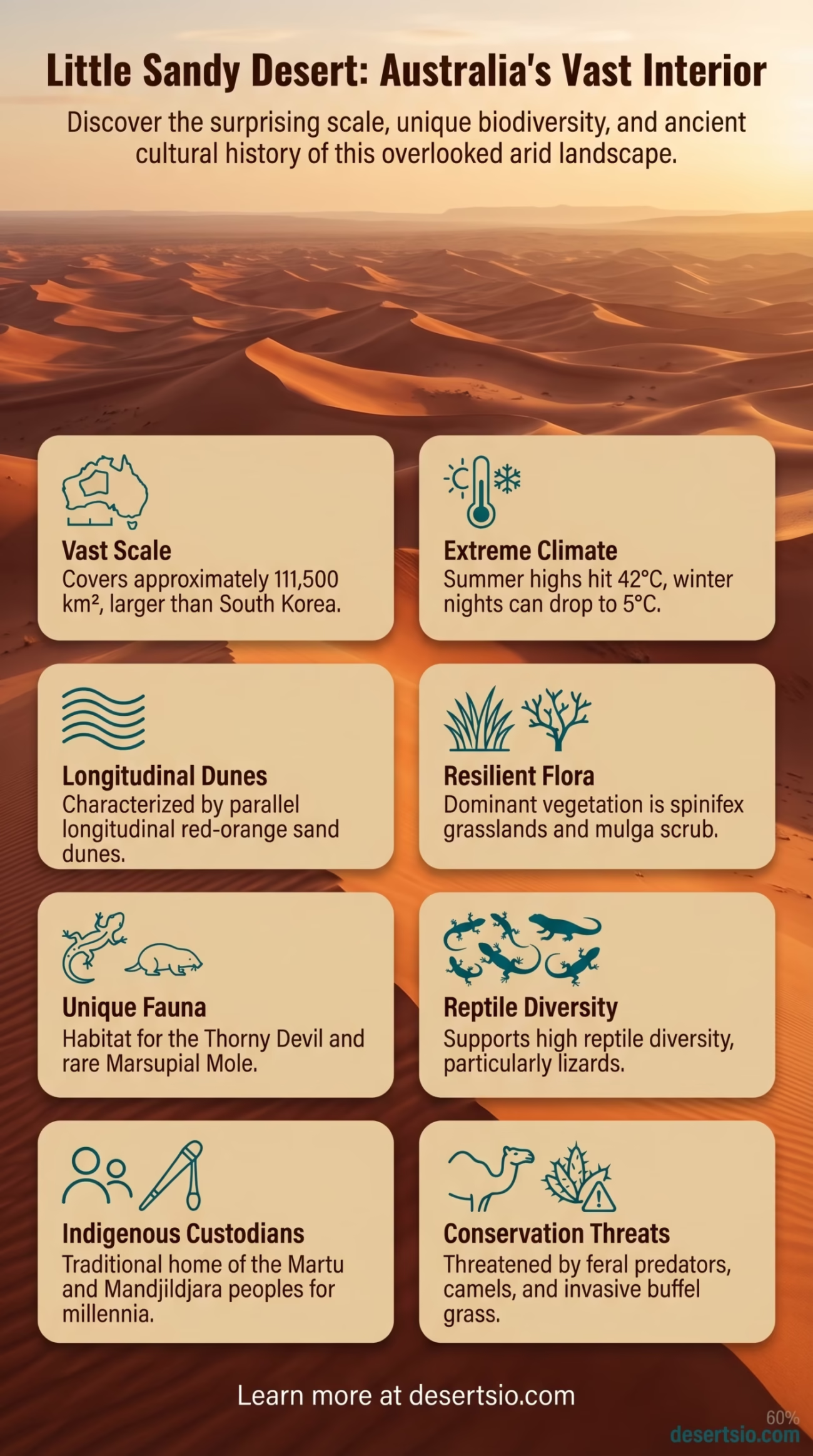
| Area | Approximately 111,500 km² (43,050 sq mi) |
| Type | Sandy desert (arid) |
| Average Annual Rainfall | Less than 250 mm (10 in) |
| Average Daytime Temperature | 35–42°C (95–108°F) in summer |
| Average Nighttime Temperature | 5–15°C (41–59°F) in winter nights |
| Elevation | 400–550 m above sea level |
| Dominant Vegetation | Spinifex grasslands, mulga scrub |
| Nearest Major City | Newman (~300 km northeast) |
| Indigenous Custodians | Martu and Mandjildjara peoples |
| Protected Status | Partially within Little Sandy Desert Biodiversity Hotspot |
| Comparable Size | Slightly larger than South Korea (100,210 km²) |
The Little Sandy Desert sits quietly in the interior of Western Australia, tucked between its more famous neighbor — the Great Sandy Desert to the north — and the Gibson Desert to the east. At roughly 111,500 square kilometers, it is anything but small in scale. The name is a relative one: “little” only when measured against the Great Sandy Desert, which sprawls across more than 284,000 km². Put side by side with a country, the Little Sandy Desert is larger than South Korea. That puts things in perspective.
Little Sandy Desert: Location and Map View
How Did the Little Sandy Desert Form?
The desert’s origin traces back millions of years, shaped by the slow geological transformation of the Australian continent. Australia drifted northward from Antarctica roughly 45 million years ago, gradually losing its once-temperate climate. As moisture-bearing winds became blocked by emerging landforms and ocean current changes shifted rainfall patterns, the interior dried out — relentlessly and completely.
The landscape itself is largely the product of aeolian processes — wind erosion and deposition over geological timescales. Massive sheets of red-orange sand, carried and sorted by ancient winds, formed the parallel dune systems visible today. These linear dunes, sometimes called longitudinal dunes, run in a northwest-to-southeast alignment, following dominant wind directions that have persisted for tens of thousands of years. Beneath the sand lies ancient laterite bedrock, a deeply weathered iron-rich layer left over from when the land held tropical soils.
Size and Geography: Bigger Than You’d Expect
Geographically, the Little Sandy Desert occupies a transitional zone — it is not the driest nor the most dramatic of Australia’s deserts, but it holds its own distinct character. The terrain combines open sandplains, low dune fields, dry salt lakes (locally called playas), and scattered gibber plains where wind has stripped the surface bare, leaving a pavement of polished stones.
The elevation sits between 400 and 550 meters above sea level across most of its extent. Seasonal dry creek systems — called watercourses in Australian geographic parlance — cut through the landscape but carry water only after rare heavy rains.
Desert Zones Within the Little Sandy
- Northern sandplains: Transition zone with the Great Sandy Desert, featuring lower dune density
- Central dunefields: Classic parallel red sand dunes, 5–15 m high, spaced 200–500 m apart
- Southern gibber flats: Rocky, windswept plains with minimal vegetation cover
- Ephemeral lake basins: Salt pans that flood temporarily after cyclone-driven rainfall events
Temperature: The Brutal Math of Day and Night
Summer days in the Little Sandy Desert are punishing. Temperatures regularly reach 40–42°C (104–108°F) from December through February, and ground-surface temperatures can exceed 70°C on exposed red sand. Then night falls — and the desert does something that surprises people unfamiliar with arid climates. The temperature drops sharply. In winter (June–August), nighttime lows can plunge to 5°C (41°F) or below, occasionally touching near-freezing levels in sheltered depressions.
This diurnal (day-to-night) temperature swing can exceed 30°C within a single 24-hour period. The reason is straightforward: desert air holds almost no humidity, and without water vapor to retain heat, the ground radiates its warmth into the atmosphere the moment the sun disappears. It’s a thermal extreme most temperate-climate residents never experience.
Annual rainfall averages under 200 mm in most areas, making it one of the more arid zones in Western Australia’s interior. What rain does fall tends to arrive erratically — sometimes driven by remnants of tropical cyclones from the northwest coast.
Flora: Spinifex, Mulga, and Surprising Resilience
The dominant plant of the Little Sandy Desert is spinifex — specifically Triodia species, the spiky, hummock-forming grasses that cover vast swaths of Australian arid zones. These grasses are architectural marvels of adaptation. Their leaves are narrow and waxy, minimizing water loss; their roots reach deep; and they resprout vigorously after fire. Spinifex communities cover an estimated 30% of Australia’s arid interior, and the Little Sandy is no exception.
Between dune crests and on the flatter sandplains, mulga (Acacia aneura) scrubland takes hold. Mulga is a remarkably drought-adapted acacia — its branches funnel even the smallest rainfall directly toward its roots, and it can survive years of near-total drought. After rain, desert wildflowers erupt across the landscape in displays that are, by any measure, spectacular: Ptilotus (mulla mulla), native daisies, and various Eremophila species color the red sand briefly and brilliantly.
Other notable plant species include:
- Desert oak (Allocasuarina decaisneana): Iconic slow-growing tree found on sandplains
- Grevillea species: Flowering shrubs that provide nectar for birds and insects
- Corkwood (Hakea spp.): Hardy shrubs adapted to nutrient-poor sandy soils
- Native tobacco (Nicotiana spp.): Fast-colonizing annual after disturbance
Fauna: Life That Hides, Then Appears
The Little Sandy Desert holds considerably more animal life than its austere surface suggests. Much of it is nocturnal — hiding through the brutal heat, emerging at dusk. The reptile diversity here is notably high. Australia’s arid zones host some of the highest lizard diversity on Earth, and the Little Sandy contributes significantly to that count.
Key fauna of the region includes:
- Thorny devil (Moloch horridus): Absorbs water through its skin from damp sand — one of the desert’s strangest and most studied adaptations
- Great desert skink (Liopholis kintorei): A social, burrow-dwelling lizard with complex family structures, considered vulnerable
- Sand goanna (Varanus gouldii): An active predator across sandy terrain
- Bilby (Macrotis lagotis): Australia’s iconic nocturnal marsupial, once widespread, now reduced to scattered populations
- Marsupial mole (Notoryctes typhlops): Rarely observed, “swims” through sand just below the surface
- Malleefowl and various honeyeaters: Among the bird species that exploit seasonal flowering events
The marsupial mole deserves a pause. It is functionally blind and earless, lives entirely underground, and leaves no permanent tunnels — it simply moves through loose sand. Encounters with one are rare enough that many researchers go entire careers without seeing one in the field.
Human Life: The Martu and Mandjildjara
The Little Sandy Desert has been home to Indigenous Australians for at least 40,000 years. The primary traditional custodians of this country are the Martu people and the related Mandjildjara group, whose traditional territories cover much of the Western Desert region, including the Little Sandy.
Martu knowledge of this landscape is encyclopedic — water sources (called rockholes or soakages), seasonal animal movements, edible plants, and fire management practices refined across countless generations. Traditional fire management — burning small patches at different times — creates a mosaic of habitats that actually increases biodiversity. This practice, sometimes called cultural burning, is now recognized by ecologists as a sophisticated land management system, not simply a survival technique.
Today, many Martu people live in remote communities such as Punmu, Parnngurr, and Kunawarritji, located on the eastern edge of the Little Sandy Desert. These communities maintain strong connections to Country — the Indigenous concept linking people, land, spirituality, and responsibility in a way that has no clean English equivalent. And that connection matters, practically: Martu rangers now work alongside scientists on conservation projects across the region.
Non-Indigenous permanent settlement in or around the desert is essentially absent. The nearest regional centers — Newman and Meekatharra — are significant distances away.
Neighboring Deserts: Understanding the Western Desert Complex
The Little Sandy Desert does not exist in isolation. It forms part of what geographers call the Western Desert — a broad cultural and ecological region encompassing several distinct desert units. Looking at its neighbors helps explain it better.
| Desert | Area (km²) | Key Feature | Relation to Little Sandy |
| Great Sandy Desert | 284,993 | Largest sandy desert in Australia | Directly to the north; shares dune systems |
| Gibson Desert | 156,000 | Stony plains and sandridges | Directly to the east; similar ecology |
| Great Victoria Desert | 424,400 | Largest desert in Australia overall | Southeast; connected via Western Desert |
| Tanami Desert | 184,500 | Flat, spinifex-dominated | Northeast; overlapping fauna |
The Gibson Desert is the closest ecological twin to the Little Sandy. Both share similar dune morphology, spinifex-dominated groundcover, and Martu cultural connections. The Gibson, however, receives marginally less rainfall and holds larger expanses of open sandplain. If the Little Sandy Desert is relatively unknown outside Australia, the Gibson is arguably even more obscure, and large parts of it remain under-studied.
Conservation and Current Challenges
The Little Sandy Desert faces a set of pressures common to Australia’s arid interior — and a few that are more specific. Feral animals are among the most damaging: feral cats and foxes have devastated populations of small native mammals across the region. Feral camels (introduced in the 19th century and now numbering in the hundreds of thousands across arid Australia) degrade water sources and trample fragile vegetation. Feral goats add further grazing pressure in peripheral areas.
Invasive buffel grass (Cenchrus ciliaris) presents a particularly urgent threat. Introduced as a pasture species, it outcompetes native spinifex, alters fire regimes by creating denser fuel loads, and can fundamentally restructure desert plant communities. Management of buffel grass across Australia’s arid zones is now a significant conservation priority — with direct relevance to the Little Sandy.
Climate projections for southwestern Australia suggest increasing aridity and higher frequency of extreme heat events through the 21st century. For a landscape already operating at the edge of biological tolerance, even marginal shifts in temperature and rainfall timing can have cascading effects on species survival and ecosystem function.
Martu-led conservation and ranger programs have shown measurable success in controlling feral predators and implementing strategic burning. Collaborative projects between Martu communities and organizations like the Australian Wildlife Conservancy have documented local recoveries of threatened species, including the bilby, in areas where traditional land management has been reinstated.
Desert Terminology: A Few Terms Worth Knowing
- Playa: A flat, dry lakebed that fills temporarily after heavy rain
- Gibber plain: A stony desert surface covered with wind-polished rocks
- Spinifex: Hummock-forming grass (genus Triodia) dominant across Australian arid zones
- Soakage: A subsurface water source accessed by digging into sandy creek beds
- Country: Indigenous Australian term encompassing land, people, spirit, and responsibility as an integrated whole
- Cultural burning: Traditional Indigenous fire management that maintains habitat mosaic and biodiversity
What Makes the Little Sandy Desert Distinct
There is a tendency to lump Australia’s interior deserts together — a broad, hot, red expanse. The Little Sandy resists that generalization. Its position as a transitional zone between the Great Sandy and Gibson deserts gives it an ecological character that is genuinely its own: slightly more vegetated than the Great Sandy’s open dune seas, more sandy than the Gibson’s stony flats, and carrying a cultural history of Indigenous occupation that is among the most enduring of any arid region on Earth.
And there is something worth noting about scale. At over 111,500 km², this “little” desert is larger than Hungary, larger than South Korea, and roughly twice the size of the state of Georgia (USA). The name is, in the most literal sense, a matter of perspective.