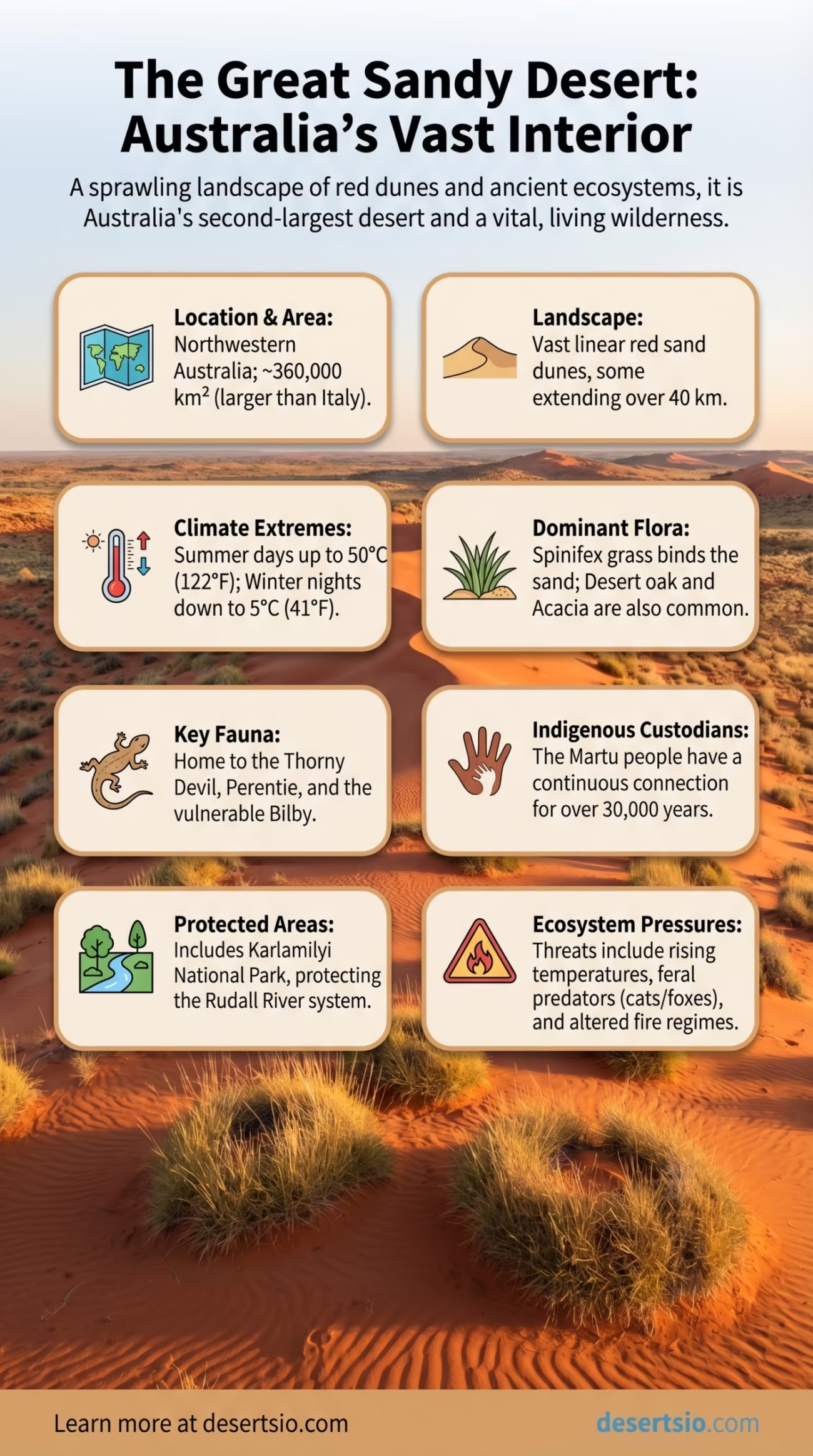
| Location | Northwestern Western Australia |
| Area | approximately 360,000 km² (139,000 sq mi) |
| Type | Sandy desert (erg) |
| Average Annual Rainfall | 150–250 mm (6–10 in) |
| Daytime Temperature (Summer) | up to 50°C (122°F) |
| Nighttime Temperature (Winter) | as low as 5°C (41°F) |
| Elevation | 300–500 m above sea level |
| Dominant Vegetation | Spinifex grass, desert oak, acacia |
| Key Fauna | Thorny devil, bilby, sand goanna, perentie |
| Indigenous Peoples | Martu people (traditional custodians) |
| Nearest Major City | Port Hedland (~400 km northwest) |
| Protected Areas Within | Karlamilyi National Park (Rudall River) |
| Dune Orientation | Parallel linear dunes, generally east-west aligned |
The Great Sandy Desert stretches across the northwestern corner of Western Australia in a vast, largely unbroken expanse of red sand and spinifex—making it the second-largest desert in Australia and one of the most remote landscapes on Earth. At roughly 360,000 km², it is bigger than Germany and Poland combined. That scale is almost impossible to picture until you realize that entire ecosystems, ancient songlines, and distinct geological formations are quietly unfolding within it, far from most human eyes.
Great Sandy Desert: Location and Map View
How Big Is It, Really?
360,000 km² is not an abstract figure. To put it plainly: the Great Sandy Desert is larger than the entire country of Italy. It also dwarfs the United Kingdom by a considerable margin. Within Australia itself, only the Great Victoria Desert edges it out in size. Its sheer scale means weather patterns, soil types, and even plant communities shift noticeably as you cross from one corner to another—this is not a uniform, featureless plain.
The desert spans from the Kimberley region in the north down toward the Gibson Desert in the south, and from the Pilbara’s edge in the west toward the Northern Territory border in the east. It effectively forms a geographic buffer between the tropical north and the temperate south of the continent.
Formation: Ancient Forces at Work
The landscape here is old. Very old. The sand that makes up the Great Sandy Desert has been accumulating and rearranging itself for tens of millions of years, shaped by tectonic stability, wind erosion, and the gradual drying of the Australian continent as it drifted northward. Australia’s interior has not been submerged by shallow seas for hundreds of millions of years, which allowed deep weathering to break ancient rocks into the fine, iron-oxide-rich grains that give the desert its distinctive red-orange color.
The linear dunes—long, parallel ridges aligned broadly east-west—are a product of persistent trade winds that have been sculpting the surface for at least the last 1–2 million years. These dunes can reach heights of 10–15 meters and extend for dozens of kilometers without interruption. And yet, unlike the Sahara’s towering ergs, they are surprisingly vegetated. Spinifex grass binds the sand, preventing the kind of dramatic dune migration you see in sandier, more exposed deserts.
Desert Geology Overview
- Substrate: Deep, fine-grained quartz sand, heavily oxidized with iron oxide (hence the red color)
- Dune type: Longitudinal (linear) dunes, some exceeding 40 km in length
- Underlying rock: Precambrian basement rock, among the oldest stable shields on Earth
- Soil pH: Generally acidic to neutral (5.5–7.0), low in nutrients
- Paleolake evidence: Dry lakebeds (playas) scattered throughout, remnants of a wetter Pleistocene climate
Temperature: A Desert of Extremes
Summer days here push the thermometer to 45–50°C (113–122°F)—ground surface temperatures can exceed 70°C. The sun is relentless, reflected and amplified by bare sand between spinifex clumps. But nights are much cooler. In winter (June–August), temperatures regularly drop to 5–8°C (41–46°F) after sunset, sometimes nearing freezing in the coldest months. That’s a daily swing of 30°C or more, which places heavy stress on organisms—and shapes how life here has adapted.
Rainfall is sparse and unreliable: 150–250 mm annually on average, though much of it falls in brief, intense summer thunderstorms linked to tropical weather systems drifting south from the Kimberley coast. Cyclone remnants occasionally push deep into the desert, temporarily flooding dry creek beds (known locally as creeks or watercourses) before evaporating within days.
Flora and Fauna: Tough, Tenacious, and Surprisingly Diverse
The Great Sandy Desert looks sparse at first glance. Look closer, and it’s anything but.
Flora
- Spinifex grass (Triodia spp.) — the dominant ground cover, forming spiky hummocks that hold moisture and shelter wildlife
- Desert oak (Allocasuarina decaisneana) — a slow-growing, deep-rooted tree found along drainage lines
- Acacia species (wattles) — particularly Acacia aneura (mulga), key nitrogen fixers in nutrient-poor soils
- Grevillea and Hakea shrubs — provide nectar for birds and insects
- Ephemeral wildflowers that bloom explosively after rare rainfall events — a phenomenon documented with increasing frequency as climate patterns shift
Fauna
- Thorny devil (Moloch horridus) — absorbs water through its skin; one of the desert’s most recognizable residents
- Perentie (Varanus giganteus) — Australia’s largest monitor lizard, reaching 2.5 m in length
- Bilby (Macrotis lagotis) — a vulnerable marsupial, nocturnal, with population strongholds in this desert
- Sand goanna and bearded dragon — common reptiles, highly adapted to temperature extremes
- Malleefowl and various honeyeaters — bird species that exploit seasonal flowering events
- Feral camels — an introduced species now numbering in the tens of thousands across Australian deserts, including this one
The bilby is worth mentioning here. Once widespread across much of Australia, it now survives primarily in remote desert regions—and the Great Sandy Desert remains one of its last significant refuges. Conservation programs are actively working to protect bilby populations here, partly by managing feral predators such as cats and foxes that have devastated marsupial populations across the continent.
Human Life: The Martu People and Their Country
The desert is not empty of people—and it never has been. The Martu are the traditional custodians of much of the Great Sandy Desert, with a continuous cultural connection to this landscape stretching back at least 30,000 years. Their knowledge of water sources, seasonal resources, and desert navigation is extraordinarily sophisticated—developed over millennia of living with and within one of Earth’s most demanding environments.
Today, Martu communities live in small, remote settlements including Parnngurr, Punmu, Kunawarritji, and Jigalong—some of the most isolated permanently inhabited places in Australia. Kunawarritji, for instance, sits roughly 1,100 km from Port Hedland by road and 500 km from the nearest major fuel stop. The community relies on regular supply runs and manages its own land through the Martu-led ranger program. And their land management practices—including patch burning, a traditional technique of controlled fire—are now recognized by ecologists as genuinely effective tools for maintaining desert biodiversity.
The Martu refer to their ancestral land as “country”—a term that carries spiritual, ecological, and social meaning far beyond its English translation. Songlines (known in Martu language as jukurrpa) map the landscape through narrative and ceremony, encoding knowledge of waterholes, safe routes, and seasonal resources in a form that sustained life here long before any written map existed.
Karlamilyi National Park: Protected Wilderness
Within the desert sits Karlamilyi National Park (formerly Rudall River National Park), covering approximately 15,000 km². It protects the Rudall River system—one of the most significant permanent water sources in the region—along with some of the most intact desert ecosystems remaining in Australia. The park is so remote that it receives only a few hundred visitors per year, while many other Australian national parks see far higher visitor numbers.
Access requires a four-wheel drive, proper desert equipment, and significant logistical preparation. It is difficult to reach, and that inaccessibility has helped keep it ecologically pristine.
Neighboring Deserts: A Broader Arid Zone
The Great Sandy Desert does not exist in isolation. It forms part of Australia’s vast interior desert belt, and understanding its neighbors helps place it in context:
| Desert | Location | Area (approx.) | Key Feature |
| Gibson Desert | South of Great Sandy Desert, WA | 156,000 km² | Rocky plains, dry riverbeds |
| Great Victoria Desert | South WA / South Australia | 424,000 km² | Australia’s largest desert, diverse dunefields |
| Tanami Desert | Northern Territory / NW WA border | 184,500 km² | Grasslands, gold mining history |
| Little Sandy Desert | Directly south of Great Sandy, WA | 101,000 km² | Transitional zone between Gibson and Great Sandy |
The Gibson Desert to the south shares similar dune structures and spinifex communities, though it receives slightly less rainfall and is geologically somewhat different. The Tanami Desert, bordering the Great Sandy to the northeast, transitions into grassland savanna and hosts its own Indigenous communities with deep cultural ties to the land.
Comparable Deserts Around the World
The Great Sandy Desert shares several characteristics with the Rub’ al Khali (Empty Quarter) of the Arabian Peninsula—both are vast sandy ergs with linear dune systems, extreme temperatures, and sparse permanent habitation. However, the Rub’ al Khali (650,000 km²) is nearly twice the size and significantly hotter in summer. The main difference is biological: the Great Sandy Desert supports far greater native biodiversity, including numerous endemic reptiles and marsupials that have no equivalent in Arabian deserts.
A closer ecological parallel might be the Namib Desert of southwestern Africa—both feature ancient, iron-rich sands, adapted specialist fauna, and Indigenous peoples with remarkable deep-time knowledge of an apparently hostile landscape. Both also face growing pressure from climate change and external land use.
Climate Change and Current Pressures
Australia’s deserts are not static. Climate modeling consistently projects that temperatures in the Great Sandy Desert region will increase by 2–4°C by 2100 under moderate emissions scenarios, with rainfall becoming more erratic—longer dry spells punctuated by more intense rain events. This pattern is already being observed. The 2019–2020 Australian wildfires, though centered further south and east, highlighted the continent-wide trend of escalating fire frequency and intensity driven by heat extremes.
Invasive species are a persistent threat. Feral cats kill an estimated 1.4 billion native animals annually across Australia, and the Great Sandy Desert’s marsupials and ground-nesting birds are directly in the crosshairs. Feral camels—descendants of animals imported in the 19th century for transport—overgraze sparse vegetation and damage water sources. Management programs, including aerial culling, are periodically conducted, but the sheer scale of the desert makes comprehensive control difficult.
Key Pressures on the Great Sandy Desert Ecosystem
- Rising average temperatures reducing habitat suitability for temperature-sensitive species
- Feral cat and fox predation on native marsupials and reptiles
- Feral camel overpopulation (estimated 300,000–500,000 across Australian deserts)
- Altered fire regimes—both too frequent and too large—degrading spinifex structure
- Weed invasions, particularly buffel grass (Cenchrus ciliaris), which outcompetes native vegetation and intensifies fire behavior
Why the Great Sandy Desert Matters
Deserts are often dismissed as wastelands. The Great Sandy Desert is the opposite of that. It holds living cultural heritage stretching back tens of thousands of years, endemic species found nowhere else on Earth, and geological records that speak to the deep history of the Australian continent. It also plays a real climatic role—regulating regional temperature and wind patterns across northwestern Australia.
And perhaps most importantly, it remains one of the largest functionally intact desert ecosystems on the planet. At a time when wilderness is shrinking almost everywhere, that is not a small thing.