
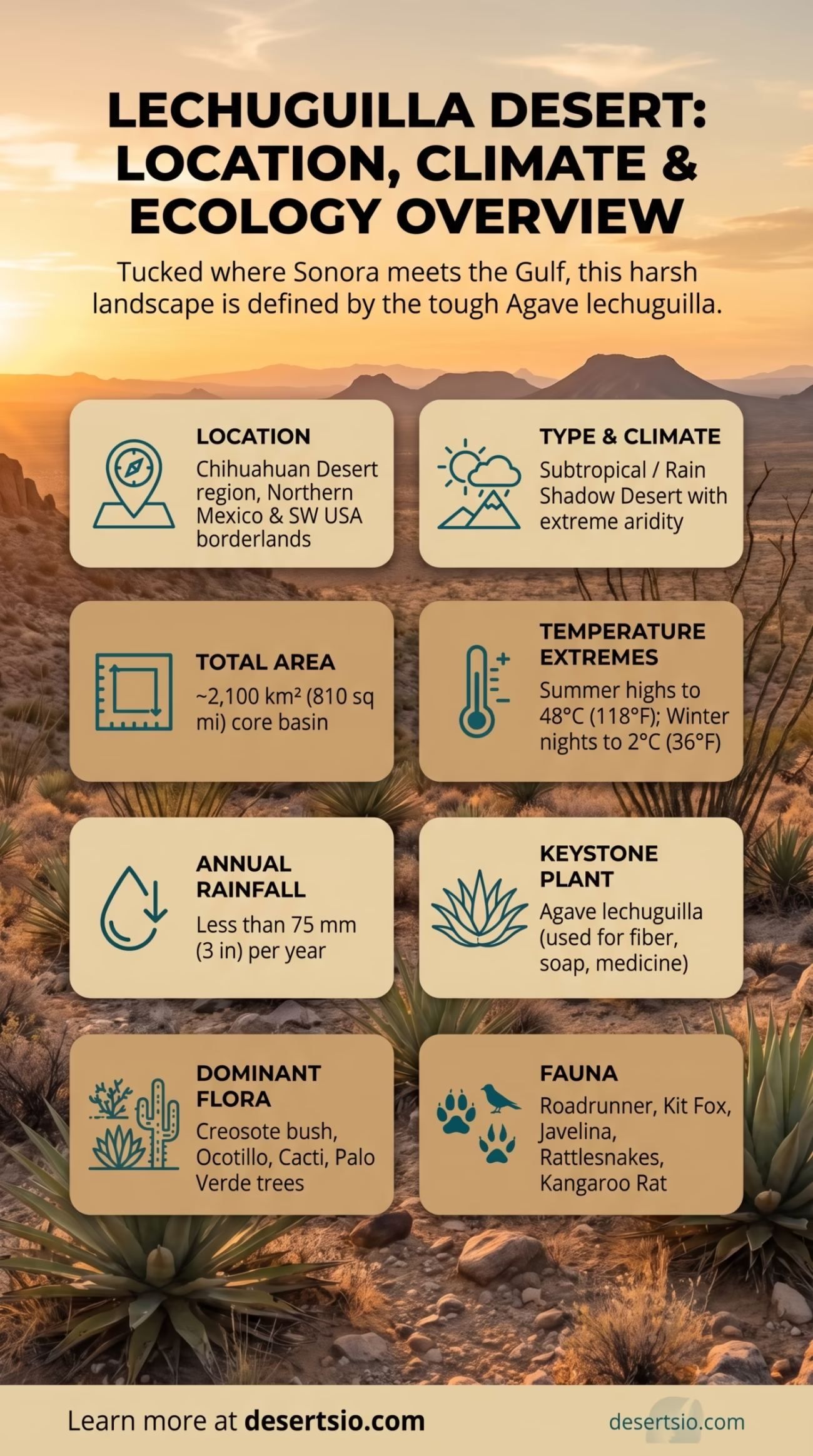
| Location | Chihuahuan Desert region, northern Mexico (Sonora & Baja California states) and extreme southwestern United States |
| Type | Subtropical / Rain Shadow Desert |
| Total Area | Approximately 2,100 km² (810 sq mi) — core Lechuguilla basin |
| Elevation | 200–900 m (650–2,950 ft) above sea level |
| Average Annual Rainfall | Less than 75 mm (3 in) per year |
| Daytime Temperature | Up to 48°C (118°F) in summer |
| Nighttime Temperature | Can drop to 2°C (36°F) in winter nights |
| Dominant Vegetation | Lechuguilla agave (Agave lechuguilla), creosote bush, ocotillo |
| Soil Type | Calcareous, rocky bajadas and alluvial fans |
| Bordering Desert | Chihuahuan Desert (east), Sonoran Desert (northwest) |
| Notable Feature | Namesake of Agave lechuguilla, a keystone desert plant used by indigenous peoples for millennia |
| Human Population | Extremely sparse; small ejido communities and ranching settlements |
The Lechuguilla Desert does not appear on every mainstream map — and that is precisely what makes it worth understanding. Tucked within the broader arid zone where Mexico’s Sonora state meets the Gulf of California, this harsh, sun-scorched landscape is named after one of the toughest plants on earth: Agave lechuguilla. That single plant tells you almost everything you need to know about this place. Where lechuguilla thrives, almost nothing else dares to.
Lechuguilla Desert: Location and Map View
Where Exactly Is the Lechuguilla Desert?
The Lechuguilla Desert sits in the northwestern corner of Mexico, primarily within the state of Sonora, extending into parts of Baja California and touching the U.S. borderlands of Arizona. It functions as a transitional arid zone — geographically wedged between the Sonoran Desert to the northwest and the Chihuahuan Desert to the east. This positioning is not incidental; it shapes nearly every aspect of the region’s climate, ecology, and geology.
The terrain is a patchwork of rocky bajadas (gently sloping alluvial plains), dried arroyos, and low volcanic ridges. Elevations across the region generally range from around 200 meters near the coast to nearly 900 meters inland, creating enough variation to support distinct micro-habitats within a relatively small area.
How Big Is It?
The Lechuguilla Desert’s core basin covers roughly 2,100 km² — that is larger than the entire country of Luxembourg (2,586 km²) and significantly larger than the U.S. state of Rhode Island (4,001 km²). When the broader ecological zone influenced by lechuguilla-type scrub is included, the area expands considerably. It is not the largest desert in the Americas by any measure, but size is not the point here. Density of ecological uniqueness — that is what defines this landscape.
Formation: How Did This Desert Come to Be?
The Lechuguilla Desert owes its existence to a combination of tectonic activity, rain shadow dynamics, and long-term climatic drying that intensified over the past 8,000 to 10,000 years following the last Ice Age.
The Sierra Madre Occidental and the coastal mountain ranges of Baja California block moisture-laden air masses from the Pacific Ocean. By the time those air masses descend on the inland side, they are dry — almost entirely wrung out. This is classic rain shadow effect, and it is relentless here. Annual precipitation rarely exceeds 75 mm, and in some years, the region receives virtually nothing.
Volcanic activity also shaped the substrate. Much of the rocky surface consists of basalt and rhyolite — old lava flows that cooled into fractured, porous terrain. Water vanishes quickly. The land holds almost none of it.
Temperature: The Daily Extremes
Summer daytime highs regularly reach 45–48°C (113–118°F) on exposed rock surfaces. The ground itself can exceed 70°C during peak afternoon hours — hot enough to cause burns on contact. Yet by a clear winter night, temperatures can fall to near 2°C (36°F). That is a swing of more than 40 degrees Celsius within a single 24-hour period during transitional seasons.
This diurnal temperature range — the gap between daytime and nighttime temperatures — is one of the defining characteristics of desert climates worldwide. In the Lechuguilla Desert, it is especially pronounced due to low humidity and minimal cloud cover. Dry air simply cannot retain heat the way moist air does. The desert cools fast, and cools hard.
Flora: The Plant That Names a Desert
Agave lechuguilla — commonly called just “lechuguilla” — is the undisputed botanical emblem of this region. It is a succulent rosette plant with rigid, spine-tipped leaves that can puncture leather boots. It stores water in its core, reproduces both sexually and vegetatively, and survives multi-year droughts that kill off competing vegetation. A single lechuguilla plant can live for 25 years before it flowers — once — then dies.
Beyond lechuguilla, the plant communities here include:
- Creosote bush (Larrea tridentata) — one of the most drought-adapted shrubs in North America, capable of reducing its metabolic activity to near zero during extreme aridity
- Ocotillo (Fouquieria splendens) — a tall, whip-like shrub that sprouts leaves within 72 hours of rainfall and drops them again within days when conditions dry out
- Palo verde trees — photosynthesizing through their green bark even when leafless
- Chollas and prickly pear cacti — providing both moisture storage and physical defense against herbivores
- Desert marigold and brittlebush — adding bursts of color in brief post-rain windows
The diversity is not obvious. The landscape looks barren at first. Look closer — or visit after a rare rain event — and you see a fully active ecosystem.
Fauna: Desert Survival Specialists
Animals here have adapted over thousands of generations to deal with heat, water scarcity, and extreme temperature swings. The Lechuguilla Desert supports a surprisingly varied wildlife community.
Reptiles
- Western diamondback rattlesnake
- Desert tortoise (Gopherus agassizii)
- Gila monster (near range boundaries)
- Multiple species of lizards, including the zebra-tailed lizard
Mammals
- Coyote (Canis latrans)
- Kit fox — one of the smallest foxes in North America, perfectly sized for heat dissipation
- Javelina (collared peccary)
- Black-tailed jackrabbit
- Kangaroo rat — obtains all needed water from dry seeds alone
Bird life includes the iconic greater roadrunner, Gambel’s quail, cactus wren, elf owls nesting in saguaro cavities, and various raptors — including the Harris’s hawk, which hunts cooperatively in packs, an unusual behavior among birds of prey. And nocturnally, the desert comes alive in ways daylight never reveals.
Human Life in the Lechuguilla Desert
People have lived in and around this desert for at least 10,000 years. The Seri people (Comcáac) — one of the most remarkable indigenous groups in North America — have historically inhabited the coastal fringes of the Sonoran and Lechuguilla desert zones. Their language, Cmique Itom, is a language isolate with no known relatives. They developed extraordinarily detailed ecological knowledge of desert plants, tidal cycles, and animal behavior that modern biologists are only beginning to document systematically.
The Tohono O’odham people also hold deep cultural and ancestral ties to the broader desert region. Their traditional calendar — called the himdag — is organized around seasonal desert events: the arrival of saguaro fruit, the monsoon rains, the movement of game.
Today, permanent settlements in the Lechuguilla Desert itself are extremely sparse. Small ejido communities (communal land-holding villages, a system established in Mexico’s land reform era) exist on the margins. Cattle ranching — despite the brutal conditions — remains a livelihood for some families, though overgrazing has historically damaged fragile desert soils in parts of the region.
Population density across the region sits well below 1 person per km² in most zones.
Ecological Pressures and Conservation
The lechuguilla plant itself has faced significant harvesting pressure. Its fibers — called ixtle — have been used commercially to produce rope, brushes, and textiles. At peak commercial extraction periods in the 20th century, lechuguilla harvesting across northern Mexico employed tens of thousands of workers. The fiber industry has declined, but ecological scars from over-harvesting in certain zones remain visible today.
Climate change is altering precipitation patterns across the North American desert southwest. Research published in recent years indicates that the region is experiencing a long-term trend toward hotter and drier conditions — a process sometimes called “aridification” rather than simple drought. For a desert already operating at moisture extremes, even marginal shifts in rainfall timing can tip the balance for entire plant communities.
Invasive grasses — particularly buffelgrass (Pennisetum ciliare), introduced for livestock forage — pose a growing threat. Buffelgrass creates continuous fuel loads that allow wildfires to spread in desert zones where fire was historically rare. Native cacti and succulents, unadapted to fire, can be wiped out in a single burn event.
Neighboring Deserts: Regional Context
The Lechuguilla Desert does not exist in isolation — it is embedded within one of the largest contiguous arid zones in North America. Understanding its neighbors provides important geographic and ecological context.
| Desert | Location | Area | Key Difference from Lechuguilla |
| Sonoran Desert | Arizona (USA), Sonora (Mexico) | ~311,000 km² | Receives two rainy seasons; far more cactus diversity including the saguaro |
| Chihuahuan Desert | Northern Mexico, New Mexico, Texas | ~362,000 km² | Higher elevation (avg. 1,100 m); summer monsoon-dependent |
| Baja California Desert | Baja California peninsula | ~75,000 km² | Coastal fog influence; distinctive boojum trees and cardón cacti |
| Altar Desert | Sonora, Mexico / Arizona, USA | ~7,000 km² | Massive sand dune fields; hyper-arid core with almost no vegetation |
The Altar Desert — sometimes considered a sub-region of the Sonoran — is perhaps the closest ecological sibling to the Lechuguilla zone. Both share extreme aridity and sparse, stress-adapted vegetation. But the Altar Desert’s iconic Gran Desierto de Altar features vast erg-type sand seas that are largely absent from the rockier Lechuguilla terrain. Different textures, same ruthless sun.
A Plant That Shaped an Entire Economy
It is worth pausing on just how significant Agave lechuguilla has been to human civilization in this region. Indigenous groups across northern Mexico used the plant for:
- Fiber production — twisted into rope, woven into sandals, baskets, and mats
- Food — the plant’s heart (piña) was roasted in pit ovens for extended periods; residual sugars provided caloric energy in an environment where calories are scarce
- Soap — saponins in the leaves create a lather when crushed with water (the plant is still sometimes called “shin daggers” by ranchers and “amole” — a general term for soap plants — by communities in the region)
- Medicinal use — steroidal compounds extracted from lechuguilla were used in traditional medicine, and in the 20th century became industrially relevant as precursors to synthesizing cortisone
The cortisone connection is particularly striking. In the 1940s and 1950s, Mexican chemist Russell Marker and later Syntex Corporation developed a process to synthesize cortisone from plant-derived sapogenins — compounds found in lechuguilla and related agave species. This helped reduce cortisone’s price from $200 per gram to under $1 per gram, making a critical medical treatment accessible worldwide. A desert plant. A global medical breakthrough.
The Lechuguilla Cave Connection
There is another famous “Lechuguilla” that shares the name — Lechuguilla Cave in Carlsbad Caverns National Park, New Mexico. It was named after the same agave plant found near its entrance. Discovered in its full extent in 1986, Lechuguilla Cave is now considered one of the longest and deepest caves in the United States (over 242 km of surveyed passage, reaching 489 meters depth). Scientists have found ancient microbial communities inside that survive on sulfur compounds — organisms that have never been exposed to surface sunlight and exist in complete isolation. Same name, completely different world underground.
The cave’s microbial ecosystem has attracted astrobiologists — researchers studying the possibility of life on other planets — because it represents one of the closest analogs on Earth to subsurface life that might exist on Mars or icy moons. And this discovery, in a roundabout way, connects back to the toughness encoded in everything that carries the lechuguilla name.
Why the Lechuguilla Desert Deserves More Attention
Most desert coverage gravitates toward the Sahara, the Gobi, or the Arabian Peninsula — the giants. The Lechuguilla Desert rarely makes that list. But within its rocky, sun-hammered boundaries, there is an extraordinary density of evolutionary adaptation, indigenous cultural heritage, and ecological complexity that rival much more famous landscapes.
The desert’s very name — carried by a plant so chemically potent it influenced 20th-century medicine — signals that this is a place where underestimating what you see will get you in trouble. Sharp spines, chemical compounds, extreme heat, radical cold. And life, everywhere, finding a way.
Desert Glossary: Key Terms
- Bajada — A broad, gently sloping surface formed by the merging of several alluvial fans at the base of a mountain range in arid regions
- Rain Shadow — The dry region on the lee side of a mountain range where air descends and warms, producing little precipitation
- Arroyo — A dry streambed or gully that carries water only after heavy rainfall; common throughout the Lechuguilla Desert terrain
- Ixtle — Coarse plant fiber extracted from Agave lechuguilla leaves, used historically for rope, brushes, and textiles across northern Mexico
- Diurnal Temperature Range — The difference between the maximum daytime temperature and the minimum nighttime temperature within a 24-hour period
- Ejido — A system of communal land ownership in Mexico, established through agrarian reform, where community members hold rights to farm and use land collectively