
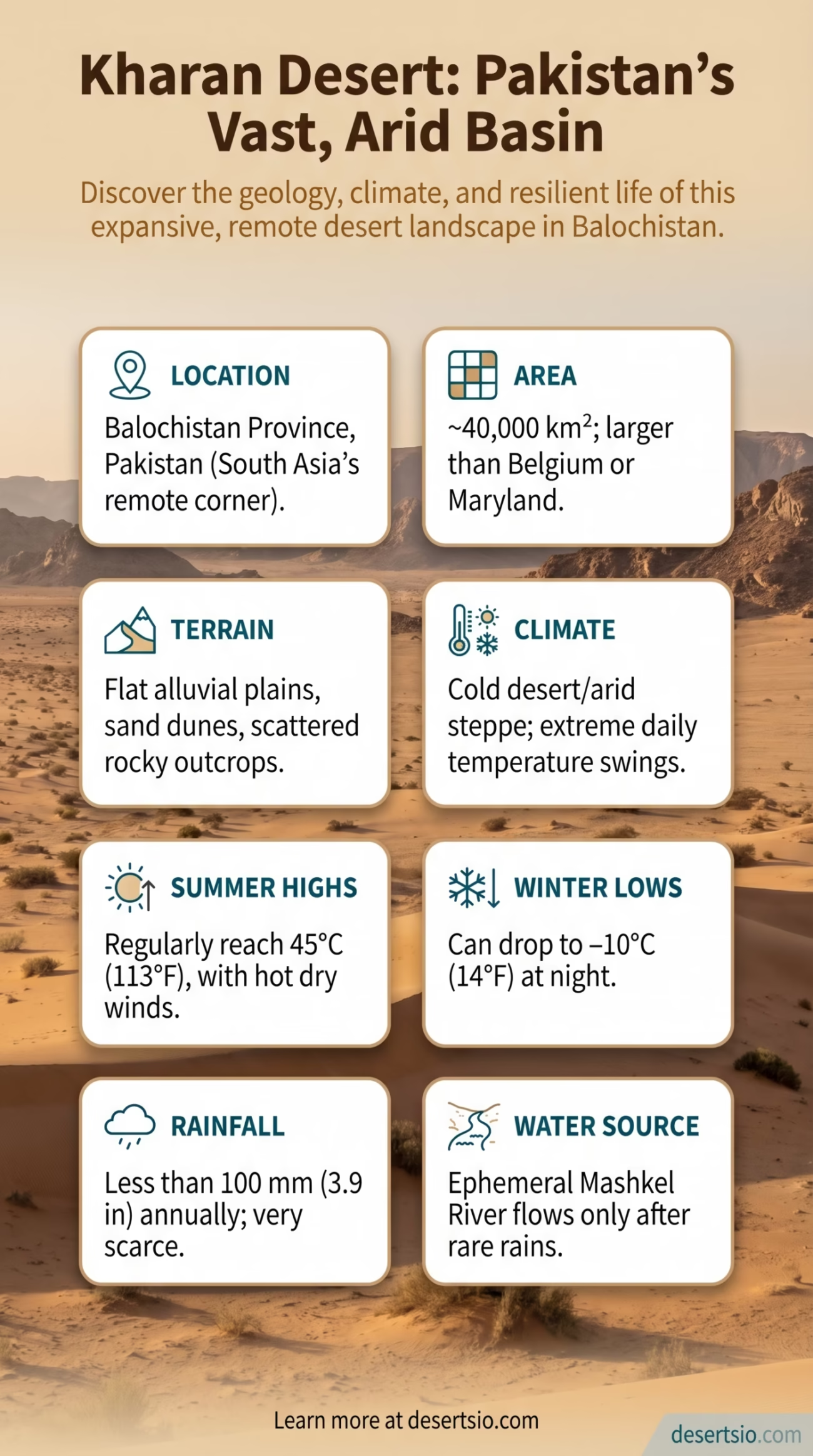
| Location | Balochistan Province, Pakistan |
| Area | No single authoritative desert-only boundary; the wider Kharan endorheic hydrologic unit covers about 15% of Pakistan |
| Type | Cold desert / Arid steppe |
| Average Elevation | 900–1,100 meters (2,953–3,609 ft) above sea level |
| Annual Rainfall | Less than 100 mm (3.9 in) per year |
| Daytime Temperature | Up to 45°C (113°F) in summer |
| Nighttime Temperature | Can drop to −10°C (14°F) in winter |
| Dominant Terrain | Flat alluvial plains, scattered rocky outcrops, sand dunes |
| Primary River | Mashkel River |
| Neighboring Regions | Chagai Desert (north), Rann of Kutch (southeast), Dasht Desert (west) |
| Notable Feature | Pakistan’s second 1998 nuclear test, Chagai-II, was conducted in the Kharan Desert |
| Main Settlements | Kharan city, Washuk, Panjgur (periphery) |
The Kharan Desert lies in western Balochistan, Pakistan, within a broad arid region of gravel plains, sandy tracts, dry drainage channels and enclosed basins. Its area is often reported with a single number, but that creates a geographic problem: authoritative hydrologic sources use the name Kharan Desert for a much larger endorheic drainage unit, while the exposed desert terrain itself does not have one consistently mapped official boundary.
Kharan Desert Area and Basin Boundaries
There is no single authoritative desert-only area that can be applied cleanly to every use of the name Kharan Desert. Pakistan hydrology references describe the wider Kharan Desert as an endorheic hydrologic unit covering about 15% of the country. That unit includes mountain catchments, dry lake basins, drainage systems and desert plains, so its area should not be presented as the surface area of the desert alone.
The terminology also changes with the type of source. Hydrologic studies refer to a broad Kharan closed-drainage system, while geological studies use Kharan Forearc Basin for a tectonic and sedimentary basin. These are related geographic settings but not interchangeable area measurements. For the desert itself, a single precise area should not be stated unless the mapped boundary and measurement method are identified.
Formation: A Basin Born from Tectonic Forces
The Kharan Basin is a tectonic depression — shaped over millions of years by the collision of the Indian and Eurasian plates. As the surrounding mountain ranges were pushed upward, the basin floor subsided. Sediment eroded from the highlands accumulated on the basin floor over geological time, creating the flat alluvial plains that define the landscape today.
Arid conditions intensified during the Holocene — roughly the last 10,000 years — as monsoon patterns weakened in this part of the subcontinent. The Makran coast to the south and the high-altitude barriers to the north block moisture from both the Arabian Sea and the central Asian systems. What arrives is almost nothing. Less than 100 mm of rain per year. In particularly dry years, that number can fall to 50 mm or below.
The Mashkel River is the one major watercourse that crosses the basin — but even it is ephemeral through much of the year, flowing only after seasonal rain events. It drains into the Hamoun-e-Mashkel lake system on the Iran-Pakistan border, a terminal drainage basin with no outlet to the sea.
Temperature: Extreme Swings, Day and Night
Kharan’s climate is brutally continental. The desert sits at an elevation of 900–1,100 meters, which adds a sharp cold edge to its winters that purely low-lying hot deserts don’t experience.
- Summer daytime highs: Regularly reach 45°C (113°F), sometimes pushing past that
- Winter nighttime lows: Drop to −10°C (14°F), occasionally colder in exposed areas
- Diurnal temperature range: Even in summer, nights can be 20–25°C cooler than peak daytime heat
- Wind: Hot, dry winds blow frequently in summer, increasing evaporation rates dramatically
- Humidity: Extremely low year-round, often below 20% in summer months
That swing — from 45°C in the afternoon to a cool desert night — is one of Kharan’s defining physical characteristics. It is what makes survival here a study in adaptation, whether you’re a lizard, a shrub, or a nomadic herder.
Flora and Fauna: Sparse, Resilient, and Underestimated
The vegetation of the Kharan Desert is sparse but purposeful. Species here don’t compete for space — they compete for water, and they’ve been at it for thousands of years.
Notable Plant Species
- Haloxylon salicornicum (locally called lana) — a salt-tolerant shrub dominant across saline flats
- Calligonum polygonoides — a leafless shrub with photosynthesizing green stems, effective in sand stabilization
- Prosopis cineraria (jand tree) — deep-rooting, drought-resistant, provides shade and fodder
- Tamarix species — found along dry riverbeds and drainage channels
- Salsola species — annual herbs that colonize disturbed ground after rare rain events
Wildlife
- Chinkara gazelle (Gazella bennettii) — one of the most commonly spotted mammals; well-adapted to extreme aridity
- Sand fox (Vulpes rüppellii and V. vulpes) — nocturnal hunters, rarely seen in daylight
- Spiny-tailed lizard (Uromastyx hardwickii) — a notable herbivorous reptile, locally called sanda
- Houbara bustard (Chlamydotis macqueenii) — a migratory bird, and a legally protected species in Pakistan
- Various desert snakes and scorpions — active primarily at night when temperatures drop
The Houbara bustard deserves a specific mention. This medium-sized migratory bird passes through Balochistan’s arid zones — including the Kharan region — seasonally, and its conservation status is actively monitored due to hunting pressures across its Central Asian flyway. Pakistan has introduced legal protections, though enforcement in remote areas like Kharan remains challenging.
Human Life in the Kharan Desert
People have lived in and around Kharan for centuries. The region is dominated by Baloch tribal communities, most notably the Nusherwani, Mengal, and various sub-tribal groups who have historically organized their lives around seasonal migration — moving herds of camels, goats, and sheep between grazing zones as conditions allowed.
Kharan city serves as an administrative center within the wider region, but modern district boundaries should not be used as a substitute for the boundaries of the Kharan Desert. Administrative units in Balochistan have changed over time, while the desert and the larger closed-drainage system follow physical geography rather than district lines.
Water access is the dominant challenge. Most communities depend on karez systems — ancient horizontal wells that tap into underground aquifers — along with seasonal surface water from the Mashkel River and its tributaries. These karez networks are centuries old, some pre-dating recorded local history, and they remain critical infrastructure even today.
And then there’s gold. Mineral surveys have identified deposits of gold, copper, and lead-zinc ores in parts of the Kharan district. Exploration activity has increased in recent years, drawing outside investment into a region that has historically been economically marginalized.
Neighboring Deserts and Regional Context
The Kharan Desert doesn’t exist in isolation. It’s part of a broader arid zone that stretches across western Pakistan and eastern Iran — a belt of interconnected desert systems each with their own character.
| Desert | Location | Key Characteristic |
| Chagai Desert | North of Kharan, Balochistan | Rocky, volcanic terrain; extreme aridity; borders Afghanistan |
| Dasht Desert | West of Kharan, toward Iran border | Flat gravelly plains; part of the Makran system |
| Thar Desert | Eastern Pakistan / NW India | Sand dune dominated; larger population; more rainfall |
| Lut Desert (Iran) | West, across the border | One of Earth’s hottest surfaces; UNESCO World Heritage Site |
| Rann of Kutch | Southeast, India/Pakistan border | Seasonal salt marsh; unique ecology |
The Chagai Desert to the north is particularly interesting in comparison. Both are extreme, both are sparsely populated — but Chagai is rockier, higher in parts, and geologically distinct with its volcanic features. The two regions share similar tribal communities and similar water scarcity problems, yet the landscapes feel different on the ground: Kharan’s basin floor is flatter, with more sand and alluvial deposits; Chagai is rougher, more angular.
Further west, Iran’s Lut Desert — the Dasht-e Lut — is a useful comparison point for understanding aridity extremes in the broader region. An earlier MODIS analysis reported a 70.7°C (159.3°F) land-surface temperature there in 2005. A later 18-year MODIS analysis covering 2002–2019 found a higher maximum of 80.8°C (177.4°F), reached in the Lut Desert in 2018 and tied by Mexico’s Sonoran Desert in 2019. These are satellite-derived land-surface temperatures, not standard air temperatures. Kharan doesn’t reach those surface extremes, but it shares the same regional climatic drivers: blocked moisture, high elevation aridity, and intense solar radiation.
Desertification Pressures and Environmental Concern
Desertification in an already-desert region sounds redundant — but it isn’t. The concern here is the degradation of the marginal semi-arid zones surrounding the core desert, areas that once supported vegetation, seasonal grazing, and limited dryland farming.
Overgrazing is the primary driver. When livestock numbers exceed what fragile desert vegetation can support — and this has happened consistently across Balochistan over the last few decades — the plant cover disappears, topsoil loosens, and wind erosion accelerates. The result is a slow, almost imperceptible expansion of bare ground into formerly productive land.
Climate projections for this part of South Asia are not encouraging. The IPCC’s Sixth Assessment Report (AR6) highlights the Hindu Kush-Karakoram-Himalayan region and adjacent arid zones as areas facing increased temperature anomalies and rainfall variability. For places like Kharan — already operating at the edge of what can sustain life — even small shifts in precipitation patterns carry serious consequences.
Key Environmental Pressures on the Kharan Desert Region
- Overgrazing by camels, goats, and sheep — degrading shrub cover across the basin
- Groundwater depletion from increasing extraction via tube wells
- Wind erosion accelerating as vegetation thins along the basin margins
- Increased frequency of dust storms reported across western Balochistan
- Limited reforestation or land restoration programs active in the area
A Desert That Carries Weight
The Kharan Desert is not famous in the way the Sahara or the Gobi are famous. It doesn’t draw tourists or generate coffee-table books. But it is a geologically fascinating, ecologically intricate landscape — one that has shaped the lives of Baloch communities for generations and continues to do so under increasing pressure from both climate and economic change.
Its mineral wealth may redefine how the outside world pays attention to it. Gold and copper deposits have a way of drawing interest that ecology and culture rarely manage. Whether that attention brings meaningful development to the communities who have called this basin home for centuries — or simply extracts value and moves on — remains one of the genuinely open questions about Kharan’s near future.
Flat. Harsh. Underestimated. The Kharan Desert rewards those who look closely.