
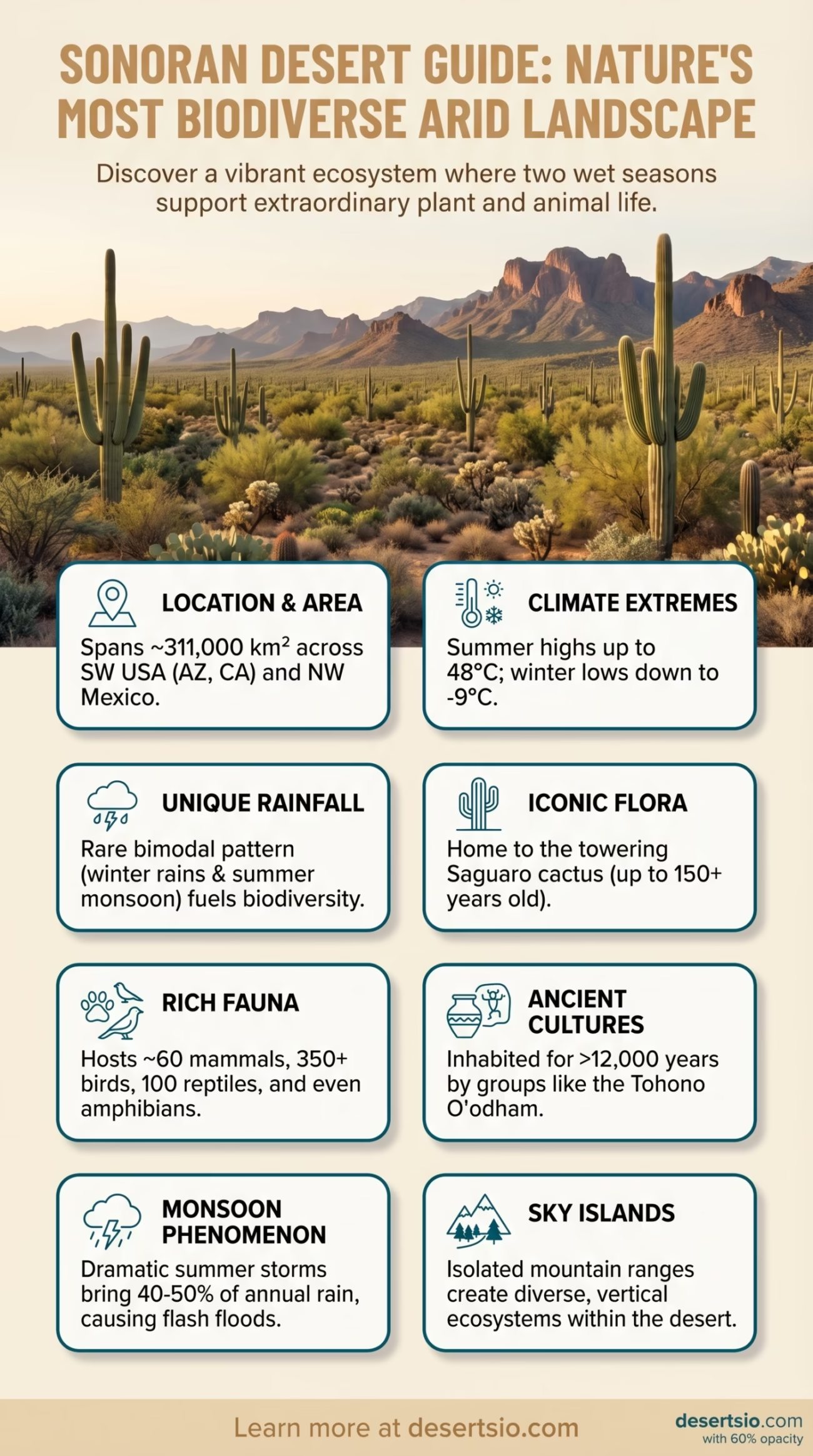
| Location | Southwestern United States (Arizona, California) and Northwestern Mexico (Sonora, Baja California) |
| Total Area | ~311,000 km² (120,000 sq mi) |
| Type | Subtropical Hot Desert |
| Average Annual Rainfall | 75–500 mm (3–20 in) depending on location |
| Summer High Temperature | Up to 48°C (118°F) during the day |
| Winter Low Temperature | As low as −9°C (15°F) at night in elevated areas |
| Day-Night Temperature Difference | Up to 20–30°C (36–54°F) swing in a single day |
| Elevation Range | Sea level to ~900 m (2,950 ft) |
| Iconic Plant | Saguaro Cactus (Carnegiea gigantea) |
| Major Cities Within or Near | Tucson, Phoenix (AZ), Yuma (AZ), Hermosillo (Mexico) |
| Protected Areas | Saguaro National Park, Organ Pipe Cactus National Monument, Pinacate Biosphere Reserve |
| Rainfall Pattern | Bimodal — winter rains and North American Monsoon (July–September) |
| UNESCO Recognition | Alto Golfo de California y Delta del Río Colorado Biosphere Reserve |
The Sonoran Desert does not fit the mental image most people carry of a desert. No endless sand dunes. No barren, lifeless horizon. Instead, it stands as the most biologically diverse desert on Earth — a sprawling, sun-scorched landscape where towering cacti reach six meters into the sky and jaguars still slip silently through dry riverbeds. That combination alone sets it apart from virtually every other arid region on the planet.
Covering roughly 311,000 square kilometers, the Sonoran Desert stretches across parts of Arizona and California in the United States and dips deep into the Mexican states of Sonora and Baja California. To put that in perspective — it is larger than the entire United Kingdom, which spans about 243,000 km². And yet, despite its scale, it supports an astonishing variety of life that continues to surprise researchers.
How Did the Sonoran Desert Form?
The Sonoran Desert’s origin is tied to large-scale atmospheric and tectonic processes that unfolded over millions of years. During the late Miocene epoch — roughly 8 to 10 million years ago — the Basin and Range Province formed through crustal extension, creating the low-lying basins that define much of the desert’s topography today. As mountain ranges rose on either side, they blocked incoming moisture from the Pacific, triggering what geologists call a rain shadow effect.
Unlike the Sahara or Arabian Desert, the Sonoran did not form simply because rain stopped coming. It formed because two separate rain systems — one from the Pacific in winter, one from the Gulf of Mexico in summer — create a bimodal precipitation pattern that is genuinely rare among the world’s deserts. This dual rainfall pulse is the very reason the Sonoran supports so much life. Dry, yes. Lifeless, not even close.
Temperature: The Double Extremes
Summer days in the Sonoran Desert can climb to 48°C (118°F). That is not a rare peak — it is a routine July afternoon in Phoenix or Yuma. Ground surface temperatures often exceed 70°C (158°F), hot enough to cause burns on exposed skin within seconds.
Then the sun drops. And everything changes.
Nighttime temperatures in elevated desert zones can fall to −9°C (15°F) in winter. The swing between a daytime high and nighttime low on a single day can reach 20 to 30°C (36 to 54°F), requiring living organisms to adapt. The Sonoran’s climate, technically classified as subtropical arid, combines extreme heat with irregular rainfall.
Flora: A Desert That Actually Blooms
More than 2,000 plant species have been recorded in the Sonoran Desert. That number is extraordinary for an arid environment. The reason comes back to that bimodal rainfall — plants here evolved to exploit two distinct wet seasons rather than just one.
The most iconic is the Saguaro cactus (Carnegiea gigantea), which grows exclusively in the Sonoran Desert. It can live for over 150 years, reach heights of 12 meters (40 feet), and weigh more than 2,000 kilograms when fully hydrated. Saguaros do not grow their first arm until they are 75 years old — patience measured in human generations. Other notable plants include:
- Palo verde (Parkinsonia spp.) — the state tree of Arizona, with green bark that photosynthesizes even without leaves
- Ocotillo (Fouquieria splendens) — bare most of the year, exploding with red flowers within days of rain
- Ironwood tree (Olneya tesota) — lives up to 1,500 years, one of the oldest living desert plants in North America
- Brittlebush, creosote bush, and chain-fruit cholla — each filling a specific ecological niche
- Cardon cactus — on the Baja California side, this close relative of the saguaro grows even taller
In spring — particularly after a wet winter — the desert floor can erupt in wildflower blooms covering hundreds of kilometers. Mexican gold poppy, lupine, and desert marigold turn whole hillsides golden. This phenomenon has become a genuine tourism driver in recent years, with satellite imagery used to predict “superbloom” events.
Fauna: Surprisingly Dense Wildlife
The Sonoran Desert hosts around 60 mammal species, 350+ bird species, 100 reptile species, and dozens of amphibians — yes, amphibians in a desert. The Sonoran desert toad (Incilius alvarius) spends most of the year dormant underground and emerges only during monsoon rains, breeding explosively in temporary pools.
Some of the most ecologically significant species include:
- Gila woodpecker and elf owl — both nest inside saguaro cavities, entirely dependent on the cactus for shelter
- Gila monster (Heloderma suspectum) — one of only two venomous lizards native to North America
- Bighorn sheep — adapted to rocky terrain, capable of surviving on minimal water
- Coyote and bobcat — apex-adjacent predators that regulate rodent populations
- Jaguar (Panthera onca) — a small but documented population still moves through the Sky Islands region on the US-Mexico borderlands
- Lesser long-nosed bat — the primary pollinator of saguaro and organ pipe cactus, migrating along the “nectar corridor” each spring
The interdependence here is tight. Remove the bat, and the cactus struggles to reproduce. Remove the cactus, and the woodpecker loses its home. These chains run deep.
Human Life in the Sonoran Desert
People have lived in the Sonoran Desert for at least 12,000 years. The Tohono O’odham — whose name roughly translates to “Desert People” — are among the most closely associated Indigenous groups with this landscape. Their traditional territory spans both sides of the US-Mexico border, and they developed sophisticated water harvesting systems called ak-chin farming, directing seasonal floodwaters onto fields to grow corn, beans, and squash.
The Hohokam civilization (roughly 1 CE to 1450 CE) built an elaborate canal network in the Phoenix Basin — over 1,600 kilometers of irrigation canals — which is, by any measure, one of the most impressive pre-Columbian engineering feats in North America. Modern Phoenix’s water infrastructure is partly built on those same corridors.
Today, the Sonoran Desert holds some of the fastest-growing urban populations in the United States. Phoenix is home to over 1.6 million people (metro area exceeds 5 million), and Tucson holds around 550,000. Water management, urban heat island effects, and groundwater depletion are pressing concerns that define life in these cities right now — not in some distant future.
The North American Monsoon — A Desert Phenomenon Worth Knowing
Every July, a shift in atmospheric pressure pulls moisture northward from the Gulf of Mexico and Gulf of California. The result is the North American Monsoon — a seasonal rainfall event that dumps roughly 40–50% of the Sonoran Desert’s annual precipitation in just two to three months. Thunderstorms build rapidly in the afternoon, often producing violent haboobs (dust walls that can reach 1,500 meters in height) before the rain arrives. Flash floods rip through dry washes called arroyos with almost no warning. This monsoon is not a gentle tropical drizzle — it is fast, dramatic, and ecologically essential.
Size in Context: Bigger Than You Think
At 311,000 km², the Sonoran Desert is larger than the United Kingdom and roughly the size of Poland. It dwarfs many better-known desert regions. For comparison:
| Desert | Area (km²) | Comparable To |
| Sonoran Desert | ~311,000 | Larger than the United Kingdom |
| Mojave Desert | ~124,000 | Roughly the size of Pennsylvania |
| Chihuahuan Desert | ~362,000 | Slightly larger than the Sonoran |
| Great Basin Desert | ~492,000 | Close to the size of Spain |
The Sonoran sits in the middle of this North American desert family — not the largest, but far and away the most ecologically rich.
Neighboring Deserts and Regional Context
The Sonoran does not exist in isolation. It is part of a chain of North American deserts, each with its own character. Understanding their differences is useful.
Directly to the north lies the Mojave Desert — cooler, drier, and home to the Joshua tree (Yucca brevifolia). The Mojave receives most of its rain in winter and is generally considered the driest of the four North American deserts. Death Valley, the hottest place on Earth, sits within the Mojave. Comparing the two: the Sonoran is wetter, warmer, and far more biologically complex.
To the east, the Chihuahuan Desert stretches across New Mexico, Texas, and deep into Mexico. It is a high-elevation desert — most of it sits above 1,000 meters — which makes it notably cooler. It also receives most of its rainfall in summer through the monsoon, similar to the Sonoran, but lacks the winter rains that make the Sonoran so uniquely diverse.
And then there is the Great Basin Desert to the north — a cold desert, technically, where precipitation often falls as snow. Sagebrush dominates. No saguaros there.
Of all four North American deserts, only the Sonoran is classified as subtropical. That distinction — warmer winters, dual rainfall seasons — is what drives its biodiversity.
Conservation Pressures and Current Challenges
The Sonoran Desert faces real, measurable stress. Urban expansion in the Phoenix metropolitan area alone has consumed hundreds of thousands of acres of native desert habitat since the 1950s. Groundwater extraction is depleting the aquifers that sustain both cities and natural springs at rates that current recharge cannot match.
Climate projections from multiple research institutions suggest that the Sonoran Desert region will experience more frequent extreme heat events, longer droughts, and more intense monsoon storms by mid-century. The 2020–2023 megadrought across the American Southwest was, by paleoclimate standards, the driest 22-year period in at least 1,200 years — and its effects on Sonoran vegetation were visible in satellite imagery.
And ironically, some of the most protected sections of the Sonoran Desert — particularly along the international boundary — contain sensitive ecological corridors that border infrastructure has disrupted. Wildlife movement, especially for large mammals like pronghorn and jaguar, depends on open passage through these transition zones.
Conservation organizations such as the Sonoran Desert Conservation Plan (managed by Pima County, Arizona) have worked to map and protect critical habitat. The plan covers over 9.3 million acres and represents one of the most ambitious county-level conservation efforts in US history. And it is ongoing — updated regularly as new species data and climate models become available.
Sonoran Desert Compared: Similar Deserts Worldwide
Globally, the Sonoran finds its closest analogs in regions with Mediterranean or subtropical arid climates. The Baja California Desert — technically a sub-region of the Sonoran system — shares its coastal edge and supports dense cardon cactus forests that mirror the saguaro-dominated interior. The Atacama Desert in South America, while far drier overall, shares the Pacific coastal influence and the phenomenon of explosive wildflower blooms following rare rainfall. Neither, however, matches the Sonoran’s animal diversity.
The Namib Desert in southern Africa presents another rough parallel — coastal influence, extreme temperature swings, surprisingly rich endemic wildlife. But its flora is far less dense. In terms of sheer biological complexity, the Sonoran sits in a category with very few rivals among the world’s arid regions.
Desert Glossary: Sonoran Terms Worth Knowing
- Arroyo — A dry riverbed or gulch that fills rapidly with water during rainstorms; the Sonoran version of a flash-flood channel
- Haboob — A massive, fast-moving dust storm generated by collapsing thunderstorm outflows; common in the Phoenix area during monsoon season
- Ak-chin — A traditional Tohono O’odham water harvesting method using seasonal floodwaters to irrigate fields in the desert
- Bimodal precipitation — Rainfall pattern with two distinct wet seasons per year; the key factor behind the Sonoran’s biological richness
- Sky Islands — Isolated mountain ranges rising from the desert floor, each supporting unique ecosystems disconnected from one another like islands in an arid sea
The Sky Islands deserve a moment on their own. These mountain ranges — the Chiricahuas, the Rincons, the Santa Catalinas — rise sharply from the desert floor and create vertical ecosystems. A hiker can move from Sonoran cactus forest at the base to spruce-fir forest at the summit within a single day. They are genuine biodiversity hotspots, and many of the Sonoran Desert’s rarest species — including the Mexican spotted owl and the Apache trout — survive only in these isolated highlands. Remarkable, really, that a desert contains mountain ecosystems dense enough to rival temperate forests.