
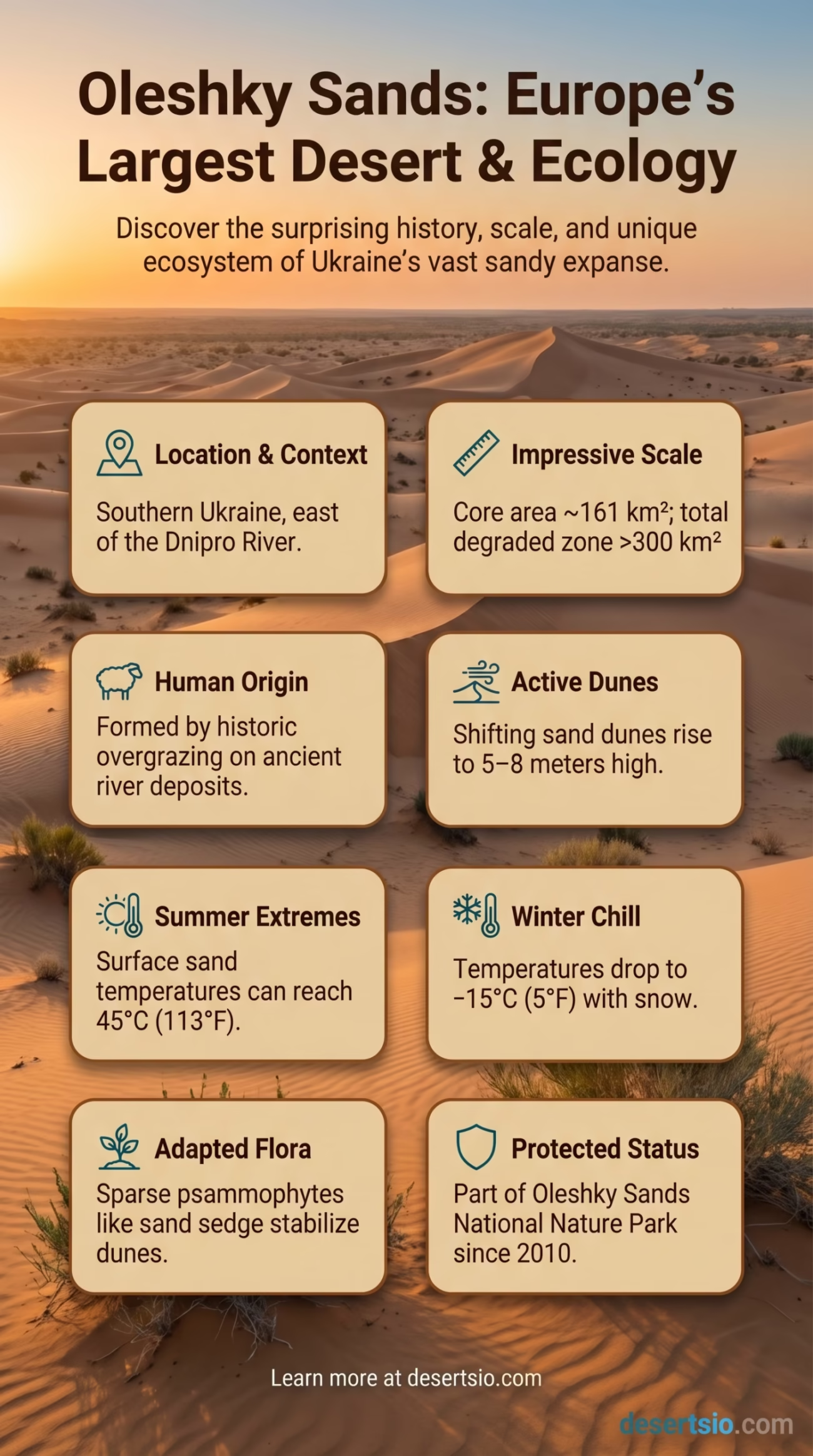
| Location | Kherson Oblast, Southern Ukraine |
| Coordinates | 46°35′N 32°58′E |
| Area | ~161 km² (core sandy area); broader degraded zone exceeds 300 km² |
| Size Comparison | Larger than the city of Washington D.C. (~159 km²) |
| Type | Semi-arid sand desert / desertified steppe |
| Average Summer Temperature (Day) | Up to 45°C (113°F) on sand surface |
| Average Winter Temperature (Night) | Down to −15°C (5°F) |
| Annual Precipitation | ~350–400 mm |
| Dominant Sand Dune Height | 5–8 m; some reaching up to 10 m |
| Nearest Major River | Dnipro River (west bank) |
| Vegetation Cover | Sparse — sand sedge, wormwood, psammophytic grasses |
| UNESCO / Protected Status | Part of Oleshky Sands National Nature Park (established 2010) |
| Also Known As | “Europe’s Only Desert,” Oleshkivski Pisky (Ukrainian) |
Europe is not a continent people associate with deserts. Yet in the south of Ukraine, just east of the Dnipro River, a vast expanse of wind-sculpted sand dunes stretches across the flat steppe — quiet, sun-scorched, and largely overlooked by the wider world. The Oleshky Sands (Ukrainian: Олешківські піски, romanized as Oleshkivski Pisky) cover roughly 161 square kilometers of true sandy terrain, with the broader zone of degraded and semi-arid land pushing well beyond 300 km². This is not a mirage. It is a real, documented, and scientifically studied desert ecosystem sitting inside Europe’s borders.
Oleshky Sands: Location and Map View
How Did a Desert End Up in Europe?
The formation of Oleshky Sands is a story that mixes geological history with human interference — and the two are inseparable here. The region sits on ancient alluvial deposits left by the Dnipro River over thousands of years. These sandy sediments were always present beneath the surface. For a long time, a natural steppe vegetation cover held them in place.
Then came the sheep. During the 18th and 19th centuries, large-scale pastoral grazing — particularly massive flocks of Merino sheep introduced under Russian Imperial administration — stripped the fragile steppe vegetation down to bare soil. Once the plant roots were gone, the wind did the rest. Sand began migrating, dunes formed, and what had been productive steppe grassland transformed into an advancing sandy desert. Overgrazing, combined with the region’s naturally low rainfall (~350–400 mm annually) and persistent strong winds from the Black Sea basin, accelerated the process dramatically.
By the early 20th century, the desertification was already severe. Soviet-era afforestation programs planted pine forests as windbreaks in surrounding zones, which slowed expansion but could not reverse the core desert area. The sand had taken hold — permanently.
Just How Big Is It?
The core sandy area of Oleshky Sands — approximately 161 km² — is larger than the entire city of Washington D.C. (roughly 159 km²). When you include the surrounding degraded steppe and semi-arid transition zones, the affected landscape extends well past 300 km². For a European context, that is extraordinary. No other location on the continent comes close to this scale of active sand desert.
Dunes here are not merely decorative. They rise 5 to 8 meters on average, with some formations reaching 10 meters in height. And they move — actively shifting with prevailing winds, consuming adjacent land at a measurable rate. This is a living, dynamic system, not a static curiosity.
Temperature: Extreme Swings, Both Directions
What surprises most people is that Oleshky Sands is not a warm desert year-round. Its continental climate position means temperatures swing violently between seasons — and even between day and night within a single summer day.
During summer, the dark sand surface absorbs solar radiation intensely. Surface sand temperatures can reach 45°C (113°F) or higher on clear days, while air temperatures in July typically range between 30–36°C. The ground radiates this heat upward, creating shimmering heat mirages across the dune fields.
Winter is a completely different world. Temperatures regularly drop below freezing, with nighttime lows reaching −15°C (5°F) in January. Snowfall does occur. The same dunes that bake in summer occasionally wear a thin coat of snow — a surreal combination that underlines exactly how unusual this desert is compared to the Sahara or Arabian archetypes most people picture.
Temperature Snapshot: Oleshky Sands
- Peak summer air temperature: 30–36°C (86–97°F)
- Sand surface temperature (summer): up to 45°C (113°F)
- Average winter low (night): −15°C (5°F)
- Day-night temperature swing (summer): can exceed 20°C within 24 hours
- Annual precipitation: 350–400 mm (low, but above true arid threshold)
Flora and Fauna: Life in the Sand
Don’t mistake sparse for lifeless. Oleshky Sands supports a distinct and specialized ecosystem — one shaped entirely by the harsh, shifting substrate underfoot.
Plant life here is dominated by psammophytes — species specifically adapted to loose, mobile sand. Key species include:
- Sand sedge (Carex arenaria) — a pioneer plant whose deep root system stabilizes fresh dune surfaces
- Wormwood (Artemisia spp.) — drought-tolerant and aromatic, widespread across the drier flats
- Sand fescue (Festuca psammophila) — a fine-leaved grass forming loose mats in semi-stable zones
- Sea buckthorn (Hippophae rhamnoides) — found in wetter interdune depressions
Vegetation cover across the active dune fields is genuinely low — often below 15% in core areas. Yet the transition zones and interdune hollows hold far more biological activity.
Fauna adapted to the sandy conditions includes several notable species. The European sand lizard (Lacerta agilis) is common here, as are steppe snakes and various burrowing beetles. Bird life is surprisingly rich — the area sits within a major migratory flyway, and raptors including Falco vespertinus (red-footed falcon) hunt across the open terrain. Small mammals like the European ground squirrel (Spermophilus citellus) — a critically watched species in regional conservation — occupy the drier edges of the reserve.
Human Life: Who Lives Here?
Unlike many of the world’s deserts, Oleshky Sands is not home to traditional nomadic tribes or indigenous desert communities. The surrounding region — the Kherson Oblast lowlands — has a settled agricultural population, and the town of Oleshky (formerly Tsyurupynsk, population roughly 25,000) sits near the western edge of the sand zone.
Within the desert itself, permanent settlement is essentially absent. The terrain is hostile to agriculture and water access is difficult — the water table beneath active dunes is often too deep or brackish for practical use. Historically, the area was used for seasonal grazing (which, ironically, helped create the desert in the first place). Today, the Oleshky Sands National Nature Park, established in 2010, formally governs access and conservation within the core zone.
Local residents from surrounding villages do interact with the desert edges — some for small-scale pastoralism, others increasingly for ecotourism, which has grown modestly over the past decade as awareness of the site has increased among Ukrainian and European visitors.
Oleshky Sands and the Broader Regional Picture
Understanding Oleshky Sands means placing it within the context of the wider steppe desertification belt that stretches across parts of Eastern Europe and Central Asia. And it connects to a region with several other significant arid and semi-arid zones worth knowing.
To the east, beyond the Caucasus, lies the Ryn-Peski (Ryn Desert) — a large sandy steppe region spanning parts of Kazakhstan and southern Russia, covering around 40,000 km². Far larger in scale, but ecologically related: both are relict sandy terrains shaped by wind erosion on ancient alluvial plains. Further east still, the Kyzylkum Desert of Uzbekistan and Kazakhstan represents the full-scale Central Asian desert system, covering approximately 300,000 km².
Closer to home, the Danube Delta region in Romania hosts pockets of sand dune terrain within its floodplain — though these are minor and biologically quite different. The Deliblato Sands in Serbia (sometimes called the “European Sahara”) offer the most direct regional comparison: a sandy terrain of roughly 300 km² in the Vojvodina lowlands, similarly formed on ancient alluvial deposits and also shaped partly by historic overgrazing.
| Desert / Sandy Region | Location | Area | Formation Type |
| Oleshky Sands | Southern Ukraine | ~161–300 km² | Alluvial + overgrazing |
| Deliblato Sands | Serbia (Vojvodina) | ~300 km² | Alluvial + wind erosion |
| Ryn-Peski | Kazakhstan / Russia | ~40,000 km² | Aeolian sandy steppe |
| Kyzylkum Desert | Uzbekistan / Kazakhstan | ~300,000 km² | Ancient continental desert |
Conservation Status and Current Developments
The designation of Oleshky Sands National Nature Park in 2010 was a significant step in formal protection. The park covers approximately 67,000 hectares in total — including not just the sandy core but surrounding steppe grasslands, floodplain forests along the Dnipro, and wetland habitats. This broader protected zone is critical: the sandy desert itself is already “set,” but the surrounding ecosystems are still dynamic and vulnerable to further degradation.
One of the central conservation challenges is controlling illegal off-road vehicle access, which destabilizes dune surfaces and destroys the fragile cryptobiotic soil crusts that help anchor semi-stable zones. This is a problem familiar to desert managers worldwide — from the Mojave to the Namib — and Oleshky is no exception.
Climate projections add another layer of complexity. Regional climate models for southern Ukraine suggest increasing aridity through the 21st century — reduced precipitation, higher temperatures, and longer drought periods. If these projections hold, the desert may expand further into currently productive agricultural land. Some Ukrainian environmental scientists have warned that without active intervention, the transition zone around Oleshky could see desertification accelerate at rates not seen since the Soviet era.
A Desert Unlike Any Other in Europe
Comparisons with other deserts always fall slightly short here. Oleshky Sands is not tropical like the Sahara. It is not cold and remote like the Gobi. It is a temperate steppe desert — a category that sounds almost contradictory until you stand at the edge of its dunes and watch the wind lift sand off the crests in long, golden plumes. The Deliblato Sands in Serbia are the closest European analogue, but even Deliblato is smaller in active sandy terrain and more heavily reforested.
What makes Oleshky genuinely unusual — beyond its geography — is its origin story. Most of the world’s great deserts formed over geological timescales, driven by tectonic shifts or long-term climate evolution. Oleshky Sands formed in centuries, driven largely by human land-use decisions. That is both a cautionary lesson and, in a strange way, a testament to how quickly ecosystems can tip.
Key Facts About Oleshky Sands National Nature Park
- Established: 2010
- Total protected area: ~67,000 hectares
- Core sandy terrain: ~161 km²
- Habitats included: sand dunes, steppe grassland, floodplain forest, Dnipro wetlands
- Main conservation threats: off-road vehicles, climate-driven aridity, surrounding land-use pressure
And desertification — the process that created Oleshky — remains one of the most pressing land degradation challenges globally. According to the United Nations Convention to Combat Desertification (UNCCD), approximately 12 million hectares of productive land are lost to desertification annually worldwide. Oleshky Sands is a local, visible, tangible example of that global process playing out — right in the heart of Europe, easily overlooked but worth understanding deeply.