
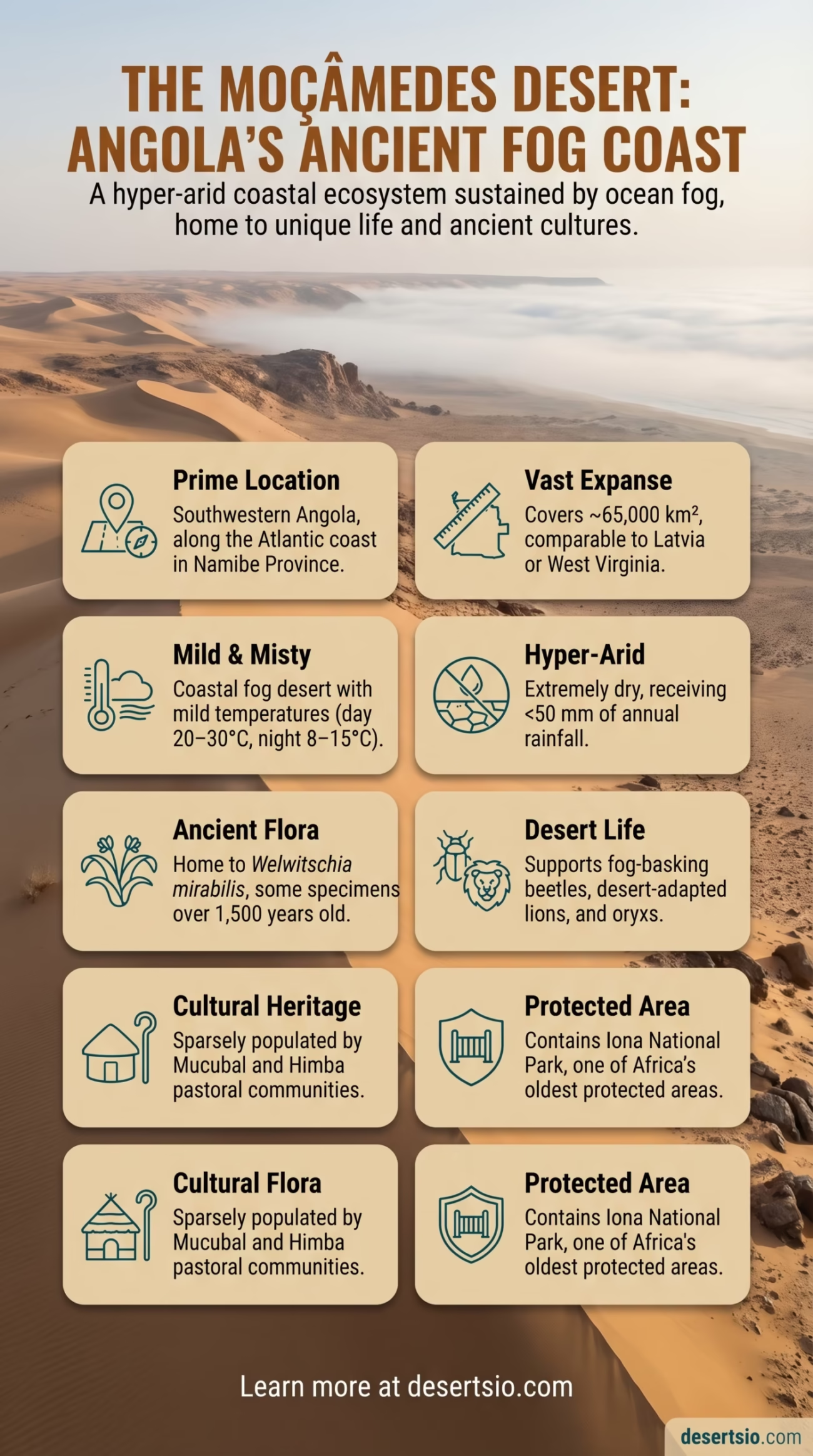
| Official Name | Moçâmedes Desert (also known as Namibe Desert) |
| Location | Southwestern Angola, Namibe Province |
| Area | Approximately 65,000 km² (25,000 sq mi) |
| Type | Coastal desert / Fog desert |
| Annual Rainfall | Less than 50 mm per year |
| Daytime Temperature | 20–30°C (68–86°F) |
| Nighttime Temperature | 8–15°C (46–59°F) |
| Elevation Range | Sea level to ~1,800 m inland |
| Main River | Curoca River |
| Bordering Desert | Namib Desert (south) |
| Oldest Known Flora | Welwitschia mirabilis — up to 1,500 years old |
| Protected Areas | Iona National Park (within the desert) |
| Human Population | Sparse; primarily Mucubal and Himba pastoral communities |
The Moçâmedes Desert stretches along Angola’s southwestern coastline — a region that most maps barely acknowledge, yet one that holds some of Africa’s most remarkable desert ecosystems. Flanking the cold Benguela Current of the Atlantic Ocean, this coastal desert sits where the land is technically tropical but behaves almost like a polar fog zone. Paradoxically dry, occasionally shrouded in mist, and geologically ancient.
Where Exactly Is the Moçâmedes Desert?
The desert occupies Namibe Province in southwestern Angola, running roughly between the city of Namibe (formerly Moçâmedes) and the Cunene River border with Namibia. It is effectively the northern continuation of the Namib Desert — one of the oldest deserts on Earth — and shares many of its physical characteristics.
The coastal strip is narrow, often less than 100 km wide. But as you move inland, the terrain climbs onto the Angolan Plateau, where the aridity softens and dry savanna begins to take over. That transition zone is where some of the most interesting biology happens.
How Big Is the Moçâmedes Desert?
At roughly 65,000 km², the Moçâmedes Desert is comparable in size to the entire country of Latvia — or slightly larger than the state of West Virginia. To put that another way: it covers more land area than the Netherlands and Belgium combined. For a desert that rarely makes headlines outside of geological literature, that is a substantial footprint.
And yet it feels oddly compressed. The coastline keeps things cool, fog rolls in from the ocean most mornings, and the landscape manages to look both barren and alive at the same time.
Formation: How Did This Desert Come to Be?
The Moçâmedes Desert owes its existence to a combination of oceanic and atmospheric dynamics that are almost identical to those that created the Namib to its south. The key driver is the Benguela Current — a cold upwelling system running northward along Africa’s southwestern coast. Cold ocean water chills the air above it, which suppresses rainfall formation. The result: a hyper-arid coastal strip despite being located well within the tropics.
This mechanism has been active for an estimated 55 million years, making the broader Namib-Moçâmedes system one of the most ancient desert environments anywhere on Earth. The Angola Plateau to the east also acts as a rain shadow for moisture coming from the interior. Dry from both sides. Almost nowhere to hide from the aridity.
The Benguela Effect — Key Figures
- Sea surface temperature off Namibe coast: approximately 12–16°C year-round (far cooler than tropical norms)
- Fog frequency: coastal areas receive fog on more than 100 days per year
- Rainfall at Namibe city: averages just 32 mm/year — less than the Sahara receives in many locations
- Desert age: geologically active arid conditions for 55+ million years
Temperature: The Surprising Mildness of a Coastal Desert
Most people assume desert means scorching heat. The Moçâmedes Desert challenges that assumption directly. Thanks to the cold Benguela Current, daytime temperatures rarely exceed 30°C along the coast — far milder than the Sahara or Arabian Desert. Nights drop to 8–15°C, which is genuinely cool for a tropical latitude.
That day-night temperature difference — roughly 15°C — is significant. It drives condensation. Coastal fog forms in the early morning and is, remarkably, a primary moisture source for much of the local wildlife. The fog moves inland, condenses on rocks and plants, and sustains life where rain essentially never falls. Fog as a lifeline — that is the defining feature of this desert’s ecology.
Further inland, temperatures become more extreme: summer highs can climb past 38°C on the plateau’s edge, and overnight lows dip sharply. The coastal strip and the interior are almost two different climatic worlds separated by just a few dozen kilometers.
Flora and Fauna: Life at the Extreme Edge
The most famous resident of this desert is beyond doubt the Welwitschia mirabilis — a plant so strange that Darwin called it “the platypus of the plant kingdom.” It produces only two leaves throughout its entire life, which can span 1,000 to 1,500 years. Specimens found within the Moçâmedes-Namib system are among the oldest living plants on Earth. The plant absorbs moisture directly from coastal fog through tiny pores on its leaves. No rain needed.
Beyond Welwitschia, the desert supports a surprisingly diverse set of species adapted to fog-dependent conditions:
- Desert-adapted succulents — including various Euphorbia species and aloes unique to Angola’s coastal strip
- Lithops (living stones) — small, camouflaged succulents that blend almost perfectly with gravel surfaces
- Oryx (Oryx gazella) — present in Iona National Park; capable of tolerating body temperatures up to 45°C
- Desert-adapted lions — a small, rare population has been recorded in the Iona area, behaviorally distinct from savanna lions
- Brown hyena — primarily nocturnal, Hyaena brunnea navigates the fog desert with remarkable efficiency
- Namaqua chameleon — found in rocky terrain near the coast, one of the few reptiles thriving in this arid zone
- Flamingos and coastal birds — seasonal visitors feeding along the Curoca River estuary and coastal lagoons
And the fog beetles. Several species of tenebrionid beetles — known locally as mistkewer in the broader region — collect fog droplets on their textured backs and drink them. This behavior has inspired real engineering research into fog-harvesting materials for water collection in arid regions. Nature solved the problem millions of years ago.
Human Life: Who Lives Here?
The desert has never been densely settled. The city of Namibe (population approximately 350,000 as of recent estimates) sits on the coast and serves as the main urban hub of the region — a fishing port with colonial-era architecture and a distinctly frontier-town feel. Outside the city, human presence drops sharply.
The pastoral communities most associated with the Moçâmedes interior are the Mucubal and the Himba peoples — semi-nomadic herders who have developed sophisticated strategies for survival in this environment. The Mucubal, in particular, are known for their onkwahita cattle culture and their ability to navigate seasonal water sources across vast distances. They move. They adapt. They have been doing this for centuries.
The Himba — more commonly associated with northwestern Namibia — also have communities that extend into southern Angola’s desert margin. Their distinctive red ochre body covering (a mixture of fat and otjize pigment) serves a practical purpose: protection against sun and insects in an environment with minimal shade.
There are also small fishing villages dotting the coastline, relying on the cold Benguela upwelling — the same current that keeps the desert dry — which happens to be one of the most productive marine ecosystems in the world, rich in sardines, mackerel, and tuna.
Iona National Park: Africa’s Oldest, Least Visited
Iona National Park, established in 1937, is one of Africa’s oldest protected areas — and arguably one of its most underexplored. Covering approximately 15,150 km² within the Moçâmedes Desert, it protects a staggering range of desert habitats: gravel plains, rocky escarpments, dry riverbeds (wadi-like ephemeral channels), and coastal fog zones.
Visitor infrastructure remains minimal. That is partly geography, partly history. The park went largely unmanaged during Angola’s prolonged internal conflict, and wildlife populations — particularly large mammals — suffered significantly. Recovery has been slow but measurable since the early 2000s, with oryx numbers increasing and the return of some predator activity.
For those willing to navigate the logistics, Iona offers something genuinely rare: a vast desert wilderness with almost no tourist infrastructure. That has a certain appeal in 2024, when most of Africa’s famous parks are increasingly crowded.
Moçâmedes and Its Desert Neighbors
The Moçâmedes Desert does not exist in isolation. It belongs to a broader arc of southwestern African aridity that includes some of the continent’s most dramatic desert landscapes.
| Desert | Location | Key Similarity | Key Difference |
| Namib Desert | Namibia / South Africa | Same Benguela-driven fog mechanism; shared geology | More studied; iconic sand dunes (Sossusvlei); far more tourism |
| Kalahari Desert | Botswana / South Africa / Namibia | Southern Africa’s arid interior; semi-arid grasslands | Semi-arid, not hyper-arid; receives far more rainfall (150–500 mm/yr) |
| Karoo Desert | South Africa | Sparse vegetation; succulents; ancient geology | Higher rainfall; cooler plateau climate; no fog mechanism |
The Namib Desert is essentially the Moçâmedes Desert’s southern twin — separated by the Cunene River, sharing the same fog-desert origin story, and harboring many of the same plant and animal families. The main difference is visibility: the Namib has Sossusvlei, Deadvlei, and decades of tourism development. The Moçâmedes remains largely unknown to the outside world.
And that is precisely what makes it interesting.
Current Conservation Challenges
As of the mid-2020s, the Moçâmedes region faces a set of pressures that are common to many underprotected desert systems. Overgrazing by livestock from expanding pastoral communities is the most immediate threat — particularly along the few permanent water sources like the Curoca River. When vegetation cover is removed, wind erosion accelerates rapidly in sandy and gravelly desert soils.
There is also growing interest in mineral extraction — Angola’s broader southwest holds known deposits of iron ore, granite, and other resources, and prospecting activity near the desert fringe has increased in recent years. Balancing resource development with ecosystem preservation in a region that already has fragile institutional capacity is genuinely difficult.
Climate science adds another layer. The Benguela Current itself shows signs of warming and variability linked to broader ocean temperature shifts. Even small changes in upwelling intensity can alter fog frequency — and fog, as we have established, is the entire basis of this desert’s ecology. A 2023 study in Geophysical Research Letters flagged intensified variability in Benguela upwelling patterns over the past two decades, which has downstream consequences for fog-dependent species throughout the coastal desert system.
Desert Glossary: Key Terms for the Moçâmedes Region
- Benguela Current — Cold, northward-flowing ocean current off southwestern Africa; primary cause of coastal desert formation
- Fog desert — Hyper-arid zone where atmospheric fog, not rainfall, is the dominant moisture input for ecosystems
- Welwitschia mirabilis — Ancient two-leafed plant endemic to the Namib-Moçâmedes system; a botanical relic from the Jurassic era
- Upwelling — Ocean process where deep, cold, nutrient-rich water rises to the surface; drives both marine productivity and coastal aridity
- Mucubal — Semi-nomadic pastoralist people of southwestern Angola; primary human community within the desert interior
- Iona National Park — Angola’s oldest national park, established 1937; located entirely within the Moçâmedes Desert
Why This Desert Deserves More Attention
The Moçâmedes Desert combines geology, biology, and human culture in a unique way. It is ancient enough to have shaped evolution — the Namib-Moçâmedes corridor has high levels of endemism, with dozens of plant and insect species found nowhere else on Earth. It is extreme enough to challenge life with almost no water. And pastoral cultures have been adapting to this landscape for centuries, long before scientists arrived with instruments.
It is also, frankly, under-documented. Compared to the Sahara, the Atacama, or even the neighboring Namib, the Moçâmedes remains a scientific frontier. Baseline biodiversity surveys for parts of Iona National Park are still incomplete. That gap is both a challenge and, for researchers and explorers alike, an open invitation.
The fog keeps rolling in off the Atlantic every morning. The Welwitschia keeps growing — slowly, stubbornly — as it has for a thousand years. And the Moçâmedes Desert keeps doing what ancient places do best: existing on its own terms, indifferent to how little the outside world knows about it.