| Location | Southern South America — Argentina (Patagonia region) |
| Type | Cold desert (temperate desert) |
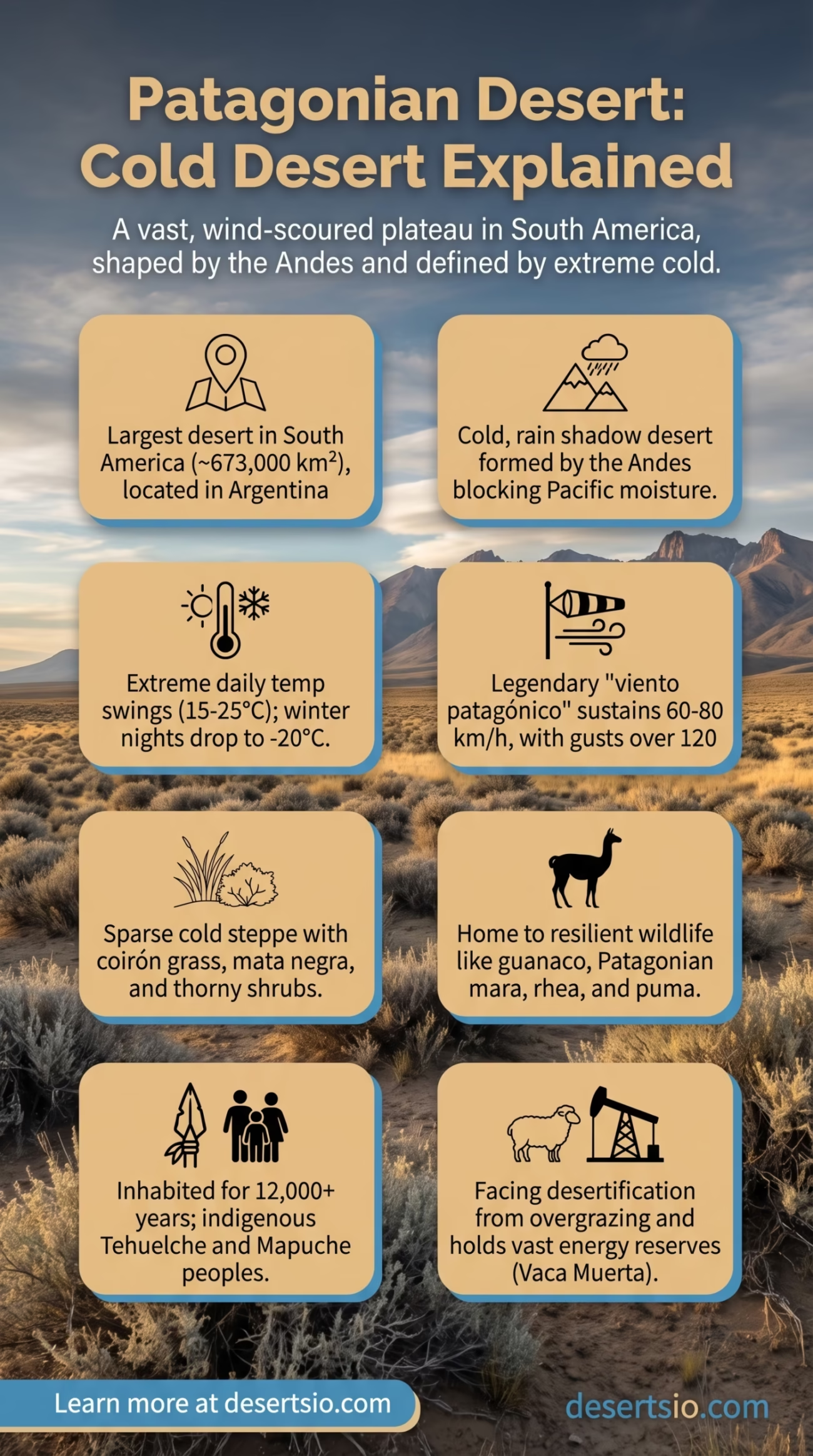
| Area | ~673,000 km² (260,000 sq mi) |
| Ranking | Largest desert in South America; 8th largest desert in the world |
| Average Annual Rainfall | 150–250 mm (6–10 in) |
| Average Summer Temperature | 12°C–20°C (54°F–68°F) during the day |
| Average Winter Temperature | −3°C–8°C (27°F–46°F); nights can drop to −20°C (−4°F) |
| Daytime vs. Nighttime Gap | Temperature swings of 15°C–25°C within a single day are common |
| Elevation | 600–900 m above sea level (average plateau) |
| Dominant Wind | Westerly winds (Patagonian winds / “viento patagónico”) — sustained 60–80 km/h |
| Main Provinces Covered | Neuquén, Río Negro, Chubut, Santa Cruz |
| Primary Vegetation | Steppe shrubland — coirón grass, mata negra, calafate bush |
| Notable Fauna | Guanaco, Patagonian mara, rhea (ñandú), puma, armadillo, Magellanic penguin |
| Formation Type | Rain shadow desert (orographic effect of the Andes) |
| Human Population | Sparse — approx. 1–2 persons per km² in most areas |
| Indigenous Peoples | Mapuche, Tehuelche (Aónikenk) |
Patagonian Desert: Location and Map View
The Patagonian Desert does not look like most people’s idea of a desert. There are no towering sand dunes, no scorching sun overhead, no mirages shimmering on a flat horizon. Instead, you get a vast, wind-scoured plateau — grey-green scrub stretching to the base of distant mountains, the sky impossibly wide, and a cold wind that never really stops. It is the largest desert in South America and one of the most distinctive cold deserts on the planet, covering roughly 673,000 square kilometers of southern Argentina.
To put that in perspective: the Patagonian Desert is larger than the entire country of France — and then some. Most of it sits on a high, windswept plateau east of the Andes, at elevations between 600 and 900 meters. The landscape feels ancient, almost geological in its silence.
How the Andes Created This Desert
The Patagonian Desert exists almost entirely because of the Andes Mountains. This is a rain shadow desert — formed by a process called orographic lift. Moisture-laden winds blow in from the Pacific Ocean, rise sharply when they hit the Andes, cool rapidly, and drop most of their rainfall on the Chilean side (the western slopes). By the time those same air masses descend onto the Argentine plateau to the east, they carry almost no moisture left. The result: a cold, dry steppe that receives 150 to 250 mm of rain per year in most areas — some eastern zones get even less.
This process has been ongoing for millions of years, intensifying as the Andes rose higher through tectonic activity during the Cenozoic era. The desert as we recognize it today took its current form roughly 2–5 million years ago, when the Andes reached sufficient height to effectively block Pacific moisture from penetrating eastward. A slow, geological act of isolation.
Temperature: Cold Days, Brutal Nights
Calling the Patagonian Desert “cold” is accurate but slightly misleading — because temperatures are highly variable depending on the season and the time of day. This is not a frozen tundra year-round. Summers (December to February in the Southern Hemisphere) bring daytime highs of 12°C to 20°C, occasionally touching 25°C near the northern zones. Comfortable, even pleasant, in the sun.
But the nights? A completely different story. Even in summer, temperatures can plunge to near freezing after dark. In winter (June to August), daytime temperatures hover between −3°C and 8°C, while nights regularly fall to −15°C to −20°C (−4°F) in the interior plateau. The daily temperature swing — the difference between midday and midnight — commonly reaches 15°C to 25°C within a single 24-hour period. That is one of the defining characteristics of arid environments worldwide: extreme thermal variation.
And then there is the wind. The viento patagónico — the Patagonian wind — is legendary among those who have spent time in the region. Sustained speeds of 60 to 80 km/h are normal; gusts exceeding 120 km/h are not rare. This wind accelerates the feeling of cold dramatically, and it shapes everything: the vegetation grows low and horizontal, animals are compact and ground-hugging, and traditional human structures lean into or shelter from it.
Flora: Life at Ground Level
The Patagonian Desert supports a cold steppe ecosystem rather than the bare sand of hot deserts. Vegetation is sparse but remarkably adapted. Key plant species include:
- Coirón grass (Festuca pallescens) — the dominant grass across the plateau, forming dense tussocks that can survive in dry, frozen soil
- Mata negra (Verbena tridens) — a low, dark-stemmed shrub that forms almost impenetrable thickets in some areas
- Calafate bush (Berberis microphylla) — produces edible purple berries; there is a Patagonian saying that whoever eats calafate berries will always return to Patagonia
- Llareta — a dense, slow-growing cushion plant found at higher elevations, known to live for thousands of years
- Neneo (Mulinum spinosum) — thorny shrubs that resist drought and cold wind with equal stubbornness
Plant density in the driest zones drops to as low as 30–50% ground cover, meaning exposed soil and rock dominate the visual landscape for long stretches. This is not lifeless — it just operates on a more patient timescale.
Fauna: Survivors of the Steppe
The wildlife here is genuinely impressive — and well-adapted to wind, cold, and scarcity. The guanaco (Lama guanicoe) is the most iconic mammal of the Patagonian steppe. A wild relative of the llama, guanacos move in herds across the plateau and can tolerate both the cold and the sparse food supply. Population estimates suggest over 30 million guanacos existed historically across Patagonia; today numbers have declined significantly due to land use changes, though Patagonia still holds the world’s largest remaining guanaco populations.
Other notable animals include:
- Patagonian mara (Dolichotis patagonum) — a large rodent that looks oddly like a small deer; monogamous and highly territorial
- Darwin’s rhea (Rhea pennata) — a large flightless bird, the Patagonian equivalent of the ostrich, standing up to 90 cm tall
- Puma (Puma concolor) — the apex predator of the steppe, following guanaco herds across the plateau
- Patagonian armadillo (Zaedyus pichiy) — small, cold-tolerant, and surprisingly fast
- Magellanic penguin — colonies nest along the Atlantic coast of the desert, most famously at Punta Tombo (home to over 1 million penguins during breeding season)
- Andean condor (Vultur gryphus) — with a wingspan up to 3.2 meters, it soars on the thermal currents above the steppe
Glossary: Key Terms of the Patagonian Desert
Rain Shadow Desert: A desert formed when a mountain range blocks moisture-carrying winds, creating a dry zone on the leeward (downwind) side.
Orographic Lift: The process by which air is forced upward when it meets a mountain range, causing it to cool and release precipitation on the windward side.
Steppe: A large, flat, treeless grassland or shrubland — the ecological term for what most people call the Patagonian landscape.
Viento Patagónico: The persistent, powerful westerly wind of Patagonia — a defining feature of daily life on the steppe, often exceeding 80 km/h.
Human Life in the Patagonian Desert
People have lived in Patagonia for at least 12,000 years. The earliest inhabitants were nomadic hunter-gatherers who followed guanaco herds across the steppe — a lifestyle that shaped everything from their tools to their social structures. Two indigenous groups have deep historical roots here:
The Tehuelche (also called Aónikenk), known historically as some of the tallest people recorded by early European explorers — a detail that fed into legends of “Patagonian giants.” They were expert hunters of guanaco and rhea, using boleadoras (weighted throwing cords) to bring down prey on the open steppe. The Mapuche, originally from further north and west (Chile), gradually expanded into Patagonia from around the 17th century onward, particularly following the horse — which transformed mobility and hunting across the entire region. Today, Mapuche communities are the largest indigenous group in Argentine Patagonia, numbering approximately 115,000 people in the region.
Modern settlement in the Patagonian Desert remains sparse. Population density across most of the plateau is 1 to 2 persons per square kilometer — one of the lowest in the Americas. The main economic activities are extensive sheep ranching (estancias covering thousands of hectares), oil extraction (particularly in the Neuquén Basin), and increasingly, tourism. Cities like Comodoro Rivadavia, Trelew, and Puerto Madryn serve as regional hubs but are separated by hundreds of kilometers of open steppe.
The Vaca Muerta Factor — A Desert Sitting on Energy
Beneath the surface of the Patagonian steppe lies one of the world’s most significant unconventional energy reserves. The Vaca Muerta formation — concentrated primarily in Neuquén Province — holds an estimated 16.2 billion barrels of shale oil and approximately 308 trillion cubic feet of shale gas, making it the second-largest shale gas reserve and fourth-largest shale oil reserve globally. This has transformed parts of the desert into an active industrial zone over the past decade, with significant infrastructure development, new roads, and a growing population of energy-sector workers concentrated around Añelo — a town that went from a few hundred residents to over 30,000 in less than 15 years.
The tension between industrial development and the fragile steppe ecosystem is an ongoing conversation in Argentina — and one that shapes the future of this desert in very concrete ways.
Desertification: A Desert Growing Larger
Here is something worth knowing: the Patagonian Desert is expanding. Overgrazing by sheep — introduced in the late 19th century, peaking at over 22 million sheep on the Patagonian steppe by the 1950s — has stripped vegetation from enormous areas, exposing soil to wind erosion. By recent estimates, approximately 30–35% of Patagonian rangelands show moderate to severe desertification, with moving sand dunes encroaching on previously stable shrubland in some zones.
Climate change compounds this. Rising temperatures and shifting precipitation patterns are altering the steppe’s delicate moisture balance. Researchers at CONICET (Argentina’s national research council) have documented increased aridity across parts of northern and central Patagonia over the past 30 years. And it is not slowing down.
Nearby and Comparable Deserts
Monte Desert (Argentina)
Directly north of the Patagonian Desert, the Monte Desert covers roughly 460,000 km² across central Argentina. It is warmer and slightly wetter than Patagonia, supporting a richer shrub layer — including large jarilla bushes (Larrea divaricata) — and a more diverse reptile community. The two deserts share some flora and fauna but differ considerably in temperature regime and soil composition.
Atacama Desert (Chile)
The Atacama sits on the other side of the Andes — and is the Patagonian Desert’s structural opposite. Both are rain shadow deserts caused by the Andes, but the Atacama is one of the hottest and driest places on Earth (some areas average less than 1 mm of rain per year), while Patagonia is cold and relatively more humid. Geologically fascinating neighbors separated by the same mountain range that created them both.
Further afield, the Gobi Desert in Central Asia offers perhaps the closest structural parallel to Patagonia: another cold, high-elevation, rain shadow steppe desert dominated by strong winds and extreme temperature swings — with an equally sparse but tenacious ecosystem. Both deserts challenge the popular image of what a “desert” should look like.
Why the Patagonian Desert Matters
Cold deserts rarely get the attention they deserve in global environmental discussions. The Sahara dominates the imagination, the Atacama gets the superlatives — but the Patagonian steppe is one of the largest and most ecologically distinct desert systems in the Southern Hemisphere. It holds unique species found nowhere else, sits atop enormous energy reserves, supports the livelihoods of indigenous and rural communities, and is changing faster than most people realize.
It is, in the plainest terms, a place of consequence. The wind carries dust from here all the way to the South Atlantic Ocean — and those dust particles fertilize the ocean’s surface waters, influencing marine productivity across a vast area. A desert that feeds the sea. Not many landscapes can claim that.
| Desert | Type | Area (km²) | Avg. Annual Rainfall | Location |
| Patagonian Desert | Cold / Rain Shadow | 673,000 | 150–250 mm | Argentina |
| Monte Desert | Warm / Rain Shadow | 460,000 | 200–350 mm | Argentina |
| Atacama Desert | Cold coastal / Rain Shadow | 105,000 | <1–25 mm | Chile / Peru |
| Gobi Desert | Cold / Continental | 1,295,000 | 100–200 mm | China / Mongolia |