
| Location | Northwestern Argentina (Provinces of Jujuy, Salta, Tucumán, Catamarca, La Rioja, San Juan, Mendoza, Neuquén, Río Negro) |
| Type | Rain Shadow Desert (Temperate Desert) |
| Total Area | ~330,000 km² (127,000 sq mi) |
| Elevation Range | 200 m – 3,500 m above sea level |
| Average Annual Rainfall | 80–200 mm |
| Average Daytime Temperature | 25–35°C (Summer) / 10–18°C (Winter) |
| Average Nighttime Temperature | 5–12°C (Summer) / -5–2°C (Winter) |
| Dominant Vegetation | Larrea (jarilla) shrubs, cacti, monte scrub |
| Key Wildlife | Puma, guanaco, Andean condor, Patagonian mara, vizcacha |
| Human Population | Sparse; indigenous Huarpe communities, small ranching settlements |
| Bordering Region | Andes Mountains (west), Patagonian Steppe (south), Puna Plateau (north) |
| UNESCO Status | Parts protected under Ischigualasto/Talampaya UNESCO World Heritage Site |
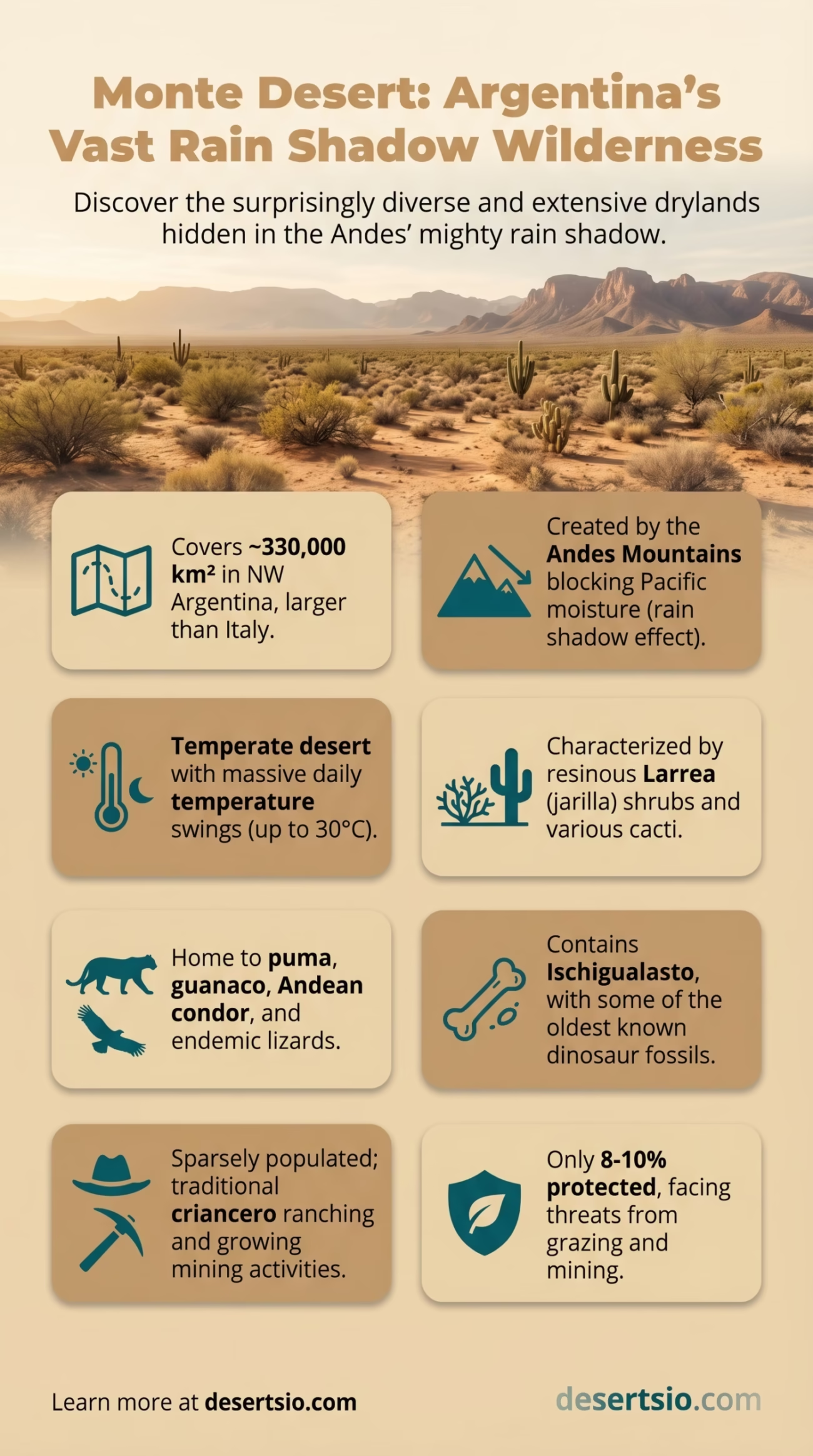
The Monte Desert stretches across Argentina’s interior like a hidden backbone — vast, sun-scorched, and surprisingly misunderstood. Covering roughly 330,000 square kilometers, it ranks as South America’s second-largest desert after the Patagonian Desert. Yet it rarely makes headlines. Most people picture Patagonia when they think of Argentina’s dry landscapes, but the Monte occupies a completely different ecological and geographic space — one shaped by the Andes Mountains, dramatic temperature swings, and a level of biodiversity that defies the word “desert.”
Monte Desert: Location and Map View
How Big Is the Monte Desert?
At 330,000 km², the Monte Desert is larger than Italy and nearly three times the size of the state of Pennsylvania. It runs in a narrow but elongated band from the province of Jujuy in the north all the way down to Neuquén and Río Negro in the south — a north-to-south span of over 2,000 kilometers. That’s a striking geographic footprint for a desert that rarely appears on global “top deserts” lists.
To put it another way: if you placed the Monte Desert over Western Europe, it would cover Portugal, Switzerland, and Austria combined. It is not a small, localized dry patch — it is a defining feature of Argentina’s western interior.
Formation: Why Does This Desert Exist Here?
The Monte Desert is a rain shadow desert — and the Andes are entirely responsible for it. As moisture-laden air masses travel eastward from the Pacific Ocean, they rise against the Andes and release nearly all their precipitation on the Chilean side. By the time those air masses descend onto Argentina’s western interior, they are dry, warm, and incapable of producing significant rainfall.
This orographic effect has been operating for millions of years, since the Andes reached their current height during the late Miocene and Pliocene epochs — roughly 5 to 10 million years ago. The result is a desert that owes its existence entirely to mountains it cannot touch.
Interestingly, the Monte is not uniformly arid. Elevation plays a major role. At lower basins (bolsones), aridity intensifies. Higher zones near the Andean foothills receive slightly more moisture, creating a patchwork of dry scrubland and semi-arid grassland. This variation is one reason scientists study the Monte so intensively as a model for understanding gradient aridity.
Temperature: A Desert of Extremes
The Monte is classified as a temperate desert, which sets it apart from tropical or subtropical arid zones. The seasonal and diurnal temperature ranges here are significant. During summer months (December–February), daytime temperatures regularly climb to 35°C or higher in lower basins, while nights drop sharply — sometimes to 5–8°C within the same 24-hour period. That’s a swing of nearly 30°C in a single day.
Winter (June–August) brings a completely different character. Daytime highs hover around 10–18°C depending on elevation, but nights regularly dip below freezing — down to -5°C in higher sections. Frost is common across much of the desert between May and September. Snow occasionally falls at higher elevations. This is not the kind of desert where cold is a surprise; it is a structural feature.
Monte Desert Temperature Snapshot
- Summer days: 25–35°C (sometimes exceeding 38°C in basins)
- Summer nights: 5–12°C
- Winter days: 10–18°C
- Winter nights: -5–2°C (frost frequent above 1,000 m)
- Daily temperature swing: Up to 28–30°C
- Annual precipitation: 80–200 mm (concentrated in summer thunderstorms)
Flora: The Jarilla Desert
The Monte has a botanical identity almost entirely defined by one plant: Larrea divaricata, locally known as jarilla. This resinous, drought-resistant shrub dominates the landscape at almost every elevation. Its small waxy leaves reduce water loss, and its root system can extend several meters laterally to capture any available moisture. The smell of jarilla after rare rain events is — according to botanists who have worked in the region for decades — unmistakable and unlike anything else.
Beyond jarilla, the Monte hosts a surprisingly rich plant community:
- Cacti: Trichocereus (cardon) and Opuntia (prickly pear) species dominate rocky slopes
- Algarrobo trees (Prosopis spp.): Found near dry riverbeds (arroyos), providing shade and food for wildlife
- Retama (Bulnesia retama): A yellow-flowering shrub adapted to sand and gravel flats
- Brea (Cercidium praecox): A small tree with green bark capable of photosynthesizing through its trunk — even without leaves
- Annual grasses and forbs: Appear rapidly after summer rains, then vanish within weeks
The Monte Desert is actually recognized as a global center of plant endemism. Over 30% of its plant species are found nowhere else on Earth — a fact that makes conservation of this desert particularly urgent.
Fauna: Who Lives Here?
Do not let the dry landscape fool you. The Monte supports a dense and varied animal community, shaped by millions of years of co-evolution with the jarilla scrubland.
Mammals
- Guanaco (Lama guanicoe): The wild ancestor of the llama; roams in herds across open scrubland
- Puma (Puma concolor): Apex predator; territorial ranges can exceed 300 km²
- Patagonian mara: Looks like a small deer but is actually a large rodent — one of the strangest-looking animals in South America
- Vizcacha (Lagidium viscacia): A chinchilla relative found on rocky outcrops
- Armadillos: Multiple species active at dawn and dusk
Birds & Reptiles
- Andean condor: Soars above the desert on thermal currents rising from sun-heated rock and sand
- Burrowing owl (Athene cunicularia): Nests in abandoned armadillo burrows
- Greater rhea: South America’s largest bird; adapted to open, dry scrubland
- Lizards: Liolaemus genus — with over 20 species endemic to the Monte — represents one of the richest lizard radiations in any desert globally
- Rattlesnakes and coral snakes: Present but not frequently encountered
Human Life in the Monte Desert
The Monte has never been truly empty. Long before colonial-era settlement, Huarpe people inhabited the desert’s lower basins and river valleys — particularly around the Mendoza and San Juan river systems. They developed sophisticated water management techniques, channeling snowmelt from the Andes into irrigation systems that allowed small-scale agriculture in one of the driest environments in the Southern Hemisphere.
Today, the Monte is sparsely populated. Population density in most desert provinces sits well below 2 people per km². Small ranching communities (puesteros) raise goats and cattle across the scrubland — a practice called criancero culture — moving livestock seasonally between lower desert floors and higher Andean pastures (veranadas). It’s a form of transhumance that has continued largely unchanged for centuries.
Mining is a significant economic driver. The provinces of San Juan, La Rioja, and Catamarca host major mineral extraction operations — including gold, silver, copper, and increasingly, lithium. Argentina holds some of the world’s largest lithium reserves, concentrated in the Puna plateau that borders the Monte’s northern edge. As global demand for battery-grade lithium rises sharply (projected to grow by over 500% by 2050 due to electric vehicle production), the broader Monte region is under increasing economic pressure.
The Ischigualasto Formation: A Desert Within a Desert
Within the Monte Desert lies one of the most extraordinary geological zones on Earth — the Ischigualasto Provincial Park in San Juan province, locally known as Valle de la Luna (Valley of the Moon). The landscape here is almost alien: grey and violet badlands, eroded clay formations, and spherical boulders scattered across the valley floor like abandoned cannonballs.
The site is scientifically important far beyond its appearance. Ischigualasto contains some of the oldest known dinosaur fossils on Earth, dating back to the Late Triassic period (~230 million years ago). Eoraptor lunensis — one of the earliest dinosaurs ever identified — was discovered here in 1991. Together with the adjacent Talampaya National Park, the site received UNESCO World Heritage status in 2000.
Neighboring Deserts and Comparisons
The Monte does not exist in geographic isolation. It sits within a larger network of South American dry zones, each distinct in character but connected by the same Andean rain shadow dynamics.
| Desert / Region | Location | Area | Key Difference from Monte |
| Patagonian Desert | Southern Argentina | ~673,000 km² | Colder, windier, lower biodiversity; Argentina’s largest desert |
| Atacama Desert | Northern Chile / Peru border | ~105,000 km² | Far more extreme aridity (some areas receive <1 mm/year); hyperarid |
| Puna Plateau | NW Argentina, Bolivia, Chile | ~250,000 km² | High-altitude (3,500–5,000 m), cold desert; borders Monte to the north |
| Sechura Desert | Coastal Peru | ~188,000 km² | Coastal fog desert; very different moisture source |
The Monte and the Patagonian Desert are often confused or lumped together, but they are ecologically distinct. The Patagonian Desert sits further south and east — colder, windier, and dominated by grass and cushion plants rather than shrubs. The Monte, by contrast, is warmer, richer in shrub diversity, and supports a far greater number of reptile and mammal species. Think of the Patagonian Desert as the Monte’s austere, windswept neighbor — related but fundamentally different in personality.
A useful global comparison: the Monte shares several ecological characteristics with the Sonoran Desert of North America — both are temperate to warm deserts with significant shrub dominance, similar rainfall seasonality (summer-biased), and impressive reptile diversity. The key difference is scale and elevation variability; the Monte’s connection to the Andes creates altitudinal gradients the Sonoran simply does not have.
Conservation Status and Current Pressures
Despite its ecological richness, the Monte Desert remains one of the least protected desert ecosystems in South America. Formally protected areas cover less than 8–10% of the total Monte region — well below the 30% target established by the global Kunming-Montreal Biodiversity Framework adopted in 2022.
Current threats include:
- Overgrazing: Goat and cattle ranching degrades jarilla scrubland, leading to soil erosion and desertification of already fragile terrain
- Mining expansion: Open-pit operations disturb soil and water systems across thousands of hectares
- Climate change: Precipitation patterns in the Monte are already shifting — some studies show a southward displacement of summer rain events, leaving northern sections increasingly dry
- Invasive species: Tamarix (saltcedar) and other invasive plants compete aggressively with native vegetation in riparian corridors
- Urban expansion: Cities like Mendoza and San Juan — located directly at the Monte’s edge — continue to expand into adjacent desert land
And the lithium question isn’t going away. Argentina, Bolivia, and Chile form the so-called “Lithium Triangle,” holding an estimated 58% of the world’s lithium reserves. Extraction activity is intensifying rapidly, and while much of it targets the Puna plateau rather than the Monte core, hydrological connections between these zones mean the impacts are rarely contained.
Monte Desert — Desert Glossary
Jarilla (Larrea): The dominant shrub of the Monte Desert; a resinous, drought-adapted plant that defines the landscape’s ecology and appearance.
Bolsón: A closed topographic basin within the desert, often the hottest and driest part of the Monte where sediments accumulate and aridity is most intense.
Rain Shadow Desert: A desert formed when a mountain range blocks moisture-carrying winds, leaving the leeward side dry. The Andes create the Monte’s rain shadow.
Criancero: A traditional Argentine ranching lifestyle practiced in the Monte — semi-nomadic herders who move goats and cattle between desert lowlands and high Andean pastures.
Orographic Effect: The process by which mountains force air upward, causing precipitation on the windward side and leaving the leeward side in a dry “rain shadow.”