
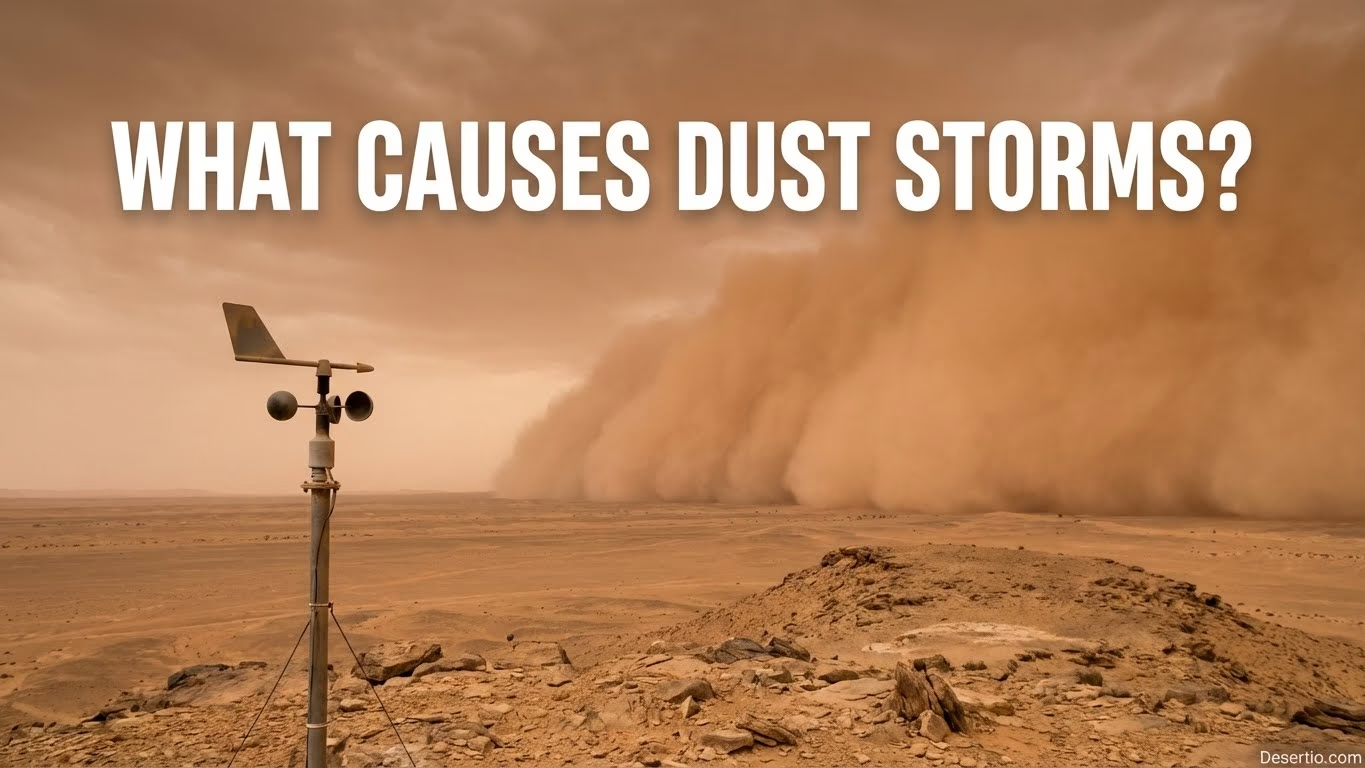
Dust storms begin when wind transfers enough force to a dry, erodible surface to loosen mineral particles and carry them into the atmosphere. That sounds simple, but wind alone does not create a major dust storm. The ground must also provide loose sediment, soil moisture must be low enough for particles to separate, and vegetation or surface crusts must leave enough material exposed. Once grains start moving, they can knock still more particles loose, turning ordinary wind erosion into a large airborne dust plume.
This is why the most active dust-producing landscapes are not simply the hottest or sandiest places. Dry lake beds, desert basins, floodplains, alluvial deposits, sparsely vegetated rangelands and exposed agricultural soils can all supply enormous amounts of fine material when weather and surface conditions line up.
| Condition | What It Does | Role in Dust-Storm Formation |
|---|---|---|
| Strong surface wind | Applies drag and turbulence to exposed sediment | Starts particle movement and keeps fine dust airborne |
| Dry soil or sediment | Reduces the binding effect of water between grains | Makes particles easier to detach |
| Loose fine material | Provides silt, clay and fine aggregates that can enter suspension | Supplies the visible dust cloud |
| Sparse vegetation | Leaves more ground exposed to moving air | Raises susceptibility to wind erosion |
| Thunderstorm outflow or broad strong winds | Produces sudden or sustained wind acceleration | Can trigger local walls of dust or regional events |
| Long dry periods | Reduce soil moisture and often thin plant cover | Prepare larger areas to emit dust |
How Wind Turns Loose Ground Into Airborne Dust
A grain lying on the ground does not move merely because air passes over it. Wind must overcome forces that keep the particle in place, including gravity, friction, cohesion between fine particles and moisture-related bonding. Scientists describe the point at which movement starts using concepts such as threshold friction velocity.
There is no single wind speed that starts every dust storm. Particle diameter, soil texture, surface roughness, crust strength, moisture and vegetation all alter the threshold. As a broad real-world reference, dust movement can begin with winds around 30 km/h (about 19 mph) on some dry, exposed surfaces, while other surfaces require much stronger winds.
Once movement starts, something interesting happens close to the ground: larger grains help release smaller ones.
Saltation Starts the Chain Reaction
Many sand-sized particles are too heavy to float high into the atmosphere. Instead, the wind makes them bounce across the surface. This movement is called saltation.
When a saltating grain lands, it strikes other grains and soil aggregates. Those impacts can break fragile aggregates apart and eject additional particles. Fine dust that was difficult for wind to lift directly can then enter the moving air. In that sense, bouncing sand grains act as small surface agitators — they keep hitting the ground and freeing finer material.
- Surface creep: relatively large grains roll or slide along the ground.
- Saltation: sand-sized grains make repeated short hops.
- Suspension: smaller particles remain airborne and travel much farther.
US soil-erosion research commonly places much of the suspension-sized material below roughly 0.1 mm (100 micrometers). Field measurements also show that the finer fraction dominates farther above the surface and during longer-distance transport. Tiny particles can remain aloft after the coarser grains have already returned to the ground.
Turbulence Keeps Fine Particles Aloft
Lifting dust is only part of the process. Atmospheric turbulence must keep stirring the particles upward faster than they settle. Fine mineral dust has a much lower settling speed than ordinary sand grains, so turbulent air can carry it hundreds or thousands of kilometers from its source.
This particle-size sorting explains a familiar desert pattern. Coarse sand tends to stay relatively close to the surface and source area. Silt-sized and still finer particles travel much farther, sometimes crossing seas and continents.
Weather Systems That Trigger Dust Storms
A dust-ready landscape can remain quiet for days. It still needs a meteorological trigger. Several kinds of weather can supply the required wind, and they produce rather different-looking storms.
Thunderstorm Outflow and Haboobs
Some of the most sharply defined dust walls develop beneath or ahead of thunderstorms. Rain and evaporative cooling create dense, cooler air that descends through a storm. When that downdraft reaches the ground, it spreads outward as a powerful surface outflow.
If this outward-moving air crosses dry sediment, it can sweep huge quantities of dust into a advancing wall. This type of event is widely known as a haboob. The Arabic-derived term became associated with dramatic thunderstorm-generated dust walls in dry regions, including parts of North Africa, the Arabian Peninsula and the southwestern United States.
A haboob is a type of dust storm, but not every dust storm is a haboob. The defining feature is its connection to thunderstorm outflow or a comparable density-current-like surge of air near the ground.
Strong Pressure Gradients and Weather Fronts
Dust storms can also form without nearby thunderstorms. When atmospheric pressure changes sharply across a region, air accelerates from higher toward lower pressure. Strong pressure gradients associated with fronts and large weather systems may produce hours of powerful surface wind over broad areas.
These events can mobilize far more than one isolated patch of soil because the wind may cross hundreds of kilometers of exposed terrain. Dust rises from multiple source areas, combines downwind and develops into a broad plume rather than a single advancing wall.
Convective Mixing Over Hot Ground
Strong solar heating also makes the lower atmosphere turbulent. Air immediately above a hot desert surface warms, rises and mixes with surrounding air. By itself, this does not always produce a large dust storm, but convective turbulence can strengthen vertical dust transport when surface winds are already moving sediment.
Small rotating vortices known as dust devils work through a related convective process. They can lift dust locally even on otherwise calm-looking days, although they are physically and spatially different from broad regional dust storms.
Why Dry Soil Produces More Dust
Water changes the way soil particles behave. A thin film of moisture between particles produces capillary and cohesive forces that help hold grains and aggregates together. As a surface dries, that extra bonding weakens.
Dryness also influences the landscape indirectly. When rainfall remains low for an extended period, plant growth may decline and more bare soil can appear between grasses and shrubs. The wind then reaches the ground with fewer obstacles.
- Wet or damp soil generally resists deflation better because particles bind together.
- Dry, loose soil separates more readily when wind shear rises.
- Dry surface crusts can temporarily resist erosion if they remain intact.
- Broken crusts may expose fine sediment that becomes highly erodible.
So, dry ground matters — but its structure matters too.
Vegetation Acts as a Natural Wind-Erosion Barrier
Grasses, shrubs and other ground cover interfere with airflow before it reaches the soil. Stems and leaves absorb part of the wind’s momentum, while roots help maintain soil structure. Plant litter lying on the surface adds another layer of protection.
On a well-covered surface, wind measured above the vegetation can be fairly strong while wind speed immediately beside the soil remains much lower. Remove much of that cover and the same weather event can exert far more force on exposed sediment.
This relationship helps explain why dust activity often changes through the year. A dryland plain may be relatively resistant while vegetation is dense, then become much more erodible after seasonal drying leaves open patches of bare earth.
Why Drought Can Prepare the Ground for Dust Storms
Drought does not physically lift particles into the atmosphere; wind does that. Drought instead changes the surface from which the wind draws dust.
Long periods with little precipitation can lower near-surface soil moisture, reduce vegetation growth, expose dry lake margins and leave fine sediment available for erosion. When strong winds eventually arrive, a much larger source area may be ready to emit dust.
The sequence is often drying → loss of protective cover or moisture → exposed sediment → strong wind → particle entrainment. That distinction matters because a region can experience severe drought without a dust storm if sufficiently strong winds never cross an erodible surface.
Why Dry Lake Beds Can Become Powerful Dust Sources
Some of Earth’s strongest dust sources are not seas of loose dune sand. They are basins where fine sediment accumulated when water was present.
Rivers and temporary lakes sort and deposit clay, silt and fine mineral material in low-lying areas. After the water retreats and the surface dries, those deposits may become exposed to wind. Salts can also accumulate in closed desert basins as water evaporates.
The result can be a broad, flat source area containing exactly the fine material needed for atmospheric dust.
The Bodélé Depression Shows How Geography Concentrates Dust
The Bodélé Depression in northern Chad, within the Sahara, is one of the clearest examples. The basin contains abundant fine sediment associated with an ancient lake environment. Its geography also helps channel winds across the source region.
The World Meteorological Organization’s July 2026 assessment reported that the Bodélé Depression remained the location with the highest annual mean dust concentrations worldwide in 2025. It illustrates an important point: the productivity of a dust source depends on sediment supply, surface condition and wind patterns together.
Human Land Use Can Change How Easily a Surface Emits Dust
Most global mineral dust forms through natural Earth-system processes, especially across deserts and drylands. Human activity can nevertheless alter how much loose material is exposed to the wind.
The World Health Organization estimates that approximately 25% of global dust emissions are associated with human-related influences. Examples include land degradation, removal of vegetation, unsuitable land management and changes in water availability that expose formerly wet sediment.
Agricultural Soil Can Become a Dust Source
Dry farmland may contain large quantities of fine soil. Crop residue and growing plants normally reduce wind exposure, but recently disturbed or bare fields can respond differently. Tillage can break large aggregates into smaller pieces, while a long bare stretch gives moving grains room to accelerate and continue saltating.
Field length matters for another reason. As saltating particles repeatedly strike an eroding surface, abrasion and aggregate breakage can release additional suspended dust farther downwind. The dust plume may therefore strengthen after wind has traveled across an extended erodible area.
Ground Cover Changes Wind Exposure
Any land change that reduces protective cover may alter local wind erosion. The effect depends heavily on soil type, climate, season, remaining vegetation and how the surface is managed. Bare ground is not automatically a major dust source, nor does every disturbed surface create storms.
The basic physical requirement remains the same: erodible particles must be available when sufficiently strong wind arrives.
Why Some Deserts Produce Much More Dust Than Others
A large dune field may look like the obvious place for atmospheric dust production, yet a different desert basin nearby can emit far more fine material. Grain size makes the difference.
Many dunes consist largely of sand grains that are comparatively heavy. Wind can move them through creep and saltation, reshaping dunes without keeping much of that sand suspended for long periods. Former lake beds, ephemeral river deposits and alluvial plains may contain much greater supplies of silt and clay-sized material suitable for suspension.
| Desert Surface | Typical Dust-Producing Potential | Reason |
|---|---|---|
| Active sand dunes | Variable | Much of the material is too coarse for long atmospheric suspension |
| Dry lake bed | Often high when exposed | Can contain abundant fine sediment deposited in standing water |
| Alluvial plain | Moderate to high in suitable conditions | Floodwater and streams deposit mixed fine sediment |
| Rocky desert pavement | Often comparatively low | Coarse surface material can protect finer sediment underneath |
| Vegetated dryland | Lower while cover remains dense | Plants reduce near-ground wind and stabilize soil |
Dust Storms Are Not Limited to Deserts
Arid and semi-arid regions provide ideal conditions because dry sediment and sparse vegetation are common there, but a formal desert climate is not required. Any landscape can produce blowing dust if enough exposed fine sediment dries out and sufficiently strong wind crosses it.
Dry agricultural plains are a good example. So are exposed lake beds and sediment-rich basins outside classic desert boundaries. Dust storms have occurred across temperate regions when unusually dry surfaces met strong winds.
A striking case occurred in the central United States on May 16, 2025, when satellite observations followed a dust storm across parts of Illinois and Indiana and into the Chicago metropolitan area. The event is a useful reminder that dust storms depend on surface and weather conditions, not simply a desert label.
Dust Storm, Sandstorm and Haboob Are Related but Not Identical
The terms overlap in everyday speech, though they describe different aspects of wind-blown sediment.
- Dust storm: an event in which fine mineral particles become airborne in large quantities and can remain suspended well above the ground.
- Sandstorm: commonly emphasizes coarser sand movement, much of which remains relatively close to the surface.
- Haboob: a dense advancing dust wall generated by strong outflow from a thunderstorm or closely related atmospheric process.
- Blowing dust: a broader meteorological description for wind-raised dust that may not develop into a large storm.
Particle size controls much of the visible difference. Sand settles rapidly. Fine dust does not.
Where Most of the World’s Atmospheric Dust Comes From
Earth emits a remarkable amount of mineral material into the atmosphere. Current World Meteorological Organization estimates place the annual total at around 2,000 million metric tons — about 2 billion tons.
More than 80% of global dust emissions originate from the deserts of North Africa and the Middle East, while Asian sources such as the Gobi also contribute large quantities. The Sahara is therefore not merely a collection of local dust sources; it is part of a vast atmospheric dust system whose particles regularly leave the continent.
Major Dust-Producing Regions Include
- The Sahara: numerous basins and sediment-rich surfaces across North Africa supply mineral dust.
- The Arabian Desert and nearby drylands: extensive arid terrain provides recurring source areas.
- The Gobi and surrounding Asian drylands: spring weather systems can mobilize sediment over very large regions.
- Central Asian basins: dry lake and desert surfaces contribute to regional dust transport.
- Australian drylands: drought, exposed soil and strong frontal winds periodically generate large plumes.
- Southwestern North America: deserts, dry lake beds and exposed soils can produce both regional dust storms and thunderstorm-driven haboobs.
Why Dust-Storm Activity Changes With the Seasons
Dust sources do not operate at the same strength throughout the year. Seasonal rainfall changes soil moisture and vegetation, while seasonal atmospheric circulation changes wind speed and direction.
In some deserts, the most active period comes when strong seasonal winds overlap with dry exposed ground. Elsewhere, summer thunderstorms provide the outflow needed for haboobs. In agricultural regions, timing can also depend on when fields are bare, recently cultivated or covered by crops.
This means two deserts at the same latitude can have different dust calendars. Local geology, rainfall timing and wind climatology matter.
How a Local Dust Storm Becomes a Long-Distance Dust Plume
The large grains responsible for saltation usually remain near their source. The finer particles released by those impacts behave differently. Once atmospheric mixing lifts them above the turbulent surface layer, regional winds can carry them far beyond the desert that produced them.
Long-distance transport favors the smallest particles because their gravitational settling is slow. Larger particles fall out first; finer mineral aerosols continue downwind.
Saharan dust provides one of Earth’s most visible examples. Plumes can cross the Atlantic and reach the Caribbean and the Americas. Dust from Asian deserts likewise travels over the western Pacific. A storm may therefore disappear at its original source while its finer material remains in the atmosphere for days.
What Determines How Much Dust a Storm Can Lift?
The size of a dust event depends on far more than peak wind speed. Researchers examining wind erosion consider a combination of atmospheric and surface properties.
- Wind stress: stronger near-surface airflow can mobilize a wider range of particles and increase sediment movement.
- Duration: sustained winds have more time to erode large surfaces and feed an expanding plume.
- Source-area size: long stretches of erodible terrain provide continuing sediment supply.
- Soil moisture: damp soil generally requires more force before particles detach.
- Particle-size distribution: a surface rich in fine sediment can supply more suspendable dust.
- Aggregate stability: strong soil aggregates resist fragmentation better than fragile dry aggregates.
- Surface roughness: stones, clods and vegetation alter airflow and may shield finer particles.
- Vegetation cover: plants absorb momentum and physically protect the soil.
- Atmospheric mixing: turbulent conditions determine how efficiently emitted particles rise and remain airborne.
Why Two Equally Windy Days Can Produce Completely Different Results
Imagine the same strong wind crossing one surface after rainfall and again several weeks later. On the first day, moist aggregates and fresh vegetation may hold most of the soil in place. After prolonged drying, exposed fine sediment may respond very differently.
The wind speed can be similar. The erodibility is not.
The reverse can happen as well. An extremely dry basin may contain plenty of loose dust but produce no major plume during calm weather. Dust storms therefore emerge from the intersection of atmospheric force and surface readiness.
Why Dust Storms Can Develop So Quickly
A prepared surface does not need much time to respond once wind exceeds its erosion threshold. Saltation starts, impacts release finer grains, and the expanding cloud makes the event visible within minutes.
Thunderstorm outflows are especially abrupt because a concentrated surge of cool air can move across the landscape as a distinct gust front. Dust accumulates along that moving boundary, giving some haboobs their sharp, wall-like leading edge.
Broad pressure-driven events usually look less abrupt. Multiple sources may emit dust over a wider area, producing an extensive haze or plume rather than one neat wall.
What Makes a Dust Storm Stop?
A storm weakens when one or more parts of the dust-producing process break down. Surface winds may fall below the threshold needed to maintain erosion. The moving air may leave the erodible source area. Rain can dampen exposed sediment. Coarser particles also begin settling almost immediately after turbulence weakens.
Fine suspended dust lasts longer. Even after the ground-level storm ends, an elevated dust layer can continue traveling with regional atmospheric circulation. That is why satellite imagery may follow a plume long after active erosion has stopped at its source.
Recent Observations Show How Variable Dust Conditions Can Be
The World Meteorological Organization’s Airborne Dust Bulletin No. 10, released in July 2026, found that the global average annual mean surface dust concentration in 2025 remained similar to 2024, even though individual regions experienced very different conditions.
That contrast is revealing. A stable global average does not mean every desert or dryland experienced an average year.
China experienced its strongest dust intrusion in a decade during April 2025 in terms of intensity, geographical reach and duration. Along the desert border region of the United States and Mexico, dust activity was also unusually frequent during 2025. El Paso, Texas, recorded 50 days with dust weather, more than twice its annual average.
Such regional differences are expected because dust production reacts to local sediment availability, drought history, vegetation, surface condition and the timing of strong winds. The atmosphere supplies the trigger; the landscape determines how much material is available to respond.
The Physical Sequence Behind Most Dust Storms
1. A dry surface contains exposed, erodible sediment.
2. Strong wind raises stress and turbulence near the ground.
3. Sand and soil aggregates begin rolling or bouncing through creep and saltation.
4. Repeated impacts loosen finer mineral particles.
5. Fine dust enters suspension and mixes upward.
6. Regional winds transport the suspended fraction away from the source, sometimes over very long distances.
Can Dust Storms Form Without Sand?
Yes. A dust source does not need to be a sandy desert. Fine sediment from a dry lake bed, silty plain, exposed river deposit or dry agricultural soil can enter the atmosphere when conditions permit.
Sand can make dust emission more efficient because saltating grains strike the surface and liberate smaller particles, but loose fine aggregates can also be entrained through turbulent aerodynamic forces. The exact balance differs from one soil and landscape to another.
Can Rain Be Connected to a Dust Storm?
Oddly enough, yes. Rain usually suppresses wind erosion after it reaches the ground because moisture binds soil particles. Yet a thunderstorm that produces rain can simultaneously generate the winds that create a haboob several kilometers away.
The downdraft forms inside the storm, spreads outward at the surface and may reach dry terrain where little or no rain has fallen. There, the outflow lifts dust. A person can therefore see an approaching dust wall created by a storm whose rainfall never reaches that particular location.
Does Extreme Heat Directly Cause Dust Storms?
Heat alone does not create a dust storm. Its role is mostly indirect. Hot conditions can accelerate surface drying and strengthen daytime convection, while prolonged hot, dry periods may reduce soil moisture and vegetation.
The actual lifting still requires wind stress and turbulence acting on erodible material. A scorching desert afternoon with weak winds may produce little airborne dust, whereas a cooler day with powerful frontal winds can generate a large plume.
Is Desertification the Same Thing as Dust-Storm Formation?
No. Desertification describes long-term land degradation in drylands, while a dust storm is an atmospheric event that may last minutes, hours or longer. The two processes can interact because degraded surfaces may lose vegetation and expose erodible sediment, but they operate on very different timescales.
A healthy natural desert can produce dust without undergoing desertification, and a degraded dryland does not automatically produce dust storms. Once again, available sediment and suitable winds must coincide.