
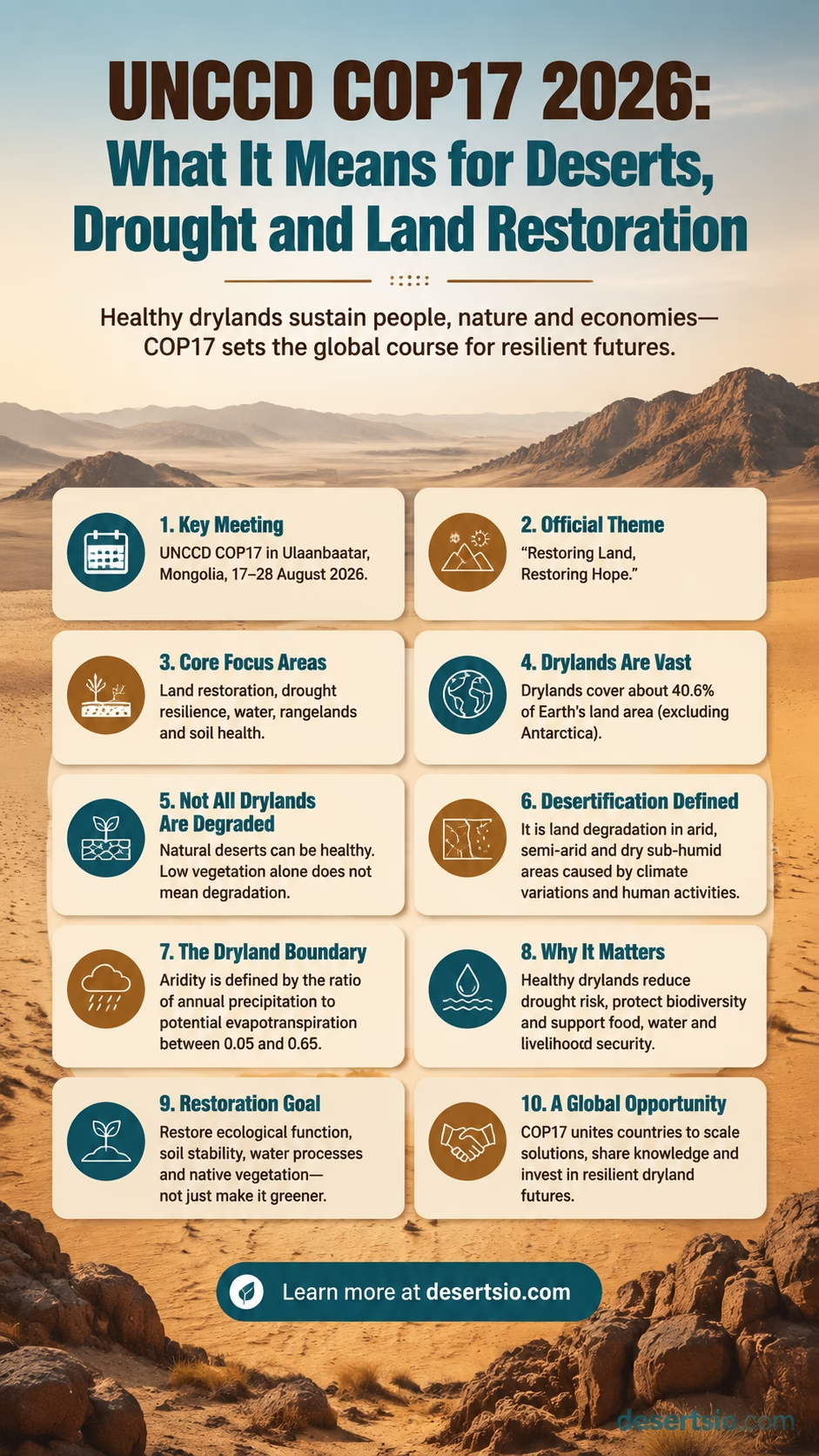
A desert can be ecologically healthy while a greener-looking dryland nearby is losing soil, vegetation and productive capacity. That distinction matters at UNCCD COP17, which runs in Ulaanbaatar, Mongolia, from 17 to 28 August 2026. The meeting focuses on land restoration, drought resilience, water, rangelands and soil health—issues that reach far beyond the edges of named deserts.
Drylands occupy about 40.6% of the world’s land area excluding Antarctica under recent aridity mapping. Yet dryland does not automatically mean degraded land, and desertification does not simply mean that a desert is physically spreading across a map. COP17 is easier to understand once those ideas are separated.
COP17 In Context
| Meeting | 17th Conference of the Parties to the UNCCD |
|---|---|
| Location | Ulaanbaatar, Mongolia |
| Dates | 17–28 August 2026 |
| Official Theme | Restoring Land, Restoring Hope |
| Main Land Issues | Desertification, drought, land degradation, restoration, rangelands, water and soil health |
| Dryland Connection | Many of the landscapes covered by UNCCD action are arid, semi-arid or dry sub-humid systems |
Desertification Does Not Mean a Desert Is Simply Expanding
The word desertification causes more confusion than almost any other term connected with drylands. Under the UN Convention to Combat Desertification, it refers to land degradation in arid, semi-arid and dry sub-humid areas resulting from climatic variations and human activities.
That is different from the natural existence of the Sahara, Gobi, Atacama or another established desert ecosystem. A naturally sparse landscape can function exactly as its climate allows. Low plant cover alone is not proof of degradation.
| Natural Desert Or Dryland | Degraded Dryland |
|---|---|
| Vegetation naturally adapted to low rainfall | Vegetation cover declining beyond normal variability |
| Soil surface shaped by the local climate and ecosystem | Accelerated wind or water erosion |
| Naturally low biological productivity in very arid zones | Loss of biological or economic productivity |
| Native dunes, gravel plains, salt flats or desert pavement | Soil structure, fertility or organic matter deteriorating |
| Normal desert dust processes may occur | Exposed degraded surfaces may add avoidable dust sources |
The technical boundary is useful too. In the Convention’s terminology, arid, semi-arid and dry sub-humid areas have a ratio of annual precipitation to potential evapotranspiration between 0.05 and 0.65. Potential evapotranspiration represents the atmospheric demand for water. In plain terms, it helps describe how strongly water demand exceeds water supply in a climate.
A healthy desert does not need to become green. Dryland restoration aims to recover ecological function, soil stability, water processes and appropriate native vegetation where land has been degraded. It does not mean turning every naturally arid landscape into woodland or farmland.
Why Mongolia Places Dryland Questions in Plain View
Mongolia covers about 1.56 million km², and nearly 77% of its land is reported as degraded. This does not mean 77% of Mongolia is desert. It means land degradation affects a very large share of a country dominated by steppe, rangeland, mountains, semi-arid terrain and the Gobi region.
The distinction matters. The Gobi is a natural desert and dryland system; its existence is not itself a land-degradation problem. COP17’s land questions concern changes in productive and ecological condition—soil erosion, vegetation decline, stressed rangelands, water limitations and damaged land—rather than the simple presence of desert scenery.
Mongolia also gives rangelands unusual prominence. COP17 coincides with the International Year of Rangelands and Pastoralists, placing grasslands, shrublands, steppe and grazing landscapes close to the center of the meeting.
Drought And Land Degradation Reinforce Each Other
Drought begins with a shortage of precipitation relative to normal conditions, but its effect on land depends partly on what condition that land was already in. Healthy soil structure and protective vegetation cannot create rain, yet they influence infiltration, runoff, erosion and the amount of moisture that remains available after rainfall.
This loop is not inevitable. Vegetation recovery, erosion control, better soil management and water planning can interrupt parts of it. That is why drought resilience and land restoration are discussed together rather than treated as unrelated subjects.
From Emergency Response To Preparation Before Drought
One of the unfinished issues carried from UNCCD COP16 into COP17 is the shape of a future global drought response regime. The practical direction is clear: reduce reliance on action that begins only after drought damage is visible and put more weight on preparedness before severe water stress develops.
- Monitoring: detect rainfall, soil-moisture and vegetation anomalies earlier.
- Early warning: turn environmental observations into usable alerts.
- Water planning: improve storage, allocation and efficiency before shortages become severe.
- Land management: protect soil cover and reduce avoidable erosion.
- Rangeland planning: adjust grazing pressure to vegetation and water conditions.
- Agricultural resilience: use locally suitable soil, crop and water practices where farming occurs.
Restoring Drylands Is More Precise Than Planting Trees
Tree planting attracts attention because it is easy to count. Dryland restoration is harder to reduce to a single number. In some places trees are appropriate; elsewhere, native grasses, shrubs, biological soil crusts, wetlands, seasonal watercourses or open desert surfaces belong to the natural ecosystem.
Water changes the calculation. Establishing vegetation that demands more water than a dry landscape can support may create a new pressure rather than repair the old one. Restoration has to fit local aridity, soils, hydrology and native ecology.
Three Different Responses To Land Condition
Protect
Keep healthy dryland ecosystems from degrading in the first place. Prevention can preserve more ecological function than repairing severely damaged land later.
Manage
Where land remains functional but faces pressure, adjust grazing, water use, cultivation and soil management to local limits.
Restore
Where ecological or productive function has already declined, use targeted measures to recover soil, vegetation, hydrology or land productivity as appropriate.
What Restoration Can Look Like On The Ground
- Re-establishing native vegetation where cover has been lost.
- Reducing wind and water erosion on exposed soils.
- Improving soil organic matter and structure in managed land.
- Restoring damaged watersheds and seasonal drainage systems.
- Managing irrigation and drainage to limit soil salinization.
- Allowing heavily pressured rangeland enough time for vegetation recovery.
- Stabilizing mobile sand where movement threatens productive or restored land and where stabilization fits the local ecosystem.
- Improving rainwater capture and infiltration where local conditions allow.
Rangelands Connect COP17 Directly With Drylands
Rangelands cover more than half of Earth’s land surface, support the direct livelihoods of around 500 million people and supply about one-sixth of global nutrition needs. A large portion of these landscapes occurs in dry climates, from semi-arid grasslands and shrublands to steppe and desert margins.
That scale explains why rangelands receive dedicated attention at COP17. They are not empty spaces between farms and forests. They are functioning ecosystems with soils, perennial vegetation, wildlife, grazing animals and water cycles adapted to environments where rainfall can vary sharply from year to year.
Grazing Does Not Automatically Equal Degradation
The ecological outcome depends on grazing intensity, timing, mobility, recovery periods, water availability and local vegetation. Grazing pressure that repeatedly exceeds a landscape’s ability to recover can reduce plant cover and expose soil. Well-matched management can produce a very different result.
Pastoral mobility is especially relevant in variable drylands. Moving livestock according to water and forage conditions can distribute pressure across a landscape instead of concentrating it in the same place continuously. On the Mongolian steppe, that relationship between mobility, pasture condition and weather variability is not an abstract concept. It is part of how the land is used.
Land Condition Changes How Water Moves Through Dry Terrain
Drought is usually discussed through rainfall totals, but what happens after rain reaches the ground matters too. Bare or structurally damaged soil may shed water rapidly as runoff. Soil protected by suitable vegetation and stable surface structure can slow that movement and, in many settings, allow more infiltration.
| Land Condition | Typical Water And Soil Response |
|---|---|
| Sparse but naturally stable desert surface | Functions according to its native arid ecology; low vegetation is not automatically degradation |
| Vegetation loss on degraded land | Greater exposure to wind and raindrop impact |
| Compacted managed soil | Reduced infiltration can increase surface runoff |
| Protected soil surface | Lower direct erosion risk and slower water movement in suitable terrain |
| Poorly drained irrigated dryland | Can accumulate salts as water evaporates |
This is why land policy and drought preparation overlap. Water storage infrastructure matters, but so do the surfaces receiving rainfall, the soils holding it and the vegetation using it.
Sand And Dust Storms Need The Same Natural-Versus-Degraded Distinction
Sand and dust storms have their own high-level event in the COP17 programme. The subject fits desert science closely, but one caution matters: not every dust storm is evidence of desertification. Natural deserts have produced airborne mineral dust long before modern land use.
At the same time, land degradation can create or intensify avoidable dust sources. When vegetation disappears from a vulnerable surface and fine soil particles remain exposed, wind erosion becomes easier under suitable weather conditions. UNCCD material estimates that roughly 2 billion tonnes of sand and dust enter the atmosphere each year from natural and human-influenced sources combined.
The Source Surface Matters
- Natural desert source: an arid surface that naturally emits sediment under strong winds.
- Seasonal source: a lake bed, floodplain or other surface exposed during dry periods.
- Degradation-related source: soil made more erodible after vegetation loss or poor land management.
Separating these source types avoids a common mistake: treating desert dust itself as environmental damage. The more useful question is whether land condition has changed enough to create additional erosion that could have been prevented.
The Restoration Finance Gap Is Measured In Hundreds Of Billions
Land restoration targets are much larger than the funding currently projected for them. UNCCD estimates that meeting existing global land restoration and drought-resilience commitments requires about US$355 billion per year through 2030. Projected annual investment is around US$77 billion, leaving a US$278 billion annual gap.
The numbers also place the more than US$12 billion pledged around COP16 for drought resilience in perspective. That money matters, but a pledge is not the same thing as the total annual investment required for global land commitments. Nor does an announced amount mean every dollar has already reached a restoration project.
What Dryland Investment Can Support
- Drought monitoring and early warning using weather, soil and Earth-observation data.
- Water-storage and irrigation-efficiency projects suited to local conditions.
- Soil restoration and erosion control on managed land.
- Recovery of degraded rangelands and native vegetation.
- Watershed rehabilitation and improved infiltration where appropriate.
- Monitoring of land cover, productivity and soil carbon.
- Local land-management programmes that maintain restored areas after initial work ends.
Land Degradation Neutrality Is About The Balance Sheet Of Healthy Land
Land Degradation Neutrality (LDN) is one of the main ideas behind UNCCD land management. The principle is easier to understand as a balance: avoid new degradation where possible, reduce ongoing degradation and restore damaged land so the total amount and quality of healthy, productive land does not keep declining.
Restoring 100 hectares while allowing a much larger area of comparable land to deteriorate would not solve the underlying loss. Prevention therefore matters as much as restoration totals.
LDN also does not imply that one ecosystem can casually replace another. A restored grassland is not automatically a substitute for the loss of a natural desert habitat, wetland or woodland somewhere else. Land type and ecological quality matter alongside area.
Different Desert Landscapes Connect To COP17 In Different Ways
“Desert” covers landscapes with very different water balances, soils and ecological processes. COP17 issues therefore do not apply to every dry region in the same way.
| Dry Landscape | Main COP17 Connection | What Matters Most |
|---|---|---|
| Hyper-arid natural desert | Ecosystem protection, water limits, dust science | Do not confuse natural low productivity with degradation |
| Arid desert margin | Erosion, vegetation condition, water stress | Detect changes beyond normal climatic variability |
| Semi-arid dryland | Drought, grazing, farming and restoration | Balance productive use with soil and vegetation recovery |
| Rangeland and steppe | Pasture condition and pastoral land management | Match grazing pressure to ecological capacity |
| Irrigated dryland | Water efficiency and soil condition | Manage salinity, drainage and long-term water demand |
| Already degraded dryland | Direct restoration | Recover appropriate ecological or productive function |
This landscape-by-landscape view matters especially for natural deserts. A restoration target should respond to a documented loss of function, not to the visual expectation that healthy land must always carry dense green vegetation.
Five COP17 Issues With Direct Dryland Consequences
- Drought arrangements: whether countries move further toward a shared international approach that emphasizes preparation, monitoring and resilience before severe drought impacts develop.
- Restoration finance: how existing pledges and larger financing needs translate into projects that can operate beyond the conference cycle.
- Rangelands: how grazing landscapes and pastoral systems are represented in restoration and drought planning during the International Year of Rangelands and Pastoralists.
- Land and water together: whether drought planning treats soil condition, vegetation, watersheds and water management as connected processes.
- Sand and dust storms: how source monitoring, land restoration and early warning are combined without confusing natural desert dust with human-amplified erosion.
What COP17 Can Change On The Ground
A conference decision does not restore soil by itself. Its practical value comes through national drought plans, restoration programmes, monitoring systems, finance and local land management. That gap between agreement and physical change is where COP17 ultimately meets the desert landscape.
What It Can Influence
- Drought preparation
- Restoration priorities
- Land monitoring
- Rangeland management
- Water and soil programmes
- Allocation of restoration finance
- Cooperation on sand and dust storms
What Still Requires Field Work
- Recovering vegetation
- Improving degraded soils
- Maintaining restored land
- Managing grazing pressure
- Improving water efficiency
- Reducing avoidable erosion
- Tracking change over many years
The Measures That Will Matter After Ulaanbaatar
The easiest COP17 outputs to count will be decisions, commitments and money announced. For deserts and other drylands, more revealing measures come later: how much degradation was prevented, whether restored land stayed functional, whether rangelands recovered and whether drought plans changed decisions before the next severe dry period.
Soil condition matters. Vegetation condition matters. Water use matters. And in natural deserts, leaving a healthy arid ecosystem appropriately arid can itself be good land stewardship. COP17’s lasting relevance to deserts will depend on whether restoration is matched to the ecology of each landscape rather than measured only by how green the land appears.