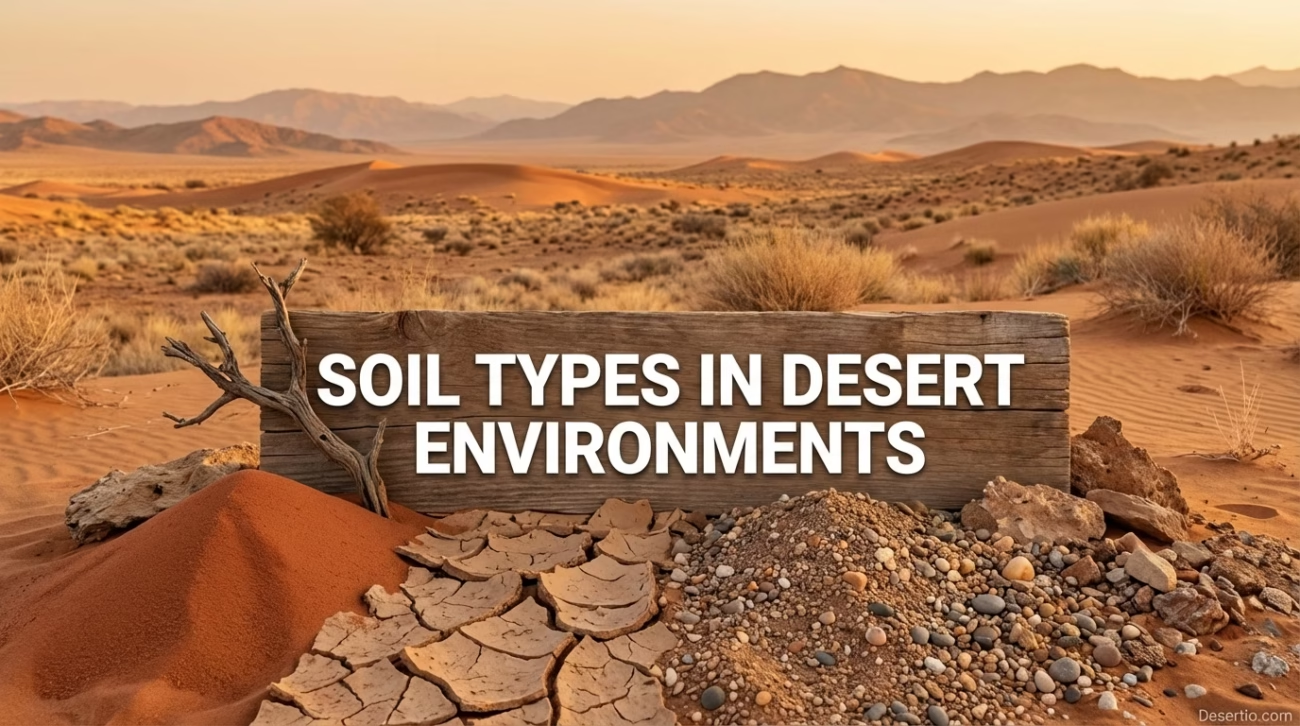
Desert soil isn’t a single “type” you can sum up in one sentence. It’s more like a patchwork-like quilt stitched from windblown sand, rocky fragments, and minerals that water would normally wash away—but in dry climates shaped by an arid desert climate, evaporation keeps many of those materials right where they land. That’s why soil types in desert environments can change dramatically over a short walk: a dune may feel like beach sand, a basin floor can be slick with clay, and a nearby terrace might hide a hard caliche layer under a thin surface skin.
- Desert Soils Are Built By Short Storms and Long Dry Spells
- What Makes Desert Soils Unique
- Main Soil Groups Across The World’s Deserts
- USDA Soil Taxonomy Lens
- WRB Lens
- Texture-Driven Soil Types You Can Feel
- Signature Desert Horizons and Layers
- How Desert Layers Build Over Time
- Carbonate-Rich Desert Soils
- Gypsum-Rich Desert Soils
- Common Forms
- Typical Settings
- Saline and Sodic Flats
- Biological Soil Crusts As The Living Skin
- Landforms That Create Soil Mosaics
- Wind-Built Settings
- Water-Built Settings
- Cold Desert Soils and Hot Desert Soils
- What Soil Type Means For Water, Roots, and Life
- How Desert Soils Are Commonly Measured
- Common Measurements and What They Reveal
Desert Soils Are Built By Short Storms and Long Dry Spells
In many deserts, moisture arrives in brief pulses, then vanishes fast. That rhythm shapes soil more than temperature alone, leaving behind mineral signatures like carbonates, gypsum, and salts that often accumulate instead of leaching away.
What Makes Desert Soils Unique
Most soils on Earth are shaped by regular downward water flow, which moves dissolved minerals deeper into the ground and slowly builds distinct layers. In deserts, that “downward conveyor belt” runs only occasionally. So you often see limited leaching, a thin surface layer with low organic matter, and a strong tendency toward mineral accumulation in the upper profile. The result is a soil that can look simple at first glance, then surprise you with a cemented layer or a hidden salt-rich zone.
- Evaporation-driven chemistry can concentrate carbonates, gypsum, or soluble salts near the surface.
- Slow horizon development is common where dust inputs and moisture are too limited to build thick, mature profiles.
- Surface armoring (gravel pavements, crusts) often protects the soil below and changes how water enters.
- Strong landscape control means landforms—dunes, fans, terraces, basins—matter as much as climate.
One quiet twist: deserts can host both “young” soils (fresh sands, recent flood deposits) and “old” surfaces where dust and minerals have been building for a very long time. That’s how you can get a thin top layer sitting over a hardpan-like horizon that feels like nature poured stone into the ground. Same desert, wildly different soil stories.
Main Soil Groups Across The World’s Deserts
Soil scientists use classification systems to describe desert soils consistently. Two of the most common lenses are USDA Soil Taxonomy and the World Reference Base (WRB). They don’t “compete” so much as spotlight different features—like moisture regimes, diagnostic horizons, and dominant materials. Seeing both helps the map make sense.
USDA Soil Taxonomy Lens
- Aridisols: defined by limited moisture for plant growth and commonly show accumulations like calcic, gypsic, salic, or duripan horizons.
- Entisols: very weakly developed soils—think dunes and fresh alluvium—where a strong B horizon often hasn’t formed.
- Inceptisols: slightly more developed profiles, sometimes appearing in desert margins, higher elevations, or places with a bit more reliable moisture.
WRB Lens
- Arenosols: sand-dominated soils common on dunes and sandy sheets, often with weak horizon contrast.
- Calcisols: soils with notable secondary carbonate accumulation, sometimes forming petrocalcic cementation.
- Gypsisols: soils enriched with gypsum, ranging from powdery accumulations to harder petrogypsic layers.
- Solonchaks: strongly saline soils typical of playas and closed basins where salts concentrate.
- Regosols and Fluvisols: weakly developed or floodplain-related soils that appear widely in desert valleys and fans.
Texture-Driven Soil Types You Can Feel
Desert soils are often described by texture because texture controls water entry, storage, and how quickly the surface crusts after rain. Texture is the “handshake test” of the desert: sand slips through fingers, silt feels like flour, clay gets sticky, and gravelly mixes crunch underfoot. In arid landscapes, those textures can sit side-by-side.
| Soil Feel | Where It Commonly Forms | Water Behavior | Signature Clues |
|---|---|---|---|
| Sandy (loose, gritty) | Dunes, sand sheets, some river terraces | Fast infiltration, low storage | Weak horizons, wind ripples, sparse fine particles |
| Loamy (crumbly mix) | Alluvial fans, valley floors, stable terraces | Balanced infiltration and storage | Subtle layers, occasional carbonate filaments or nodules |
| Clay-Rich (sticky when wet) | Basins, playas, interdune flats | Slow infiltration, high shrink–swell in some areas | Cracks, smooth surfaces, salt crusts in closed basins |
| Gravelly/Stony (coarse fragments) | Rocky uplands, desert pavements, old fan surfaces | Rapid runoff on the surface, patchy infiltration | Armored surface, thin fine-soil layer beneath stones |
Signature Desert Horizons and Layers
Desert profiles often look “simple” from the top, yet their most important features can hide just below the surface. Many arid soils have a thin A horizon, sometimes an Av (vesicular) horizon with tiny air bubbles formed by fine particles and repeated wetting–drying, then a zone where minerals build up. Those subsurface layers can control everything from infiltration to root depth. Desert soils love secrets.
Common Diagnostic Layers Seen In Desert Profiles
- Calcic horizon: secondary calcium carbonate accumulation, often as filaments, nodules, or coatings.
- Petrocalcic horizon: carbonate cemented enough to behave like a hard layer; caliche is a common field term.
- Gypsic horizon: visible gypsum crystals or powdery gypsum enrichment; can form a petrogypsic cemented layer in some settings.
- Salic horizon: accumulation of soluble salts, common in basin floors and some irrigated desert valleys.
- Duripan: silica-cemented layer; less common globally than carbonates, yet very influential where present.
- Argic/illuvial clay features: clay moved downward in the profile; in sandy deserts this can appear as thin lamellae.
How Desert Layers Build Over Time
- Dust and fine particles settle, forming a thin surface mantle over sand or gravel.
- Short rains wet the soil, then rapid drying pulls dissolved minerals upward by capillary action.
- Carbonate or gypsum begins to appear as threads, coatings, or tiny nodules.
- Repeated cycles thicken the accumulation zone, turning it into a recognizable diagnostic horizon.
- In stable landscapes, cementation can strengthen, forming petrocalcic or petrogypsic layers.
- Surface armoring (gravel pavements, crusts) can develop and persist, shaping how each new storm interacts with the soil.
Carbonate-Rich Desert Soils
Carbonate accumulation is one of the classic signatures of arid soil formation. When water is scarce, calcium carbonate is less likely to be flushed away, so it can build up into a calcic horizon. In older, stable landscapes, carbonate can cement the soil into a harder layer often called caliche. It’s like a slow-motion limestone maker, assembling mineral grains into a firmer fabric over long spans of time.
What carbonate can look like: white filaments on soil peds, pale nodules, coatings on gravel, or a continuous cemented zone. A gentle color shift toward lighter browns and off-whites can be a clue, especially when paired with hardness that increases with depth.
Gypsum-Rich Desert Soils
Gypsum is a different kind of desert “white.” It can appear as glittery crystals, powdery accumulations, or dense layers in soils shaped by evaporating groundwater or gypsum-bearing parent materials. In WRB terms, these are often Gypsisols; in Soil Taxonomy, gypsum-enriched horizons show up as gypsic or petrogypsic features. Gypsum can store water within its crystal structure, so gypsum-rich soils sometimes behave differently than purely salty soils.
Common Forms
- Powdery gypsum mixed through the profile
- Gypsum crystals lining pores or forming rosettes
- Cemented layers where gypsum binds grains together
Typical Settings
- Closed basins with evaporating groundwater
- Alluvial fans fed by gypsum-bearing rocks
- Arid plains where dust and salts accumulate over time
Saline and Sodic Flats
In many deserts, water flows inward toward basins and has nowhere else to go. When that water evaporates, it leaves behind soluble salts. Over time, basin floors and playas can develop salic horizons or strongly saline surface crusts. WRB often places these soils in Solonchaks when salinity dominates. The surface can look bright, sometimes with fine polygon patterns where drying and minor shrinking create a natural mosaic.
Lab language you may see: salinity is often summarized with electrical conductivity (EC), while sodicity is linked to sodium dominance and can be expressed with measures like SAR. These numbers help compare soils that look similar but behave very differently when wet.
Biological Soil Crusts As The Living Skin
Not all desert soil “types” are defined only by minerals. In many drylands, the top few millimeters can be a living community called biological soil crust (often shortened to biocrust). It’s built from cyanobacteria, lichens, mosses, fungi, and microscopic partners that bind particles into a stable surface. Think of it as nature’s thin protective fabric, holding loose grains in place while quietly supporting nutrient cycles.
In many deserts, the “soil surface” is also an ecosystem. Biocrusts can influence infiltration, reduce dust movement, and add small but meaningful pulses of carbon and nitrogen to nutrient-poor ground.
Landforms That Create Soil Mosaics
Deserts are famous for open space, yet their soils are often organized into tight patterns controlled by landforms. A dune field, an alluvial fan, and a basin floor may share the same climate, then produce totally different soils because they receive and store water differently, and because their parent materials don’t match. Landscape position is the hidden organizer. It decides where sediments collect and where minerals concentrate.
Wind-Built Settings
- Dunes: often Arenosols or sandy Entisols, typically low in organic matter and weakly layered.
- Sand sheets: broad sandy blankets where subtle carbonate or clay features can appear with stability.
- Dust mantles: fine sediments that can help form surface crusts and feed mineral horizons below.
Water-Built Settings
- Alluvial fans: mixtures of sand, silt, and gravel; carbonate and gypsum often accumulate in stable fan surfaces.
- Wadis and washes: younger deposits with weak horizons, shifting textures, and layered sediments.
- Playas: fine clays and salts, commonly forming saline soils in closed basins.
Cold Desert Soils and Hot Desert Soils
“Desert” describes low precipitation, not a single temperature range. Hot deserts often emphasize evaporation and strong salt and carbonate movement. Cold deserts add another ingredient: seasonal freezing and thawing that can shuffle grains, fracture rock, and change drainage pathways. In some cold settings, soils may fall into classes linked to permafrost (like Gelisols in Soil Taxonomy or Cryosols in WRB), while still showing familiar arid features such as carbonate or salt accumulation where water is limited.
What Soil Type Means For Water, Roots, and Life
Desert plants and microbes live by timing and efficiency, and soil type can tilt the odds. Sandy soils let water in fast, then let it go just as fast. Clay-rich basin soils can hold more water, yet it may be harder for it to enter quickly during short storms. Carbonate- or gypsum-cemented layers may redirect water sideways, creating hidden wet zones upslope and drier ground downslope. In deserts, water doesn’t just “soak in.” It negotiates.
- Sandy dune soils often favor deep-rooting strategies when vegetation is present, because moisture can move downward quickly.
- Fan and terrace soils with calcic layers can concentrate roots above or along cracks in cemented horizons.
- Biocrust-rich surfaces can stabilize soil and influence where seedlings establish by shaping micro-scale moisture patterns.
- Saline basin soils may limit which plant communities thrive, making chemistry as important as texture.
How Desert Soils Are Commonly Measured
Because desert soils can look deceptively uniform at the surface, measurements focus on what’s happening within the profile: texture, cementation, salts, and diagnostic horizons. A basic soil description often combines field observations with a few key lab tests. That mix keeps the story honest, balancing what you can see with what you can’t. In desert settings, chemistry is a co-author.
Common Measurements and What They Reveal
| Measurement | What It Tells You |
|---|---|
| Texture (sand–silt–clay) | Infiltration potential, water storage, surface crust tendency, and erosion behavior in wind and rain. |
| Carbonate content | Strength of calcification, presence of calcic or petrocalcic development, and buffering of soil pH. |
| Gypsum content | Degree of gypsification, which can shape structure and influence how water interacts with the profile. |
| Electrical conductivity (EC) | Overall salinity level; helpful for identifying strongly saline horizons in basins and some valleys. |
| pH | Chemical environment for nutrient availability; many arid soils are neutral to alkaline, though sandy and rocky settings can vary. |
| Horizon description | Where diagnostic layers sit, how thick they are, and whether cementation or clay movement is present. |
A practical detail: in deserts, a “thin” soil can still be information-rich. A few centimeters may contain a biocrust, an Av horizon, and the first signs of carbonate or gypsum. Small layers can carry big meaning.
