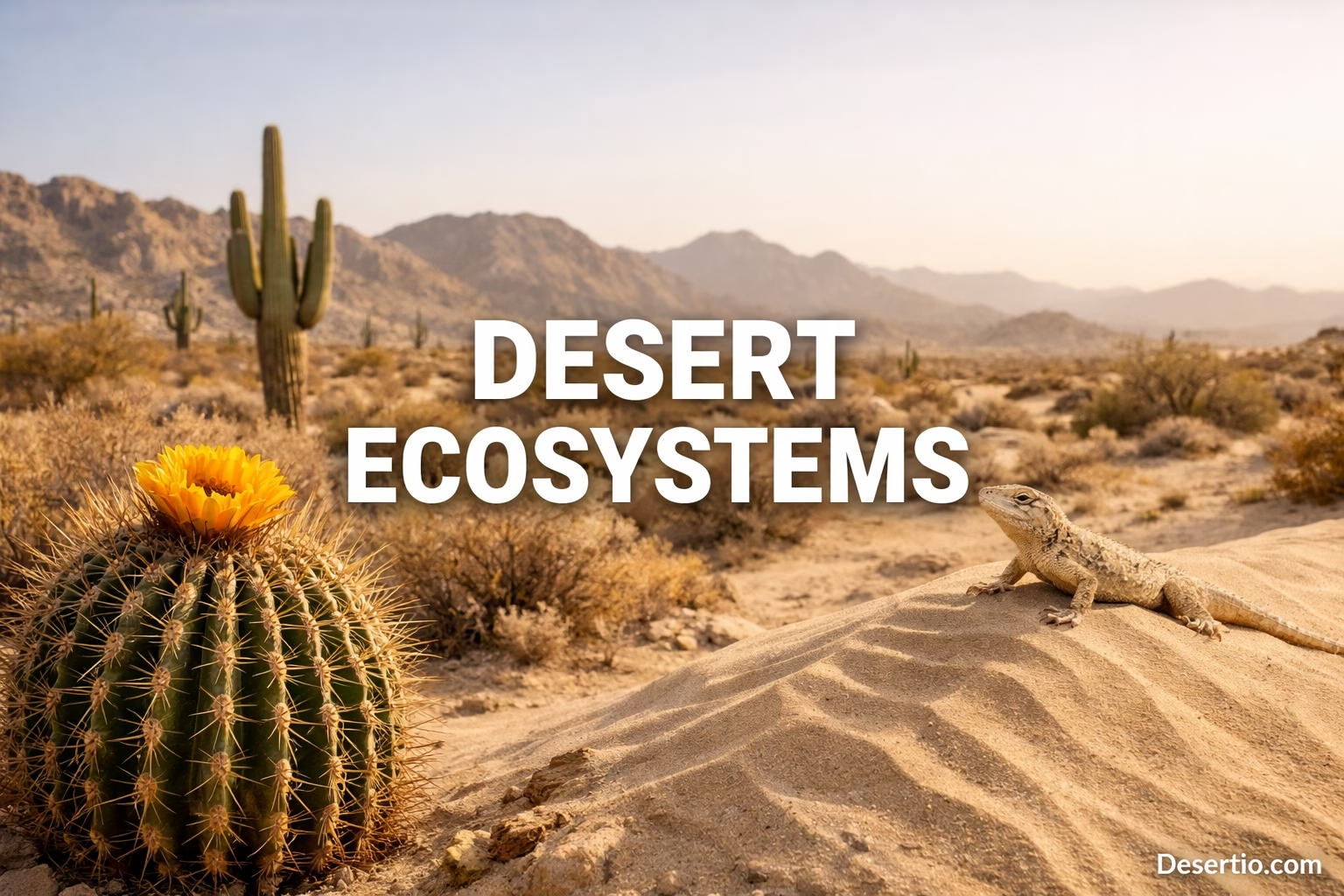
What Makes A Desert Ecosystem A Desert
Desserts aren’t defined by sand—they’re defined by water. A desert ecosystem is any place where precipitation is consistently scarce compared to how quickly moisture can evaporate or be used by life. That balance—low input, high demand—creates a landscape where every drop counts, every shadow matters, and survival depends on clever design rather than brute force, shaping the conditions that many desert animals and plants must adapt to.
- What Makes A Desert Ecosystem A Desert
- The Core Ingredients Of Desert Life
- Desert Ecosystem Types You’ll Actually Meet In The Real World
- Hot And Dry Deserts
- Cold Deserts
- Coastal Fog Deserts
- Polar Deserts
- How Water Moves Through A Desert Ecosystem
- The Desert Water Pulse In Plain Steps
- Microhabitats: Where Desert Biodiversity Hides
- Plants: Built For Thirst, Sun, And Patience
- Three Big Plant Strategies
- CAM Photosynthesis: A Night-Shift Trick
- Roots: The Underground Strategy Layer
- Animals: Timing Is Everything
- Behavioral Strategies
- Body-Level Adaptations
- Food Webs And Nutrient Cycling In Drylands
- Where Do Desert Nutrients Come From?
- Soils, Stones, And The Living Crust You Might Step Over
- Two Famous Desert Surface Features
- Oases, Dry Riverbeds, And Other Unexpected Wet Spots
- Common Desert Water-Linked Landforms
- Why Desert Ecosystems Matter Beyond Their Borders
- Misconceptions About Deserts
- Desert Ecosystem Vocabulary, Without The Jargon Overload
That’s why deserts can be hot, cold, rocky, gravelly, salty, foggy, or even icy. The common thread is aridity: the long-term shortage of available water. Think of a desert ecosystem like a tight-budget household—it can still run beautifully, but waste is not an option.
The Core Ingredients Of Desert Life
- Low And Unpredictable Moisture that arrives in short, intense pulses
- Big Temperature Swings across day and night, especially in inland deserts
- High Sunlight that fuels fast growth when water shows up
- Patchy Resources, creating “hotspots” of life around shade, rocks, and drainage lines
- Specialized Adaptations in plants, animals, and even microbes
Desert Ecosystem Types You’ll Actually Meet In The Real World
Deserts are often grouped by how they get dry, not just how they look. Some sit beneath persistent high-pressure air that discourages rain. Others lie in the “rain shadow” of mountains. Coastal deserts can be dry even with cool air—because fog doesn’t always turn into rainfall. Each type creates a different ecological playbook, with different winners and different survival tricks.
Hot And Dry Deserts
These are the classic “sun-and-silence” deserts. Days can be scorching, nights can cool fast, and water arrives as rare storms. You’ll often see open ground between plants, with life clustered around shade and roots.
- Key Pattern: brief rains, long dry stretches
- Signature Plants: succulents, thorny shrubs, deep-rooted trees
- Common Microhabitats: dunes, rocky slopes, dry washes
Cold Deserts
Cold deserts are proof that “desert” doesn’t mean “hot.” Winters can be freezing, and precipitation may fall as snow that doesn’t always soak into soil. Many cold deserts have hardy grasses, shrubs, and animals built for temperature extremes.
- Key Pattern: moisture locked up as snow or ice
- Signature Plants: sagebrush-type shrubs, drought-tolerant grasses
- Common Microhabitats: basins, steppe edges, rocky flats
Coastal Fog Deserts
Some coasts stay dry because cool ocean currents stabilize the air, limiting rain. Fog can become an ecological lifeline—condensing on leaves, stones, and spider webs like a slow-motion drip system. Life here often depends on capturing moisture from the air.
- Key Pattern: fog as “hidden precipitation”
- Signature Plants: fog-harvesting shrubs, lichens, hardy succulents
- Common Microhabitats: dunes, gravel plains, rocky coastal slopes
Polar Deserts
Yes—polar regions can be deserts because the air is so cold and dry that very little precipitation falls. Despite the chill, these systems still run on the same rule: water is limited. The biological community is often small, but remarkably resilient.
- Key Pattern: extremely low precipitation, low evaporation, limited liquid water
- Signature Life: mosses, lichens, cold-adapted microbes
- Common Microhabitats: rock surfaces, meltwater edges, sheltered hollows
How Water Moves Through A Desert Ecosystem
In deserts, rain is an event. When it happens, ecosystems respond fast—like a city waking up after a power outage. The key is that deserts run on pulses: short periods of abundance followed by longer periods of conservation. That rhythm shapes plants, animals, soils, and even the chemistry of rocks.
The Desert Water Pulse In Plain Steps
- Arrival: Rain or fog moisture shows up, often unevenly across the landscape.
- Infiltration: Water soaks in—unless crusts, compaction, or hard layers push it to run off.
- Runoff And Concentration: Dry channels and slopes funnel water to “gathering spots.”
- Fast Uptake: Seeds germinate, roots drink, microbes activate, and insects appear.
- Rapid Loss: Sun and wind pull moisture back into the atmosphere.
- Storage: Whatever remains gets banked underground, inside plant tissues, or in shaded micro-sites.
This pulse logic is why desert ecosystems can look quiet for weeks, then feel surprisingly busy overnight. The system isn’t asleep—it’s waiting efficiently.
Microhabitats: Where Desert Biodiversity Hides
Deserts are not uniform. They’re mosaics. A few centimeters of shade, a crack in a rock, or a slight dip in the ground can shift temperature and moisture enough to change what survives there. These small-scale differences build big ecological variety, and they explain why deserts can hold highly specialized species even when plant cover looks sparse.
| Microhabitat | What Creates It | Why It Matters | What You Often Find |
|---|---|---|---|
| North-Facing Slopes | Less direct sunlight | Cooler, slightly moister conditions | More shrubs, seasonal wildflowers, sheltering reptiles |
| Rock Crevices | Cracks and fractures | Shade and wind protection | Lichens, insects, small mammals, nesting sites |
| Dry Washes | Storm runoff channels | Water concentrates after rain | Deeper-rooted plants, richer soils, temporary blooms |
| Under-Plant “Islands” | Leaf litter and trapped dust | Nutrients accumulate in patches | Microbes, seedlings, decomposers |
| Salt Flats And Playas | Evaporation leaves salts behind | Only salt-tolerant life thrives | Halophytes, brine-adapted microbes, shorebirds in wet phases |
Plants: Built For Thirst, Sun, And Patience
Desert plants don’t “fight” dryness—they sidestep it. Some store water like living canteens. Others avoid losing it in the first place. Many simply wait as seeds until conditions are perfect, then sprint through a life cycle in days. It’s a botanical toolbox packed with smart trade-offs and beautiful efficiency.
Three Big Plant Strategies
- Store Water: Succulents keep moisture in thick stems or leaves, often protected by waxy surfaces.
- Save Water: Small leaves, spines, hairs, and reflective coatings reduce evaporation.
- Escape Dryness: Annual plants lie low as seeds, then burst into growth right after rain.
CAM Photosynthesis: A Night-Shift Trick
Some desert plants use CAM photosynthesis, a strategy that opens leaf pores mostly at night. Cooler air means less water loss. During the day, the plant uses stored carbon to make sugars while keeping pores more closed. It’s like doing errands at midnight to avoid the daytime crowd—same goal, lower cost.
Roots: The Underground Strategy Layer
Root systems in desert ecosystems are often extreme in one of two directions: wide and shallow to grab brief surface moisture, or deep and persistent to reach stored groundwater. Some species combine both. Either way, the logic stays consistent: capture water quickly and hold onto it longer.
Animals: Timing Is Everything
Desert animals often solve the water problem by solving the heat problem first. If you can avoid overheating, you can reduce water loss. Many species become active at dawn, dusk, or night. Others live in burrows where temperatures stay steadier. The result is a community that feels quiet at noon, then suddenly comes alive under a cooler sky.
Behavioral Strategies
- Nocturnal Activity to avoid daytime heat
- Burrowing for stable temperatures and humidity
- Shade Tracking by moving with shadows
- Seasonal Dormancy during the driest periods
Body-Level Adaptations
- Efficient Kidneys that conserve water
- Light-Colored Coats that reflect sunlight
- Specialized Feet for sand, rock, or heat
- Water From Food via seeds, insects, and succulent tissues
A subtle detail: many desert animals don’t need to “find” water the way humans do. They often rely on metabolic water—moisture produced inside the body when nutrients are broken down. It’s not magic, just tight chemistry paired with careful energy use.
Food Webs And Nutrient Cycling In Drylands
Desert food webs are shaped by two big constraints: water and timing. Primary production (plant growth) surges after rain. Then it slows. Herbivores and predators track those changes. Decomposers—bacteria, fungi, and tiny invertebrates—often wait for moisture pulses to break down litter and release nutrients. It’s a system that runs like a seasonal engine, not a constant one.
Desert ecosystems aren’t empty. They’re selective: only the most efficient strategies get a long-term membership card.
Where Do Desert Nutrients Come From?
- Wind-Blown Dust that delivers minerals and fine particles
- Weathering of rocks, slowly releasing nutrients over time
- Plant “Islands” that trap leaf litter and build richer soil patches
- Animal Activity such as burrowing, droppings, and seed caching
Soils, Stones, And The Living Crust You Might Step Over
Look closely at desert ground and you may see a dark, bumpy layer that feels almost like a thin carpet. That can be biological soil crust—a community of cyanobacteria, lichens, mosses, and fungi that binds soil together. It’s small-scale life with big impact: it can reduce erosion, influence how water infiltrates, and even help add nutrients in some settings. In ecological terms, it’s a living skin that helps deserts hold their shape.
Two Famous Desert Surface Features
- Desert Pavement: a surface layer of tightly packed stones that can form over time as wind removes fine particles and stones settle.
- Desert Varnish: thin, dark coatings on rocks created through long-term interactions among minerals, moisture, and microbes.
These features remind you that desert landscapes aren’t “unfinished.” Many are highly mature systems, shaped patiently by wind, rare water, and slow chemistry—like a sculpture made with time instead of tools.
Oases, Dry Riverbeds, And Other Unexpected Wet Spots
Even the driest deserts have places where water gathers or lingers. These pockets can act as biodiversity magnets, concentrating plants and animals in a way that changes the entire local food web. The landscape becomes a map of hidden opportunities—some obvious, some only visible after rain.
Common Desert Water-Linked Landforms
- Wadis And Arroyos: dry channels that flow briefly after storms, moving water and nutrients.
- Playas: flat basins where water can collect temporarily, often leaving salt as it evaporates.
- Oases: areas supported by groundwater or springs, often with denser vegetation.
- Rock Pools: small basins in stone that hold short-lived water after rain.
Why Desert Ecosystems Matter Beyond Their Borders
Deserts influence the planet in ways that don’t always look dramatic at first glance. They shape atmospheric dust cycles, host uniquely adapted life, and preserve landscapes and soils that reveal long environmental histories. For science and education, deserts are like open-air laboratories—clean lines, clear signals, and a lot of cause-and-effect.
- Unique biodiversity, with plants and animals found nowhere else
- Records of past climates preserved in rocks, dunes, and sediments
- Nutrient and dust transport that can enrich distant ecosystems
- Adaptations to extreme conditions that inform research in biology, engineering, and materials science
Misconceptions About Deserts
“All Deserts Are Hot And Sandy.”
Many deserts are rocky, gravelly, or cold. Sand dunes are iconic, but they’re only one possible surface type. The real defining feature is low available moisture.
“Deserts Have Very Little Life.”
Deserts can support rich ecological networks, especially when you look at microhabitats and the night-time community. Life is often less visible, not less present. Watch the ground after rain and you’ll see how quickly dormant systems switch on.
“Nothing Changes In A Desert.”
Deserts change constantly—just on rhythms that can be easy to miss. Wind reshapes surfaces, plants and animals track water pulses, and soils develop patterns over time. It’s more like slow choreography than stillness, with burst moments when conditions align.
Desert Ecosystem Vocabulary, Without The Jargon Overload
| Term | Meaning In Simple Words |
|---|---|
| Aridity | Long-term dryness driven by low moisture input and high evaporation demand |
| Xerophyte | A plant adapted to dry conditions |
| Ephemeral Plant | A plant that grows fast after rain, then completes its life cycle quickly |
| Rain Shadow | A dry zone that forms downwind of mountains where moist air drops rain on the windward side |
| Biological Soil Crust | A living surface layer of microbes, lichens, and mosses that stabilizes soil |
| Oasis | A spot where groundwater or springs support denser life in an otherwise dry region |
Once you start noticing these patterns—pulses of water, patches of fertility, and microclimates—desert ecosystems stop looking empty. They start looking intentional.
