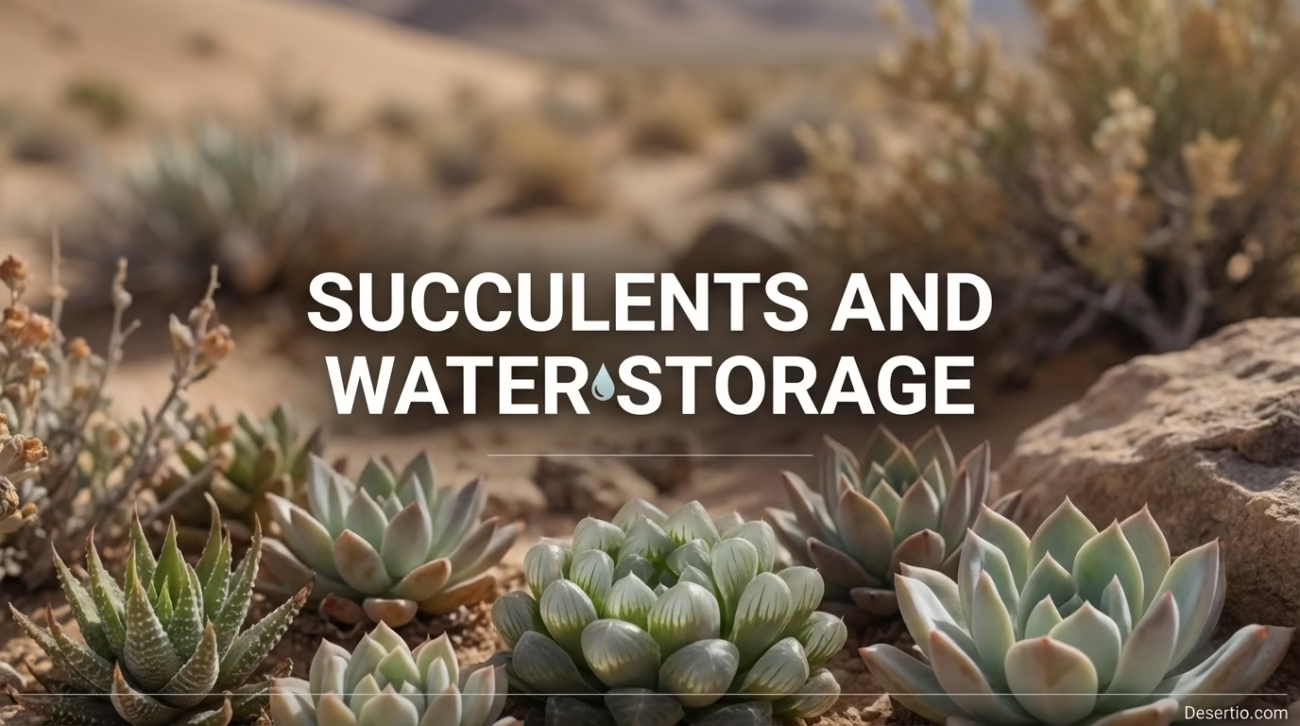
Succulence is nature’s version of a reusable water bottle—except it’s alive, green, and unbelievably good at budgeting moisture. In drylands where rain arrives like a surprise guest, a succulent’s job is simple: catch water fast, stash it safely, and spend it slowly. That “stash” isn’t a single tank. It’s a whole toolkit of tissues, coatings, and timing tricks working together like a well-run desert pantry that supports many forms of desert wildlife and plant life.
- What “Water Storage” Really Means in a Succulent
- Where the Water Lives
- Leaves
- Stems
- Roots and Caudex
- Hidden Storage Inside Cells
- How a Succulent Holds Water Without “Bursting”
- The Skin That Keeps the Savings Inside
- Common “Water-Saver” Features
- What You Might Notice Outdoors
- CAM Photosynthesis: Nighttime Breathing, Daytime Work
- Water Storage Changes the Way a Succulent Feels Heat
- Not All Succulents Store Water the Same Way
- Common Signals a Plant Is Using Succulence
- Everyday Questions About Succulents and Water Storage
What “Water Storage” Really Means in a Succulent
When people say a succulent “stores water,” they usually picture thick leaves and call it a day. The reality is more interesting. Storage means extra space inside cells, flexible cell walls that can shrink and re-inflate, and a chemistry setup that keeps water from “leaking” out too easily. Many succulents pack oversized vacuoles (think: expandable inner sacks) and water-friendly gels called mucilage that help hold moisture in place.
And here’s a key detail: storing water only works if the plant also reduces water loss. That’s why succulents are famous for waxy skins, fewer open pores, and slower growth. Water storage and water saving are a matched set—like a canteen and a tight lid.
Where the Water Lives
Leaves
Leaf succulents turn leaves into hydration bricks. Thick leaf blades are filled with water-storing cells (often called hydrenchyma) that swell after a rare soak. A tighter outer skin and a shiny cuticle help keep that water inside, while the interior stays juicy and calm. You’ll see this style in many rosette-formers and aloes, where fleshy leaves do most of the heavy lifting.
Stems
Stem succulents move the “tank” into the body. Their stems are built with layers of water-storing tissue, and many reduce leaves to tiny scales or skip them entirely. This cuts surface area and evaporation. In some groups, stems also take on more of the green work of photosynthesis, keeping things efficient. A thick stem is basically a living canteen wrapped in protective skin, often tinted by sun-filtering pigments.
Roots and Caudex
Some succulents store water below ground, especially in swollen roots or a thickened base called a caudex. This strategy keeps reserves away from heat and drying winds. It’s common in plants from seasonal drylands, where rain comes in bursts and then disappears for long stretches. The caudex works like a water-and-energy vault, and the plant can regrow leaves quickly when conditions improve.
Hidden Storage Inside Cells
Even when a succulent doesn’t look “plump,” its cells can still be tuned for water retention. Larger vacuoles, gel-like mucilage, and dissolved compounds that adjust internal water balance (often called osmolytes) help keep water where it belongs. It’s subtle engineering—less “big tank,” more smart plumbing.
| Storage Style | Main Reservoir | What You Usually Notice | Common Examples |
|---|---|---|---|
| Leaf Succulents | Fleshy leaves with large vacuoles | Plump leaves, rosettes, thick blades | Aloe, Echeveria, Sedum |
| Stem Succulents | Swollen stems with water-storing tissue | Chunky stems, reduced leaves | Many cacti, Euphorbia (succulent species) |
| Caudiciforms | Thickened base or roots (caudex) | Bulb-like base, seasonal leaf flush | Adenium, Pachypodium |
| Mixed Strategy | Leaves + stems + roots share the job | Moderate thickness across the plant | Agave, Kalanchoe |
How a Succulent Holds Water Without “Bursting”
A big gulp of water can be risky. Cells that swell too fast may rupture, and tissues that expand unevenly can tear. Succulents handle this with elastic cell walls and careful internal structure. Many have a supportive outer layer that acts like a flexible jacket, while inner tissues act like a sponge. When water is plentiful, the plant fills up. When it’s dry, it deflates a bit—without falling apart. That gentle in-and-out rhythm is part of the survival design.
- Expandable cells that swell and shrink without cracking
- Dense, water-friendly tissues (often called storage parenchyma) that hold moisture efficiently
- Protective outer layers that limit damage during drying cycles
- Internal compartmentalization so one section can store while another handles photosynthesis
The Skin That Keeps the Savings Inside
Storage is half the story. The other half is not wasting it. A succulent’s outer surface is often a high-performance barrier: thick cuticle, wax layers, and sometimes a powdery bloom that reflects sunlight. Many also place stomata (tiny pores) in ways that reduce evaporation—fewer stomata, sunken stomata, or stomata protected by hairs. The result is a surface that acts like weatherproof clothing for plant tissue, with water loss kept on a tight leash.
Common “Water-Saver” Features
- Thick cuticle that slows evaporation
- Waxy surface that sheds water and reduces heat load
- Reduced leaf area (or leaves absent) in stem succulents
- Compact shapes that reduce exposed surface area
What You Might Notice Outdoors
- Blue-gray or green coatings that look “dusty” but protect the plant
- Ribs or folds that allow swelling after rain
- Thickened edges and rounded forms that resist drying winds
- Slow, steady growth that matches limited water budgets
CAM Photosynthesis: Nighttime Breathing, Daytime Work
Many iconic succulents use a clever schedule called CAM photosynthesis (Crassulacean Acid Metabolism). Instead of opening stomata during the hot day, they often open them at night, when air is cooler and humidity is higher. They take in carbon dioxide then, store it in a usable form, and run most of their sugar-making chemistry during daylight with stomata mostly closed. It’s like shopping for groceries at midnight to avoid the crowds—except the “crowd” is evaporation.
- Night: stomata open, carbon dioxide enters with less water loss
- Storage: carbon is held inside cells for later use
- Day: stomata stay mostly closed while photosynthesis runs using stored carbon
Succulence is not just “holding water.” It’s a full strategy: store moisture, lock it in, and time gas exchange to lose as little as possible.
Water Storage Changes the Way a Succulent Feels Heat
Water is a temperature buffer. A plant with well-hydrated tissues can warm and cool more slowly, which helps in places where afternoons bake and nights cool quickly. Some succulents also use light-reflecting surfaces and protective pigments to manage solar load. When you see a bluish coating, a silvery sheen, or a deep green body, you’re often looking at heat management as much as water storage. In many dry regions—rocky deserts, coastal fog zones, and sun-blasted plateaus—this balance is what keeps tissues stable and functional, with photosynthesis still ticking along.
Not All Succulents Store Water the Same Way
“Succulent” is a description, not a single family tree. Many unrelated plant groups evolved succulence because dry conditions reward water-storing anatomy. Some species are extreme specialists, built for long drought. Others are moderate, storing enough to bridge short dry spells. That’s why you’ll find succulents in a wide range of habitats—hot deserts, seasonally dry shrublands, high-elevation rocky slopes, and even places where fog provides moisture but rain is rare. Same challenge, different solutions, all anchored by water storage.
Common Signals a Plant Is Using Succulence
- Thickened leaves, stems, or base that visibly swell after watering
- Firm, rubbery texture rather than thin and papery tissue
- Ribs, folds, or tubercles that allow expansion without tearing
- A slow-and-steady growth rhythm tuned to limited moisture
Everyday Questions About Succulents and Water Storage
Do Succulents “Hold” Water in a Single Pocket?
No single pocket. Most of the reserve sits in many enlarged cells, especially in storage tissues. Think of it as a sponge made of thousands of tiny balloons rather than one big tank. Those balloons (cells) can swell and shrink safely, and mucilage helps keep water available inside the tissue when conditions get dry.
Why Do Some Succulents Look Wrinkled During Drought?
Wrinkling is often a visible sign that stored water is being used. As cells lose water, tissues gently contract. Many species are built to do this without damage because their outer structure and internal fibers support controlled shrinking. It’s a practical design: use the savings when needed, then refill when moisture returns, with minimal stress.
Is CAM Photosynthesis the Same as “Storing Water”?
Different, but connected. CAM is mainly about when stomata open to reduce water loss during gas exchange. Water storage is about keeping a reserve in tissues. Put together, they’re a powerful duo: stored water supports survival, and CAM helps the plant avoid wasting it. That’s why CAM is common in many classic succulents, with nighttime breathing and daytime efficiency.
