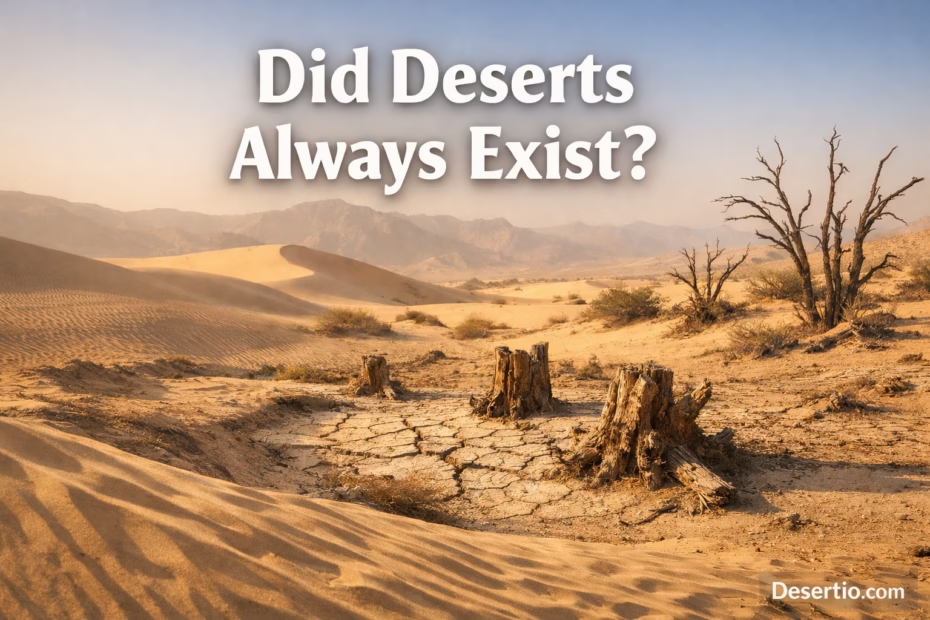
Ask if deserts always existed and you’ll get a fun surprise: a desert is less a “place” and more a pattern. Earth keeps remixing wind, water, and rock like a slow DJ, and dryness can land almost anywhere when the setup is right. Some deserts are ancient, some are young, and many are basically Earth’s “weather mood” frozen into a landscape for a while.
- What Counts As a Desert, Really?
- Deserts as a Moving Target
- How Far Back Can We Trace Desert-Like Conditions?
- Why Deserts Form in the First Place
- 1) Global Wind Belts
- 2) Mountains and Rain Shadows
- 3) Cold Ocean Currents
- 4) Distance From Moisture Sources
- Ancient Deserts vs. Modern Deserts
- Did Deserts Exist on Early Earth?
- How Scientists Reconstruct Desert History
- Fast Answers to Common Desert-Time Questions
- So, Did Deserts Always Exist?
What Counts As a Desert, Really?
A desert isn’t defined by sand. It’s defined by water scarcity—specifically, how little precipitation arrives compared to how fast moisture can leave. That’s why you can have sand seas, rocky badlands, and even icy deserts that look nothing like the classic postcard dunes.
- Hot subtropical deserts (high-pressure belts) often sit under sinking, drying air; think wide dune fields and big temperature swings.
- Coastal fog deserts (cold currents) can be bone-dry yet regularly wrapped in mist, feeding life with droplets instead of rain.
- Rain-shadow deserts (mountains in the way) form where air drops its moisture on one side and arrives dry on the other.
- Cold deserts (low moisture, low evaporation) can be polar or high-altitude, where snow is scarce and air is naturally dry.
So when we ask “Did deserts always exist?” we’re really asking whether persistent aridity and desert-making systems have been around long enough to build desert landscapes over Earth’s deep history.
Deserts as a Moving Target
Earth isn’t a static stage. Continents drift, oceans open and close, mountains rise, and wind belts shift. That means desert zones can migrate over time, and a spot that’s wet in one era can become dry in another. The landscape remembers, though—like a notebook full of old sketches under the newest drawing.
Even today, deserts show how flexible the system is. Some are ruled by wind and dust, others by rare but dramatic flash floods. A desert can be quiet for months, then suddenly shaped in a single storm that carves channels like quick brushstrokes.
How Far Back Can We Trace Desert-Like Conditions?
To spot ancient deserts, geologists don’t need a time machine. They look for desert fingerprints in rocks: wind-blown sand layers, dune cross-beds, salt minerals, and surfaces cracked by drying mud. These clues show that arid environments have appeared many times across deep time, especially once large continents existed to create big interior dry zones.
That said, “desert-like” doesn’t always mean “a modern desert.” Ancient drylands could be smaller, patchier, or shaped by different atmospheric rules. Earth’s air chemistry, ocean circulation, and continent positions have all changed, which tweaks how aridity shows up. Still, the core idea—not enough water arriving—is timeless, and it shows up again and again in the rock record.
| Clue in the Rocks | What It Often Points To | What It Looks Like Up Close |
|---|---|---|
| Cross-bedded sandstone | Wind-built dunes (ancient ergs) | Slanted layers that stack like tilted pages |
| Evaporite minerals | Strong evaporation in closed basins | Salt crystals, gypsum, and chalky deposits |
| Desert pavement surfaces | Long-term wind deflation | Interlocked stones with finer grains removed |
| Caliche / hardpan layers | Soils forming in dry climates | White to tan crusts, often rich in carbonates |
| Ancient lake beds nearby | Wet-dry swings within a dry region | Fine layers with shoreline markers and mud cracks |
These features tell a clear story: Earth has hosted deserts and semi-arid belts for a very long time, though not always in the same locations—or with the same “feel” as the deserts we know now.
Why Deserts Form in the First Place
Deserts don’t need a single cause. They’re usually born when a few drying forces team up—like multiple locks clicking at once. You’ll often see atmospheric patterns, geography, and ocean influence working together, sometimes for thousands of years, sometimes for millions.
1) Global Wind Belts
Near certain latitudes, air tends to sink, warm up, and dry out. That sinking air acts like a giant lid on clouds. When this pattern is steady, subtropical deserts can thrive, building dunes and spreading drylands outward.
2) Mountains and Rain Shadows
Mountains can squeeze moisture out of incoming air, leaving the downwind side parched. It’s like wringing out a sponge before passing it along. The result is a rain-shadow desert where clear skies are common and plants learn to be thrifty.
3) Cold Ocean Currents
Cold water cools the air above it, which can reduce rain even when humidity exists. That’s how some coasts become foggy yet rain-starved, with mist feeding life more than storms do. These places can look gentle, then surprise you with how dry they really are.
4) Distance From Moisture Sources
When a region sits deep inside a continent, storms can run out of moisture before they arrive. That’s the classic setup for continental interiors: long skies, big horizons, and dry winds that reshape the ground grain by grain.
Now add slower “dials” like orbital cycles, shifting sea levels, and changing vegetation cover, and you get deserts that can expand, shrink, or even flip into grassland for a while—then swing back again. Earth’s climate has a memory, but it also has a sense of improv.
A desert is not just a place without water. It’s a conversation between air, rock, and time.
Ancient Deserts vs. Modern Deserts
Here’s the tricky part: the age of a desert and the age of its sand are not the same thing. Sand grains can be older than the desert, younger than the dunes, or recycled from far away. Winds can transport material, rivers can dump it, and later a dry phase can sculpt it into fresh dunes. So a region can have a long arid history while its surface sands are constantly getting “refreshed.”
Think of dunes like a moving crowd: the group exists, but the individual people inside it shift all the time. That’s why you might see a very old desert basin with young dune ridges on top. It’s also why desert landscapes can feel timeless even though they’re always in motion—sometimes slowly, sometimes in bursts after a storm.
Did Deserts Exist on Early Earth?
Early Earth had different rules: different ocean layouts, different atmosphere chemistry, and very different land distribution. But once large landmasses existed and the planet’s climate system had room to create strong wet-to-dry contrasts, arid regions became possible. Dry zones don’t require modern ecosystems; they require limited moisture delivery and enough time for wind and evaporation to leave their mark. In other words: deserts don’t need sand dunes first—those are a style choice the planet adds when conditions fit.
One more twist: “desert” can show up as a seasonal or episodic state, not only as a permanent biome. A place can swing between wetter and drier phases, leaving layered evidence of both. That back-and-forth is a big reason why desert history is so fascinating. It’s not linear. It’s rhythmic—and sometimes teh rhythm changes mid-song.
How Scientists Reconstruct Desert History
To figure out when a region turned dry, researchers use multiple “memory sticks” stored in nature. No single clue tells the whole story, so they compare signals from soils, lakes, dunes, caves, and ocean sediments. It’s like building a playlist from different speakers, each carrying part of the climate beat.
- Lake and river sediments can show wet periods inside today’s drylands, often marked by fine layers and shorelines.
- Dune fields and dust layers reveal when wind activity ramped up and surfaces became exposed.
- Soil carbonates (hard layers) can hint at long dry intervals, where water rarely soaks deep.
- Cave deposits can preserve dripwater chemistry linked to rainfall patterns, offering a timeline of wet and dry.
If you’re reading desert landscapes for your own curiosity, you can do a mini version of this: look for old shorelines etched into hills, salt flats in closed basins, and wind-sculpted surfaces that hint at long exposure.
Fast Answers to Common Desert-Time Questions
Are deserts “natural,” or do they need a trigger?
Most deserts are driven by natural climate mechanics—wind belts, ocean currents, mountains, and distance from moisture. Some areas can also become more arid when vegetation thins and soils lose moisture faster, but the big desert-making engine is still the planet’s circulation.
Can deserts “move” over time?
Yes, and in two ways. The desert zone can shift as climates and wind belts move, and within a desert, dunes can migrate like slow waves. The landscape looks still, yet it’s constantly rearranging.
Why do some deserts have almost no sand?
Sand needs a supply and the right winds to pile it up. Some deserts are dominated by bedrock, gravel plains, or hard crusts where fine grains have been removed. “Desert” is about dryness, not a specific texture.
Could a desert exist without any dunes at all?
Absolutely. A desert can be a salt pan, a rocky plateau, or a cold, wind-swept plain. Dunes are just one expression of arid conditions when loose sediment is available and winds are consistent.
So, Did Deserts Always Exist?
In a broad sense, Earth has hosted desert-like conditions for a very long time—once there were big land areas and the climate system could create strong wet-to-dry contrasts. But the deserts we name on maps today are not eternal fixtures. Specific deserts can be reborn, reshaped, or replaced as winds shift, oceans change, and mountains rise. The planet keeps reassigning where dryness lives, like moving the spotlight across a stage.
If you want the simplest mental image, try this: deserts are chapters in Earth’s climate story, not the whole book. Some chapters are long, some are short, and the plot has plenty of twists—yet the theme of aridity shows up again and again, written in sand, stone, and sky.