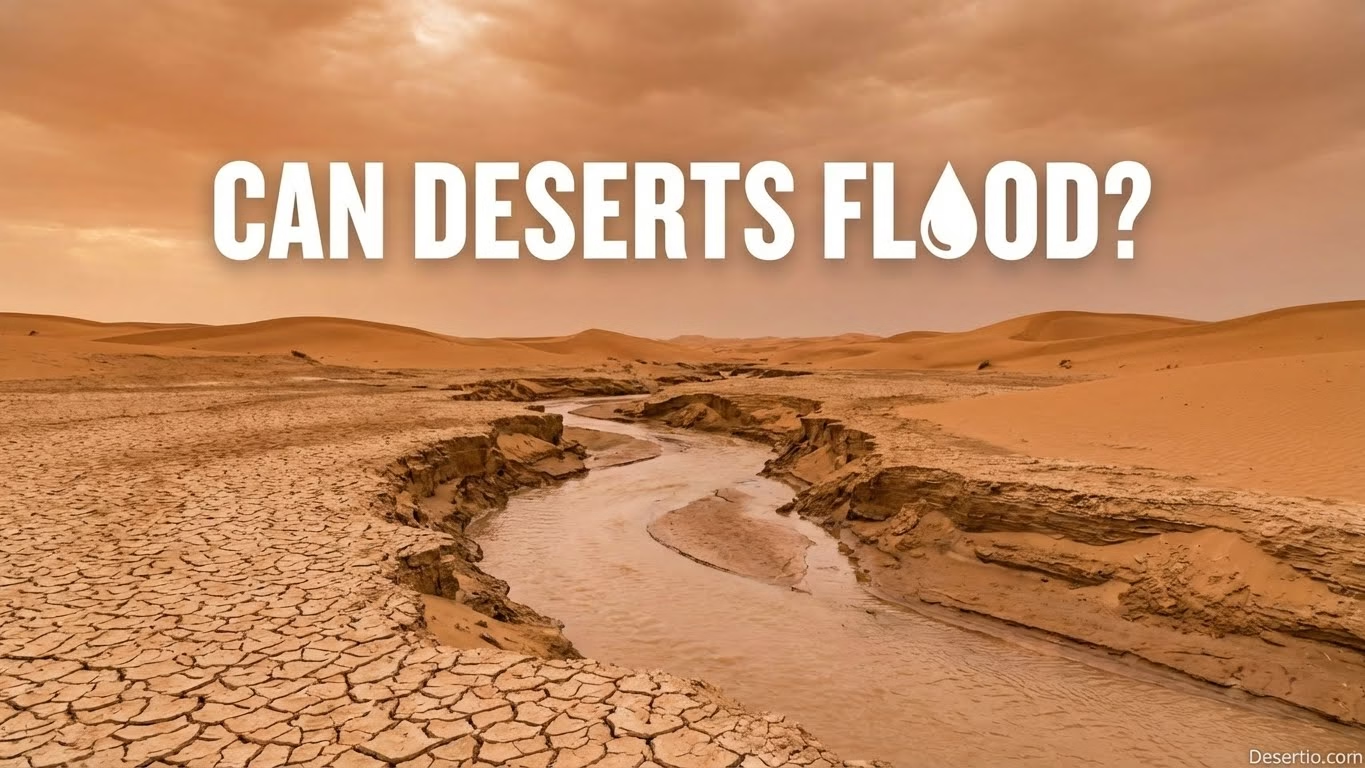
Yes—a desert can absolutely flood. It sounds like a joke until you see a bone-dry channel turn into a moving ribbon of water. The trick is that many dry landscapes behave like a hard roof when rain hits: water can’t sink in fast, so it runs, gathers, and suddenly you’ve got a flash flood.
- Why Dry Ground Can Produce So Much Water
- Rain Can Be Small Yet Intense
- Water Can Arrive From Elsewhere
- What A Desert Flood Looks Like In Real Life
- Where The Water Goes Afterward
- Landforms That Hint Flooding Is Normal
- Common Desert Flood Settings
- Simple Flood Mechanics Without The Headache
- When Are Deserts Most Likely To Flood?
- Fast Clues You Can Use
- Do Sand Dunes Flood Too?
- Why Floods In Deserts Feel “Extra Fast”
- Practical Tips For Travelers And Outdoor Plans
- Mini Checklist: Read The Ground Like A Map
- Questions People Ask About Desert Flooding
Quick Reality Check: A desert flood doesn’t need hours of rain. A short, intense storm can dump water faster than soil infiltration can keep up. Add smooth rock, crusted ground, and long slopes, and runoff becomes the main character.
- Can deserts flood? Yes, often as flash floods.
- Does it need to rain where you stand? No. Water can arrive from distant hills through a dry wash.
- Is it rare? It’s occasionally rare in some places, seasonal in others, and always worth respecting.
Why Dry Ground Can Produce So Much Water
Deserts are often low on plants, and that matters. Dense vegetation slows water down, but in many arid areas there’s less to “grab” the rain. So droplets hit bare ground and quickly become surface runoff. Pair that with tight soils and hardpan layers, and the land acts like a tilted plate: water slides instead of soaking. That’s how desert flooding can feel sudden and surprisingly powerful.
Another sneaky detail: desert soils often form thin crusts. Some crusts are natural, some are shaped by repeated drying and tiny particles settling into a “seal.” When rain falls hard, the seal can reduce infiltration even more. So a short storm can create a fast sheet of runoff that funnels into channels like arroyos, washes, and wadis—basically temporary rivers waiting for their cue.
Rain Can Be Small Yet Intense
A desert may get little rain overall, yet still receive burst storms that are wildly efficient at making floodwater. Think of it like this: a drizzle is a slow drip into a sponge. A downpour is a bucket thrown onto tile. In many arid landscapes, the downpour wins, and flash flooding becomes the headline.
Water Can Arrive From Elsewhere
Desert drainage can be a long game. Rain falls on higher ground, then travels through dry channels that look harmless most days. You might stand under blue sky while a flood pulse rolls in from upstream. That’s classic wash flooding: quiet, then whoosh.
What A Desert Flood Looks Like In Real Life
Not all desert floods are the same. Sometimes water spreads as a thin “sheet” across firm ground—sheet flow—before it collects. Other times it rockets down a narrow channel as a classic flash flood. In steep terrain, you can even get debris-rich flow where water carries sand and gravel like a moving conveyor belt. Either way, the main pattern is simple: fast gathering, quick movement, and short duration.
A desert wash is a hallway. When rain opens the door upstream, water rushes through that hallway whether you invited it or not.
One reason desert flooding surprises people is the “dry look.” A channel can be dusty, cracked, even dotted with stones that feel permanently parked. Then water arrives and instantly redraws the scene—cutting fresh lines, piling sediment, leaving drift marks. Those fresh marks are like a signature saying “water was here”, even if the flood lasted less than an hour.
Where The Water Goes Afterward
In many deserts, floodwater disappears almost as quickly as it arrives. Part of it evaporates under dry air and sun. Part of it soaks into coarse sediment along channels, helping groundwater recharge when conditions line up. And in closed basins, water may pool into a temporary lake on a flat surface called a playa, then shrink day by day like a puddle on a warm sidewalk—just bigger, quieter, and ephemeral.
That “disappearing act” is why deserts can hold both truths at once: they’re dry, and they can still flood. The flood is the sprint; the dryness is the marathon. Floodwater also moves nutrients and seeds, briefly waking up plants and insects in a way that feels like the landscape took a deep breath. It’s short-lived, but it’s not pointless.
Landforms That Hint Flooding Is Normal
If you want proof without waiting for rain, look at the shape of the land. Alluvial fans—those broad, gently sloping aprons of gravel at the base of hills—often form from repeated bursts of flowing water and sediment. Washes and arroyos with clean banks show where moving water has carved and re-carved paths. Even the smooth, rounded stones you sometimes see in dry channels are a quiet clue: they were tumbled by water energy, not by wind alone, and that’s flood history written in rock.
In narrow canyons and slots, flooding is especially efficient. Tight walls focus water like a nozzle on a hose. A small volume can become a concentrated, fast-moving stream. That’s why “dry canyon” doesn’t mean “safe canyon.” It means the system is on standby, waiting for the next storm pulse.
Common Desert Flood Settings
| Setting | What It Looks Like | Why It Floods | What You Might Notice After |
|---|---|---|---|
| Dry Wash | Flat sandy or pebbly channel | Runoff funnels into a single path; low infiltration during intense rain | Fresh ripples, drift lines, rearranged stones |
| Alluvial Fan | Wide gravel slope at hill base | Many small flows spread and merge; sediment moves easily | New shallow channels, small gravel ridges, fans of sand |
| Playas And Basins | Very flat, often hard-packed ground | Water collects where it can’t drain outward | Temporary pooling, thin mud crusts, salt patterns |
| Narrow Canyons | Steep walls, limited escape routes | Flow concentrates; water speeds up | Scoured floors, moved debris, clean “high-water” marks |
Simple Flood Mechanics Without The Headache
Desert flooding is mostly about timing and intensity. If rainfall arrives faster than the ground can absorb it, the extra water becomes runoff. That runoff collects in tiny grooves, then small channels, then larger washes—like a neighborhood of small streets feeding into a highway. Add steep slopes and smooth rock, and water accelerates. It’s physics with a desert accent: fast input, fast response.
There’s also the “first-flush” effect. After long dry spells, dust and fine particles can sit on the surface. The first heavy rain can push that material into flow, making water appear cloudy or muddy. That’s normal for arid floods and doesn’t automatically mean anything is “wrong.” It just means the flood is carrying the landscape’s loose layer downstream—like sweeping a floor with a wet broom, messy but expected.
When Are Deserts Most Likely To Flood?
It depends on the desert, but a few patterns show up often. Some regions get seasonal thunderstorm bursts; others see their biggest downpours during cooler months when broader storm systems pass through. In a few places, leftover moisture from ocean-born weather can drift inland and dump sudden rain—behavior closely tied to larger desert storm patterns that shape how heat, wind, and moisture interact across arid regions. The key idea: total annual rain isn’t the best clue. The better clue is how quickly rain can arrive in a short window, and whether the land encourages rapid runoff.
Fast Clues You Can Use
- Dark clouds over high ground can matter even if your sky is bright; upstream rain feeds washes.
- Fresh wind gusts plus distant thunder often mean a storm is nearby; watch drainage paths and low crossings.
- If you’re in a channel that looks “too flat and inviting,” treat it like a temporary riverbed, not a trail.
- Steep, smooth rock surfaces shed water quickly; that boosts runoff speed and peak flow.
Do Sand Dunes Flood Too?
Sand can soak up water better than hard clay, so dunes often handle light rain with less drama. Still, dunes don’t live alone. Many dune fields sit next to firmer ground, rocky hills, or crusted flats that generate runoff. Water can pool in low spots between dunes, and it can also cut temporary channels around dune edges. So the better question is: what surrounds the dunes? If nearby terrain sends water downhill, flooding can show up in the “gaps” even if the dune sand itself absorbs a lot.
Also, not all sand is loose and fluffy. In some areas, the surface can be packed by wind and moisture cycles, forming a firmer skin. That skin can briefly reduce infiltration during an intense burst, making shallow sheet flow more likely. It’s usually short-lived, but it’s another reminder: deserts aren’t one texture. They’re a patchwork quilt of surfaces, each with its own water behavior.
Why Floods In Deserts Feel “Extra Fast”
In many wetter places, water has lots of speed bumps: grasses, leaf litter, soft soil, and winding streams. In many deserts, those speed bumps are fewer, and channels can be straight and smooth. That lets a flood wave move like a rolling carpet: it spreads, it gathers, it surges. And because storms can be compact—one intense cell over one basin—the whole event can ramp up quickly, peak, then fade. The speed is what makes desert floods feel surprising, not some magical “extra water” trick.
Another thing: deserts often have big temperature swings. Warm air can hold more moisture, and when conditions line up, storms can unload a lot in a short time. That doesn’t mean it happens every day. It means when it happens, it can be bold. Like a quiet room where someone suddenly claps—your brain notices the contrast. Same with a flash flood in a place you expect to stay bone dry.
Practical Tips For Travelers And Outdoor Plans
If you hike, camp, or drive in arid landscapes, you don’t need to be anxious—you just need a few smart habits. Treat dry channels as drainage infrastructure, not as guaranteed safe ground. A wash can be a lovely pathway until it’s a moving stream. The good news: risk often drops fast when you step to higher ground and avoid narrow, low corridors. That’s simple, human-friendly strategy, not complicated science, and it respects how desert flooding actually works.
- Pick campsites on higher benches, not inside a channel, even if it’s wide and flat.
- When exploring canyons, keep an eye on escape routes to higher ledges and open slopes.
- Low crossings and dips can collect flow; choose routes with elevation options.
- After a storm, expect washes to be softer and rutted; give yourself extra time and patience.
Mini Checklist: Read The Ground Like A Map
- Smooth, clean channel floors often signal recent flow; look for fresh ripples.
- Drift lines (twigs, grass, foam) show how high water has reached before.
- Rocky “steps” and polished stones can mean water occasionally moves with real energy.
- If the valley narrows ahead, assume flow would speed up there.
Questions People Ask About Desert Flooding
Can a desert have rivers?
Yes, but many are ephemeral rivers. They flow after rain, then fade back into dry channels. Some deserts also have perennial rivers fed by mountains or springs. Either way, a “river” in a desert often behaves like a mood ring: calm most days, active when conditions line up.
If it rains lightly, will there still be a flood?
Light rain often soaks in or evaporates without creating much flow. Flooding is more tied to intensity than to “did it rain at all.” A short, heavy burst can outpace infiltration, producing runoff even if the week was dry.
Why do floods sometimes look muddy?
Floodwater in deserts often picks up fine dust, sand, and small sediment. That can make it look brown or cloudy. It’s simply water doing what it does best: moving material. In some channels, this sediment transport is how alluvial fans grow and how arid landscapes keep reshaping themselves—slowly, then suddenly, then slowly again, like nature’s reset button with a quick tap.
Do deserts flood “often”?
It varies a lot. Some deserts see seasonal storm pulses; others go long stretches with minimal surface flow. The consistent point is this: even infrequent floods can shape channels and landforms. So it’s smart to treat washes and low basins as flood-capable features, not as permanent shortcuts. That mindset is calm, practical, and good planning.
Can desert floods help the ecosystem?
Yes. Short flows can spread moisture, support brief bursts of plant growth, and refill pockets of subsurface water. It’s like giving the landscape a quick sip through a straw. The magic is in the timing: a small window of water can spark a lot of life. That’s a big reason deserts aren’t “empty”—they’re patient, and they respond fast when water arrives.
