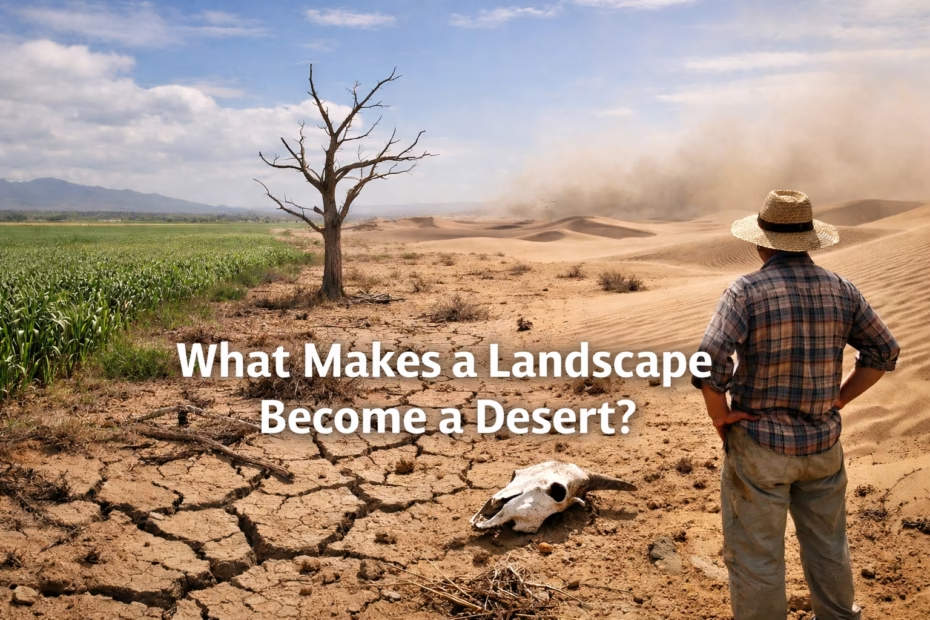
Deserts don’t “happen” because someone forgot to water a place. A landscape becomes a desert when the long-term water budget tips hard into the red: too little precipitation, too much evaporation, and not enough moisture left for steady plant cover.
- First, what “desert” really means
- The big drivers that turn land dry
- 1) Global air circulation
- 2) Mountains and the rain shadow effect
- 3) Distance from moisture sources
- 4) Cold ocean currents near coasts
- When land feedbacks lock dryness in place
- Hot deserts vs. cold deserts
- Quick table: common pathways to desert conditions
- Desertification: when drylands get pushed too far
- Simple signs a landscape is drying out
- Why some deserts are sandy and others aren’t
- Can a desert reverse back into greener land?
First, what “desert” really means
A desert climate is defined by persistent aridity, not by temperature. Some deserts are hot, some are chilly, and some feel downright cold at night. The core idea is simple: over years and decades, the land receives less water from the sky than the air can pull back out of the ground and plants.
Scientists often describe this with potential evapotranspiration (how “thirsty” the atmosphere is) versus rainfall (how much water arrives). When atmospheric thirst stays higher than rainfall for long stretches, the landscape starts behaving like a leaky bucket—it never quite refills.
The big drivers that turn land dry
1) Global air circulation
On a planet with spinning air and uneven heating, huge circulation cells form. In many regions, air rises, drops moisture, then later sinks and warms. Sinking air is a rain-killer: warm air can hold more moisture, so clouds struggle to grow. These sinking zones often sit around similar bands of latitude, creating classic subtropical deserts.
2) Mountains and the rain shadow effect
Mountains can act like giant wringers. Moist air gets pushed uphill, cools, and drops rain on the windward side. Then it slides down the far side warmer and drier, leaving a rain shadow. The result can be a surprisingly sharp transition: green slopes on one side, dusty arid terrain on the other.
3) Distance from moisture sources
Some landscapes are simply too far from big moisture highways. As air masses travel inland, they lose water along the way. Deep interiors of large landmasses can end up with low humidity, fewer storms, and thin rainfall. Think of it like a sponge carried across a room—by the time it arrives, it’s already been squeezed out.
4) Cold ocean currents near coasts
It sounds weird, but cold water offshore can help create coastal deserts. Cold currents cool the air near the surface, which can reduce evaporation and keep the lower atmosphere stable. You might see fog or low clouds, yet little actual rain. It’s moisture that hovers instead of falling.
When land feedbacks lock dryness in place
Climate starts the story, but the land can join in. Once vegetation thins, the surface heats up faster in the day and cools faster at night. With fewer leaves, there’s less evapotranspiration to “recycle” water back into the air. Dust and bare ground can also change albedo (how much sunlight is reflected), nudging local temperatures and airflow.
Soils matter too. In dry settings, salts can build up near the surface, and crusts can form after rare rains. That makes it harder for seeds to sprout and roots to breathe. A landscape with salty, compacted soil is like a sealed jar: even when water shows up, it doesn’t soak in the way you’d hope.
Hot deserts vs. cold deserts
“Desert” and “sand” get paired like they’re inseparable, but they’re not. Many deserts are rocky plains, gravel fans, or wind-polished bedrock. Cold deserts exist where precipitation is very low and most moisture is locked up as ice, with air that’s still dry enough to pull water from surfaces. Different feel, same core math: not enough water.
Quick table: common pathways to desert conditions
| Pathway | What reduces moisture | Typical landscape clues |
|---|---|---|
| Subtropical sinking air | High pressure suppresses cloud growth and storms | Wide open skies, big day–night temperature swings |
| Rain shadow | Mountains drop rain on one side, dry air descends on the other | Sharp change across a ridge; dry valleys downwind |
| Continental interior | Air loses water before reaching far inland | Short, intense storms; long dry stretches |
| Cold-current coast | Stable, cool air limits rainfall even when fog forms | Frequent fog, sparse shrubs, very light annual rain |
| Cold desert | Low snowfall/rainfall plus very dry air | Ice or frost nearby, yet minimal snow accumulation |
Desertification: when drylands get pushed too far
Not every dry place is “newly desert.” Plenty of regions are naturally drylands that still support grasslands, shrubs, and seasonal farming. Desertification is the process where productive drylands lose resilience—usually through a mix of shifting rainfall patterns and tough land pressure (like overgrazing, repeated soil disturbance, or poor irrigation choices).
Here’s the tricky part: drylands can look “fine” until they don’t. A couple of dry years might be survivable, but if roots can’t recover and topsoil blows away, the system starts to behave differently. Water runs off instead of soaking in. Seeds can’t anchor. And the land becomes teh kind of place where every small storm feels like it disappears instantly.
Simple signs a landscape is drying out
If you’re looking at a landscape and wondering whether it’s sliding toward desert-like conditions, these clues are worth watching. They’re not “proof” on their own, but they’re strong hints.
- More bare ground between plants; vegetation cover becomes patchy
- Soil crusts or hard pans that stop water from soaking in
- Rills and small channels after rain (water is running off fast)
- More dust in windy seasons; fine topsoil is disappearing
- Shrubs replacing grasses (a shift in plant community)
Why some deserts are sandy and others aren’t
Sand is a material, not a definition. For big dune fields to form, three things usually line up:
- A steady supply of sand-sized grains (often from old river deposits or weathered rock)
- Strong, persistent winds to move the grains
- Open space with limited plant cover so sand can travel
Many deserts are dominated by gravel, stones, or bedrock because wind can blow the finer stuff away, leaving a “pavement” of pebbles behind. That rocky skin can actually reduce erosion a bit, acting like armor over softer ground—an odd but real self-protection mechanism.
Can a desert reverse back into greener land?
Sometimes, yes—especially at the edges. If climate patterns shift toward more reliable moisture, or if land is managed to keep soil in place and boost infiltration, plant cover can return. In many areas, the biggest win is not “turning a desert into a forest,” but helping a dryland stay a healthy dry ecosystem with stable soil, steady ground cover, and water that sinks in instead of sprinting away.
Practical approaches tend to be surprisingly down-to-earth: protecting the soil surface, reducing repeated disturbance, guiding water gently across the land, and giving plants enough breathing room to recover. Small moves, big ripple.