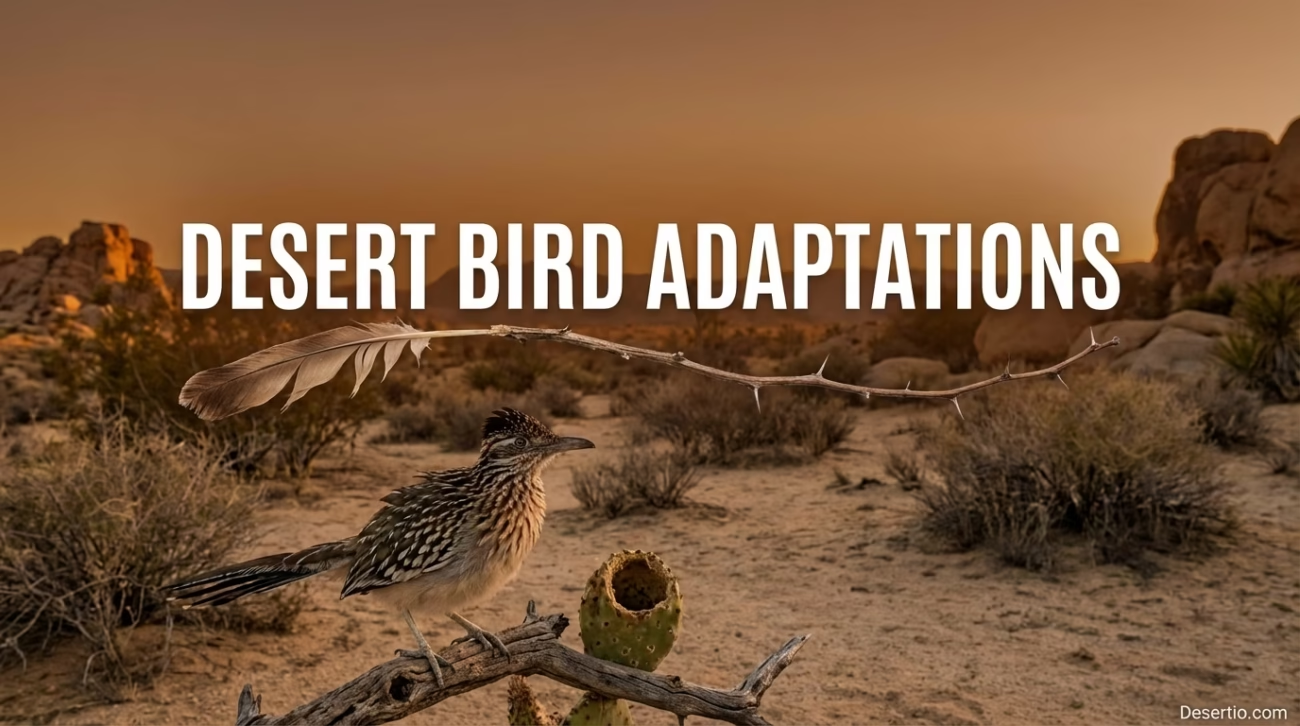
Desert birds live where water feels like a rare coin and shade can be the best shelter you’ll ever find. What makes them fascinating is not “toughness” in a vague sense—it’s the fine-tuned toolkit inside their bodies and behaviors that turns scorching air and dry horizons into workable habitat—patterns that echo the broader strategies seen across desert wildlife adaptations.
- What Desert Birds Are Up Against
- Water-Saving Physiology That Works Like Recycling
- Breathing Without Bleeding Water
- Salt Balance Without Extra Drinking
- Cooling Moves That Keep Body Temperature In Range
- Built For Sun And Sand: Shape Matters
- Feathers That Do More Than Fly
- Color And Reflectance
- Daily Life: Timing Is An Adaptation
- Food And Water: Getting Moisture Without A Drink
- Nesting And Parenting In A Dry Landscape
- Standout Species And What They Teach Us
- Sandgrouse: The Feather-Canteen Miracle
- Small Songbirds: Microclimates, Not Muscle
- Misunderstood Ideas About Desert Birds
Think of desert life as a budget. Birds must “spend” water and “spend” heat. The smartest species don’t waste either. Every sip, breath, feather, and timetable can be part of the plan. That’s what “adaptation” looks like up close.
What Desert Birds Are Up Against
Deserts aren’t “just hot.” They’re places where humidity is low, sunlight is intense, and temperatures can swing hard between day and night. Add patchy food, salty dust, and long gaps between reliable water sources, and you get a landscape that rewards precision more than brute strength. Small efficiencies stack into survival.
- Heat load: direct sun plus hot air can push body temperature upward fast.
- Water scarcity: many desert stretches offer no surface water for long periods.
- Dry air: breathing and cooling can quietly leak precious moisture.
- Food patchiness: meals may be seasonal, brief, or concentrated at dawn and dusk.
- Salts and minerals: some deserts have salty soils and plants, challenging fluid balance.
Water-Saving Physiology That Works Like Recycling
One big advantage birds have is how they handle nitrogen waste. Many mammals flush waste as urea dissolved in water. Birds, on the other hand, mostly package waste as uric acid, a thicker paste that uses far less water. It’s a quiet superpower in arid zones. Less water out means more water in the tank. It’s efficiency, not magic.
Desert birds also squeeze value from every drop passing through the lower gut. The cloaca (a shared exit for digestive and urinary systems) can reabsorb water before it’s lost. Combine that with smart kidney function and you get a system built for minimum waste. Desert living favors “reuse.”
Breathing Without Bleeding Water
Many birds have nasal turbinates—scroll-like structures that help recover heat and moisture from exhaled air. Picture a tiny built-in heat exchanger: warm, moist breath passes over cooler surfaces, and water vapor can condense back toward the body. In a desert, that moisture matters. It’s like reclaiming steam from your own breath.
Salt Balance Without Extra Drinking
Some species manage salts with specialized glands (often discussed as “salt glands” in birds), helping keep fluid chemistry stable when diet or dust adds minerals. The key idea is simple: control electrolytes so the body doesn’t have to waste water to dilute them. Balance first, thirst later. It’s clean internal bookkeeping.
| Desert Challenge | Adaptation | What It Achieves | Easy Example |
|---|---|---|---|
| Limited water | Uric acid waste | Less water needed for excretion | White “paste-like” droppings |
| Dry air | Nasal turbinates | Moisture recovery from exhaled air | Reduced respiratory water loss |
| Hot afternoons | Shade timing | Lower heat gain and less cooling demand | Resting midday, active early/late |
| Overheating risk | Panting / gular flutter | Evaporative cooling to shed heat | Rapid throat vibrations |
| Chicks need water | Water-carrying feathers | Transport water to nest | Male sandgrouse belly feathers |
Cooling Moves That Keep Body Temperature In Range
When air temperature climbs, a bird can’t rely on “just sweating.” Birds don’t sweat like mammals. Instead, they lean heavily on evaporative cooling: letting water evaporate from moist surfaces to carry heat away. The trick is doing it without draining the body. Desert birds treat evaporation like a controlled release valve.
Gular flutter is a favorite desert tactic. Instead of heavy full-body panting, some birds rapidly vibrate the throat area, boosting evaporation while keeping energy costs relatively low. It’s like fanning a small wet cloth rather than opening every window. Efficient cooling, smaller water bill.
Behavior helps, too. Many species adopt a “thermal schedule”: forage at dawn, pause during peak heat, then move again later. Others angle their bodies to reduce sun exposure, lift feathers to create insulating air layers, or hold wings slightly away from the body to increase airflow. Less heat in means less water spent to cool. That trade is everything.
- Timed activity: mornings and late afternoons are prime bird hours in hot deserts.
- Microhabitats: shade from shrubs, rocks, cliffs, or cavities can drop heat load dramatically.
- Posture changes: wing droop, feather lift, body orientation to sun and wind.
- Controlled heat storage: brief, safe rises in body temperature can reduce the need for evaporation.
Built For Sun And Sand: Shape Matters
Desert birds aren’t all built the same, but certain design themes show up again and again. Plumage can look fluffy, yet it often acts like insulation—shielding skin from radiant heat while still allowing airflow when the bird loosens feathers. Insulation works both ways: it can keep heat out, not just keep heat in. Think of it as a wearable shade structure.
Leg length and stance can also help. A slightly taller posture lifts the body away from scorching ground surfaces, while long toes can spread weight on soft sand. Bills and unfeathered areas can serve as heat exchange zones, letting birds dump heat when conditions allow. Form follows physics. That’s desert design in one line.
Feathers That Do More Than Fly
Some adaptations are so specific they feel unbelievable until you see the details. Male sandgrouse have belly feathers engineered to absorb and hold water, then carry it back to chicks at the nest. Those feathers aren’t just “wet.” Their structure helps trap water for long distances. It’s a living canteen.
Color And Reflectance
Many desert birds wear sandy, pale, or muted tones. It can support camouflage, sure, but it can also reduce heat gain by reflecting more sunlight than darker plumage. Less absorbed radiation means less cooling needed later. Light colors can be a thermal strategy. Subtle shades, big payoff.
Daily Life: Timing Is An Adaptation
In many deserts, the difference between 7:00 a.m. and 1:00 p.m. is the difference between “comfortable” and “too costly.” So desert birds often treat the day like a map of safe zones. Early hours are for feeding and moving. Midday is for resting, preening, and staying still in shade. Late day brings another window. It’s not laziness. It’s smart scheduling. Energy and water stay in balance.
- Dawn: feeding bursts while air is cooler.
- Late morning: short movements, careful shade use.
- Midday: minimal activity; cooling behaviors if needed.
- Late afternoon: second feeding window.
- Night: roosting; in some species, cooler-hour foraging.
Food And Water: Getting Moisture Without A Drink
Not every desert bird visits water daily. Many species collect water indirectly through food. Insects can be surprisingly moisture-rich. Some birds shift diets seasonally, leaning more on insects, fruits, or nectar when those options are available. Food becomes hydration with calories attached. That’s efficient foraging.
Seeds are common desert staples, but they’re dry. Birds that rely on seeds often combine them with strategies like early-day feeding, shade use, and ultra-efficient water handling. Others pick plant parts with higher water content when possible. Desert menus are flexible because conditions are. Adaptation isn’t one trick—it’s a whole style of living. Flexibility is a survival skill.
Nesting And Parenting In A Dry Landscape
Eggs and chicks don’t get to choose shade. Adults do the choosing for them. Nest placement is often about microclimate: cactus arms, shrub interiors, cavities, cliff ledges, or thick woven structures that buffer heat swings. Some birds build “decoy” nests or multiple nests—one for breeding, another for cooler roosting. Architecture matters when weather is intense. A well-placed nest is like a tiny climate-controlled room. Just without the electricity bill.
Timing also plays a role. Many desert birds breed when food is more available—often linked to seasonal patterns that boost insects and plants. That means chicks grow when parents can feed them reliably, reducing stress on water and energy budgets. Reproduction is planned around resources, not the calendar humans use. Nature schedules with supply chains. And deserts demand good planning.
Standout Species And What They Teach Us
“Desert bird” is a huge category—tiny songbirds, doves, ground runners, raptors, and more. Still, a few well-studied examples make the adaptation story click fast. Each one highlights a different solution to the same two big problems: heat and water, themes shared across many desert species and their adaptations. Different tools, same goal. That variety is the beauty of evolution.
| Species (Example) | Signature Adaptation | Why It Helps In Deserts |
|---|---|---|
| Namaqua Sandgrouse | Water carried in belly feathers | Delivers water to chicks far from watering sites |
| Greater Roadrunner | Heat management through timing and cooling behaviors | Stays active in cooler windows; avoids peak heat costs |
| Verdin | Multiple nests, including roost nests | Uses nest structures to buffer temperature swings |
| Cactus Wren | Nesting in protective, shaded cactus sites | Microclimate advantage and reduced heat exposure |
| Hoopoe Lark | Behavioral thermoregulation and ground-life efficiency | Uses habitat and timing to keep cooling costs manageable |
Sandgrouse: The Feather-Canteen Miracle
Sandgrouse are often the headline act for a reason. Males can soak specialized belly feathers at water sources and transport water back to chicks, even when nests are far away. The feather structure helps hold water during flight, turning a normal body feature into a delivery system. It’s parenting under desert rules. And it’s brilliantly specific.
Small Songbirds: Microclimates, Not Muscle
Many small desert birds win by choosing the right place at the right time. Shade inside shrubs, nesting sites that block direct sun, and activity schedules that avoid peak heat can matter as much as physiology. Add water-efficient waste handling and moisture recovery while breathing, and you get a package that looks simple but performs like a high-efficiency system. They survive by being picky in smart ways. Precision is power.
Misunderstood Ideas About Desert Birds
Desert birds are sometimes described as if they “never need water.” That’s not the real story. Many do drink when water is available. The key point is that they’re built to stretch intervals, to get moisture from food, and to reduce losses that would sink other species. They’re not ignoring biology—they’re mastering it. Efficiency is the headline.
Another common mix-up: “Desert heat means birds must be miserable.” Not necessarily. Birds can be perfectly comfortable when their behavior matches conditions—shade at noon, feeding at dawn, cooling when needed, and nesting in buffered sites. It’s a lifestyle tuned to place. Desert birds aren’t fighting the environment every second. They’re cooperating with its rhythms. That’s adaptation at its calmest.
