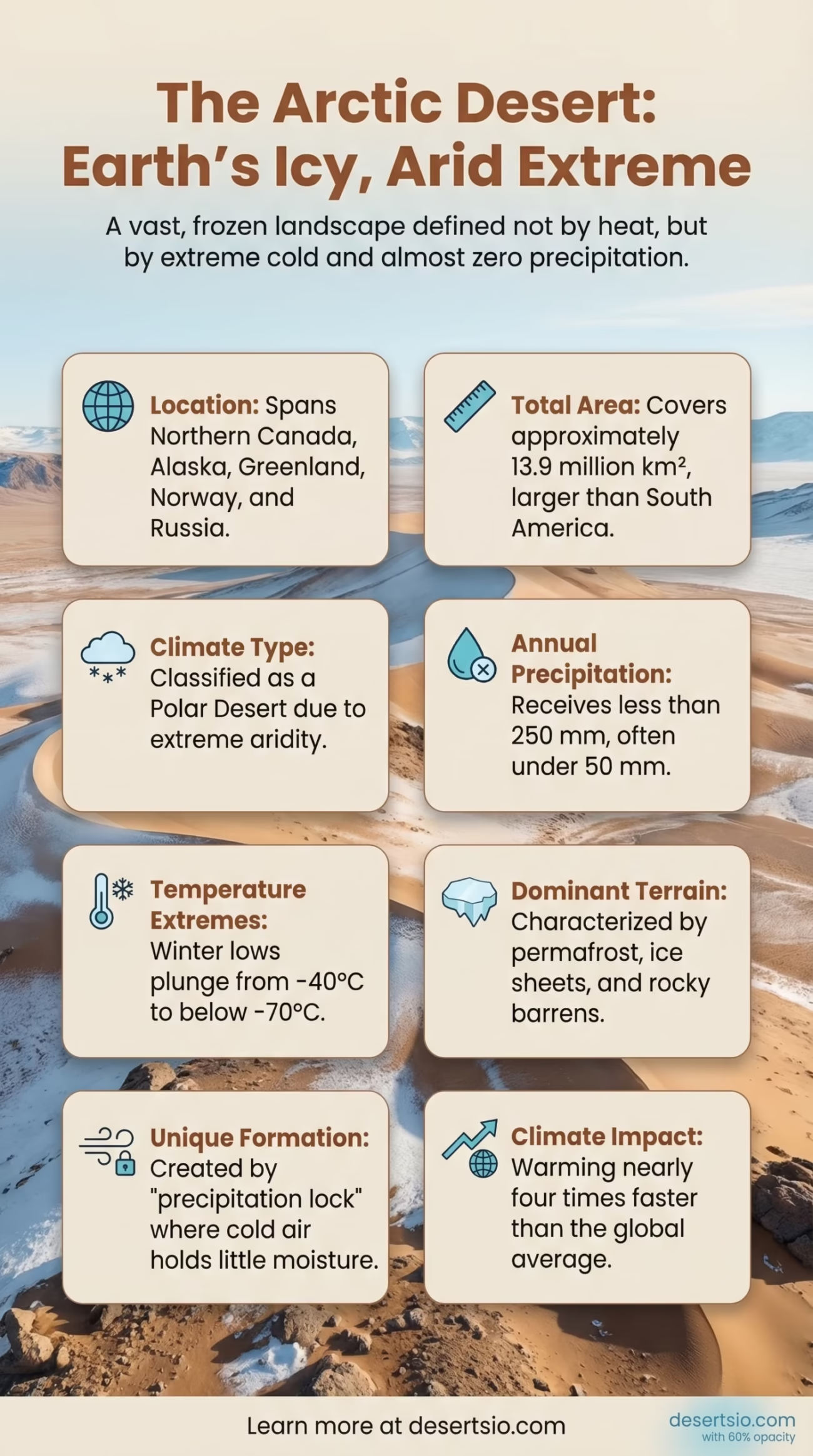
| Location | Arctic regions: Northern Canada, Alaska, Greenland, Norway, Russia, Antarctica |
| Total Area | ~13.9 million km² (Antarctica alone: ~14.2 million km²) |
| Type | Polar Desert (Cold Desert) |
| Annual Precipitation | Less than 250 mm per year (many areas receive under 50 mm) |
| Average Summer Temperature | -5°C to +10°C depending on region |
| Average Winter Temperature | -40°C to -70°C (extreme lows recorded) |
| Day/Night Temperature Difference | Up to 20–30°C swing in summer; minimal in polar night |
| Ice Coverage | Arctic sea ice: ~15 million km² (winter peak), ~4 million km² (summer minimum, 2023) |
| Dominant Terrain | Permafrost, ice sheets, rocky barrens, frozen tundra |
| Human Population | Approximately 4 million people in the broader Arctic region |
| Notable Wildlife | Polar bear, Arctic fox, musk ox, snowy owl, narwhal, walrus |
| Formation Age | Current polar desert conditions established ~2.7 million years ago (Pleistocene glaciation) |
Most people picture rolling sand dunes when they hear the word “desert.” The Arctic Desert shatters that image completely. Defined not by heat but by extreme aridity, the Arctic Desert is one of Earth’s largest and least understood desert systems — a vast, wind-scoured landscape where liquid water almost never exists at the surface, temperatures plunge to lethal extremes, and life clings on with extraordinary stubbornness.
- Arctic Desert Location and Map View
- How Big Is the Arctic Desert?
- Formation: How Did the Arctic Desert Come to Be?
- Temperature: A World of Extremes
- Flora and Fauna: Life at the Edge
- Plant Life
- Animal Life
- Human Life in the Arctic Desert
- The Arctic Desert and Climate Change: What the Data Shows
- Nearby Deserts and Regional Comparisons
- Arctic Desert vs. Gobi Desert
- Arctic Desert vs. Antarctic Desert
- Technical Characteristics: Permafrost and Katabatic Winds
- Permafrost Fast Facts
- Scientific Research and Strategic Importance
Technically, a desert is any region receiving less than 250 mm of precipitation annually. By that definition, large parts of the Arctic — and virtually all of Antarctica — qualify as deserts. This makes the polar desert not a poetic label but a precise scientific classification.
Arctic Desert Location and Map View
How Big Is the Arctic Desert?
The Arctic Desert covers roughly 13.9 million square kilometers across northern Greenland, the Canadian Arctic Archipelago, parts of Alaska, northern Russia, Svalbard, and other high-latitude territories. Antarctica adds another approximately 14.2 million km² of polar desert — making the combined polar desert zone larger than the entire continent of South America (roughly 17.8 million km²). To put that another way: the Antarctic polar desert alone is nearly twice the size of Australia’s total land area.
The Arctic Ocean basin, covered in sea ice for most of the year, functions as an extension of this cold desert environment. During winter, sea ice reaches approximately 15 million km². By summer 2023, that extent had dropped to around 4.23 million km² — the sixth-lowest minimum on record, a pattern that is becoming grimly routine.
Formation: How Did the Arctic Desert Come to Be?
The polar deserts did not form overnight. Earth’s climate shifted gradually toward a colder state over tens of millions of years — a result of shifting tectonic plates, changes in ocean circulation, and declining atmospheric CO₂ levels. Antarctica began glaciating around 34 million years ago when the Drake Passage opened, isolating the continent and enabling the circumpolar current to form. The Arctic, by contrast, accumulated its major ice sheets much later, during the Pleistocene epoch beginning roughly 2.7 million years ago.
The mechanism that makes these regions deserts — rather than merely cold — is a phenomenon called precipitation lock. When temperatures drop this low, the atmosphere holds almost no moisture. Cold air simply cannot carry water vapor the way warm tropical air can. What little precipitation falls arrives mostly as snow, often driven horizontally by powerful katabatic winds. Accumulation is minimal. The ground stays frozen. And that frozen ground — permafrost — in turn prevents any meltwater from infiltrating the soil, amplifying the surface aridity further.
Temperature: A World of Extremes
The temperature range across the Arctic Desert is one of the most dramatic on the planet. Day and night differences can swing by 20–30°C during the brief Arctic summer, especially in areas where 24-hour sunlight suddenly gives way to long twilight periods. Winter is another matter entirely.
- Summer highs (coastal Arctic): +5°C to +10°C
- Winter lows (interior Greenland/Canada): -40°C to -50°C
- Record low (Antarctica, Vostok Station): -89.2°C — the coldest naturally occurring temperature ever recorded on Earth
- Wind chill factor: katabatic winds exceeding 100 km/h make effective temperatures far lower than thermometer readings
- Polar night duration: Up to 6 months of continuous darkness in high-latitude zones
During the Arctic summer, paradoxically, some coastal zones experience sudden warmth. Parts of northern Alaska and Siberia have recorded temperatures above 38°C in recent years — an anomaly directly connected to accelerating climate change, not natural seasonal variation.
Flora and Fauna: Life at the Edge
Calling it barren is too easy. The Arctic Desert supports a surprisingly resilient web of life — though the density and diversity are understandably low compared to temperate or tropical zones.
Plant Life
Vascular plants struggle in permafrost soil, but mosses, lichens, and certain grasses dominate the ground cover across tundra zones adjacent to the polar desert. True polar desert areas — particularly in northern Greenland and the Canadian High Arctic — may have less than 5% plant cover. Yet even there, species like Saxifraga oppositifolia (purple saxifrage) manage to bloom within weeks of snowmelt, squeezing a full reproductive cycle into an impossibly short window. Lichens, which are technically fungi-algae partnerships, are perhaps the most successful colonizers — slow-growing, frost-tolerant, and capable of photosynthesis even at temperatures just above 0°C.
Animal Life
The fauna is more visible — and more charismatic. Polar bears (Ursus maritimus) are the apex predator, entirely dependent on sea ice for hunting ringed seals. Arctic foxes follow polar bears to scavenge scraps. Musk oxen — essentially unchanged since the Pleistocene — graze on sparse tundra grasses, insulated by their extraordinary qiviut undercoat (finer than cashmere). In the ocean, narwhals, beluga whales, and walruses navigate beneath ice sheets. Above, snowy owls hunt lemmings through blizzards. The lemming itself is a keystone species — its population cycles directly drive the population swings of foxes, owls, and other predators across vast stretches of the Arctic.
Human Life in the Arctic Desert
Roughly 4 million people live within the Arctic region broadly defined — a number that seems remarkable given the conditions. The Inuit of northern Canada, Alaska, and Greenland; the Yupik of Alaska and Siberia; the Nenets, Evenki, and Chukchi peoples of Russia; and the Sámi of Scandinavia — these are the indigenous communities whose cultures evolved directly within polar desert and Arctic tundra environments.
The Inuit word siku describes sea ice — but it doesn’t stop there. Traditional Inuit vocabularies contain dozens of distinct terms for different ice conditions, each carrying life-or-death practical significance for hunters and travelers. That granularity of knowledge reflects millennia of observation and adaptation. And it is knowledge that is now under pressure: as sea ice patterns become less predictable, traditional navigation and hunting methods face unprecedented disruption.
Permanent settlements like Longyearbyen (Svalbard, Norway) and Barrow/Utqiaġvik (Alaska, USA) sit at some of the highest latitudes on Earth, with modern infrastructure operating in permafrost — an engineering challenge that requires buildings to be raised on pilings to prevent ground thaw caused by heat from the structures themselves.
The Arctic Desert and Climate Change: What the Data Shows
The Arctic is warming at nearly four times the global average rate — a phenomenon known as Arctic amplification. Between 1979 and 2023, the Arctic lost approximately 13% of its sea ice extent per decade. Permafrost — which underlies roughly 24% of the Northern Hemisphere’s land surface — is thawing at accelerating rates, releasing stored carbon dioxide and methane in a feedback loop that climate scientists have been warning about for decades.
| Sea Ice Loss Rate | ~13% per decade (since 1979) |
| Arctic Warming Rate | ~4x global average |
| Permafrost Coverage | ~24% of Northern Hemisphere land surface |
| 2023 Summer Sea Ice Minimum | 4.23 million km² (6th lowest on record) |
| Greenland Ice Sheet Mass Loss | ~280 billion tonnes per year (average 2002–2023) |
| Projected Ice-Free Arctic Summer | Potentially before 2050 under current trajectories |
These numbers are not abstractions. Thawing permafrost directly threatens infrastructure across northern Russia and Canada — roads buckle, pipelines shift, and buildings sink. In 2021, a fuel spill near Norilsk, Russia was partly attributed to permafrost degradation causing a storage tank foundation to fail. The Arctic Desert’s physical transformation is already creating measurable, costly consequences.
Nearby Deserts and Regional Comparisons
The Arctic Desert does not exist in isolation. Moving south from the polar desert zone, the landscape transitions into Arctic tundra — technically not a desert but sharing many characteristics: low precipitation, extreme cold, permafrost, and sparse vegetation. Further into the Northern Hemisphere, cold deserts like the Gobi Desert (Central Asia) and the Taklamakan Desert (western China) share the cold-desert classification — though they are mid-latitude cold deserts, not polar ones.
Arctic Desert vs. Gobi Desert
- Type: Polar desert vs. Mid-latitude cold desert
- Area: ~13.9 million km² vs. ~1.3 million km²
- Winter Low: -50°C vs. -40°C
- Precipitation: Under 50 mm vs. 50–200 mm/year
- Vegetation: Mosses, lichens vs. sparse shrubs, grasses
Arctic Desert vs. Antarctic Desert
- Location: North Pole region vs. South Pole continent
- Area: ~13.9 million km² vs. ~14.2 million km²
- Record Low: -67.8°C (Greenland) vs. -89.2°C (Vostok)
- Human Presence: Indigenous communities vs. research stations only
- Land Base: Mostly ocean + islands vs. solid continent
The comparison with the Antarctic Desert is particularly instructive. Both are cold deserts defined by extreme aridity. But Antarctica is colder, drier, and higher in elevation — the continental interior sits at an average elevation of about 2,300 meters above sea level. The Arctic, by contrast, is largely ocean-based, which moderates temperatures slightly and allows for more biological complexity on its surrounding landmasses.
Technical Characteristics: Permafrost and Katabatic Winds
Two physical features define the Arctic Desert’s terrain more than any other: permafrost and katabatic winds.
Permafrost is ground that remains at or below 0°C for at least two consecutive years. In parts of Siberia, the permafrost layer reaches depths of over 1,500 meters. The active layer — the top portion that thaws seasonally — ranges from a few centimeters to about 2 meters depending on location and climate. This thin active layer is where all soil-based biological activity occurs. And it is this layer that is expanding downward as the climate warms.
Katabatic winds form when dense, cold air flows downhill from elevated ice sheets or plateaus under gravity. In Antarctica, these winds regularly exceed 100 km/h and can sustain speeds above 300 km/h in extreme events — making them among the most powerful sustained winds on Earth. In the Arctic, similar (though generally less intense) drainage winds scour the landscape, carrying fine ice particles and creating conditions that make human exposure dangerous within minutes.
Permafrost Fast Facts
- Max depth (Siberia): Over 1,500 meters
- Northern Hemisphere land coverage: ~24%
- Estimated carbon stored: ~1.5 trillion tonnes of organic carbon
- Thaw rate acceleration: Active layer deepening by 1–2 cm per year in many zones
- Methane release: Arctic lakes releasing measurable CH₄ plumes from thawing beds
Scientific Research and Strategic Importance
The Arctic Desert is one of the most intensively studied environments on Earth — and that research intensity has only grown. Ice cores drilled from Greenland’s ice sheet provide climate records stretching back 800,000 years, offering an unparalleled archive of past atmospheric conditions. Stations like Summit Camp (Greenland, elevation 3,216 m) operate year-round to monitor atmospheric chemistry, ice dynamics, and meteorological data.
Beyond pure science, the Arctic has become a zone of growing geopolitical and economic interest — driven directly by climate change. As ice retreats, previously inaccessible shipping lanes like the Northwest Passage and Northern Sea Route become seasonally navigable. Estimates suggest the Arctic seabed holds approximately 13% of the world’s undiscovered oil reserves and 30% of its undiscovered natural gas. And it’s happening fast. The Northern Sea Route saw a record 37 million tonnes of cargo transit in 2022 — a number unthinkable just 20 years ago.
The Arctic Desert is, in a very real sense, a place where ancient geological processes and contemporary human decisions are colliding at speed. What happens there — the melting, the thawing, the opening of new routes — does not stay there. Sea level rise, disrupted jet streams, altered precipitation patterns across Europe and Asia: the downstream consequences are genuinely global.
Understanding the Arctic Desert means understanding one of the planet’s most sensitive and consequential environments. Cold, dry, and extraordinarily fragile — it is not a wasteland. It is a barometer.
{
“@context”: “https://schema.org”,
“@graph”: [
{
“@type”: “Organization”,
“@id”: “https://desertio.com/#publisher”,
“name”: “DESERTIO”,
“url”: “https://desertio.com”
},
{
“@type”: [“Landform”, “Place”],
“@id”: “https://desertio.com/arctic-desert/#arcticDesert”,
“name”: “Arctic Desert”,
“alternateName”: [
“Arctic Polar Desert”,
“High Arctic Desert”
],
“description”: “The Arctic Desert is a vast polar desert surrounding the North Pole, covering about 13.7 million square kilometers across the Arctic Ocean basin and the northernmost parts of North America, Greenland, Svalbard and Arctic Russia.”,
“image”: {
“@id”: “https://desertio.com/arctic-desert/#arcticHero”
},
“geo”: {
“@id”: “https://desertio.com/arctic-desert/#arcticGeo”
},
“additionalProperty”: {
“@type”: “PropertyValue”,
“name”: “Köppen climate classification”,
“value”: “EF, ET”
},
“url”: “https://desertio.com/arctic-desert/”
},
{
“@type”: “GeoCoordinates”,
“@id”: “https://desertio.com/arctic-desert/#arcticGeo”,
“latitude”: 84.0,
“longitude”: 0.0
},
{
“@type”: “GeoShape”,
“@id”: “https://desertio.com/arctic-desert/#arcticShape”,
“box”: “66.3 -180 90 180”,
“addressCountry”: [“CA”, “DK”, “NO”, “RU”, “US”]
},
{
“@type”: “TouristDestination”,
“@id”: “https://desertio.com/arctic-desert/#arcticDestination”,
“name”: “Arctic Desert”,
“description”: “A vast polar desert biome of snow, ice, gravel plains, rocky coasts and frozen ground around the North Pole, known for extreme cold, very low precipitation, polar night and sparse vegetation.”,
“geo”: {
“@id”: “https://desertio.com/arctic-desert/#arcticGeo”
},
“includesAttraction”: [
{
“@id”: “https://desertio.com/arctic-desert/#northeastGreenlandNationalPark”
},
{
“@id”: “https://desertio.com/arctic-desert/#svalbard”
},
{
“@id”: “https://desertio.com/arctic-desert/#quttinirpaaqNationalPark”
}
]
},
{
“@type”: “TouristAttraction”,
“@id”: “https://desertio.com/arctic-desert/#northeastGreenlandNationalPark”,
“name”: “Northeast Greenland National Park”,
“description”: “The world’s largest national park, protecting a huge High Arctic wilderness of glaciers, coasts, mountains and polar desert landscapes in Greenland.”
},
{
“@type”: “TouristAttraction”,
“@id”: “https://desertio.com/arctic-desert/#svalbard”,
“name”: “Svalbard”,
“description”: “A Norwegian High Arctic archipelago known for polar desert scenery, glaciers, rugged mountains, sea ice and Arctic wildlife.”
},
{
“@type”: “TouristAttraction”,
“@id”: “https://desertio.com/arctic-desert/#quttinirpaaqNationalPark”,
“name”: “Quttinirpaaq National Park”,
“description”: “A remote national park on Ellesmere Island in Nunavut, Canada, representing one of the most northerly and driest polar desert environments in the world.”
},
{
“@type”: “ImageObject”,
“@id”: “https://desertio.com/arctic-desert/#arcticHero”,
“url”: “https://desertio.com/wp-content/uploads/2026/03/Arctic-Desert-Map-Size-Climate-Animals-Facts-infographic-scaled.avif”,
“caption”: “Arctic Desert infographic showing location, size, climate and wildlife”,
“inLanguage”: “en-GB”,
“copyrightHolder”: {
“@id”: “https://desertio.com/#publisher”
}
},
{
“@type”: “Dataset”,
“@id”: “https://desertio.com/arctic-desert/#arcticClimateDataset”,
“name”: “Arctic Desert Climate and Geography Data”,
“description”: “Compiled table of Arctic Desert size, climate, terrain, ice coverage, vegetation and wildlife data cited in the Arctic Desert guide.”,
“creator”: {
“@id”: “https://desertio.com/#publisher”
},
“spatialCoverage”: {
“@id”: “https://desertio.com/arctic-desert/#arcticDesert”
},
“variableMeasured”: [
{
“@type”: “PropertyValue”,
“name”: “Total Area”
},
{
“@type”: “PropertyValue”,
“name”: “Average Annual Precipitation”
},
{
“@type”: “PropertyValue”,
“name”: “Warmest Month Temperature”
},
{
“@type”: “PropertyValue”,
“name”: “Winter Temperature”
},
{
“@type”: “PropertyValue”,
“name”: “Sea Ice Coverage”
},
{
“@type”: “PropertyValue”,
“name”: “Permafrost Extent”
},
{
“@type”: “PropertyValue”,
“name”: “Vegetation Cover”
}
],
“license”: “https://creativecommons.org/licenses/by/4.0/”
},
{
“@type”: “FAQPage”,
“@id”: “https://desertio.com/arctic-desert/#arcticFAQ”,
“mainEntity”: [
{
“@type”: “Question”,
“name”: “Where is the Arctic Desert located?”,
“acceptedAnswer”: {
“@type”: “Answer”,
“text”: “The Arctic Desert surrounds the North Pole and extends across the Arctic Ocean basin and the northernmost parts of Greenland, Canada, Svalbard, Russia and parts of Alaska.”
}
},
{
“@type”: “Question”,
“name”: “How big is the Arctic Desert?”,
“acceptedAnswer”: {
“@type”: “Answer”,
“text”: “The Arctic Desert covers about 13.7 million square kilometers (5.3 million square miles), making it one of the largest deserts on Earth.”
}
},
{
“@type”: “Question”,
“name”: “Why is the Arctic considered a desert?”,
“acceptedAnswer”: {
“@type”: “Answer”,
“text”: “The Arctic is considered a desert because it receives very little precipitation. In many polar desert areas, annual precipitation is 250 millimeters (10 inches) or less, mostly falling as snow.”
}
},
{
“@type”: “Question”,
“name”: “How cold does the Arctic Desert get?”,
“acceptedAnswer”: {
“@type”: “Answer”,
“text”: “The Arctic Desert stays cold year-round. In true polar desert areas, even the warmest month usually remains below 10 degrees Celsius, and winter temperatures in some Arctic regions can fall below minus 40 degrees Celsius.”
}
},
{
“@type”: “Question”,
“name”: “Is the Arctic Desert all ice and snow?”,
“acceptedAnswer”: {
“@type”: “Answer”,
“text”: “No. Much of the Arctic Desert includes sea ice, glaciers and snowfields, but there are also extensive areas of bare rock, gravel plains, frozen soil and sparsely vegetated ground.”
}
},
{
“@type”: “Question”,
“name”: “Which animals live in the Arctic Desert?”,
“acceptedAnswer”: {
“@type”: “Answer”,
“text”: “Notable Arctic Desert animals include the polar bear, Arctic fox, musk ox, Arctic hare, snowy owl and several seal species.”
}
},
{
“@type”: “Question”,
“name”: “What plants grow in the Arctic Desert?”,
“acceptedAnswer”: {
“@type”: “Answer”,
“text”: “Plant life is sparse and mainly includes lichens, mosses, sedges, grasses and a few dwarf shrubs or small flowering plants in milder ice-free areas.”
}
},
{
“@type”: “Question”,
“name”: “What are famous places in the Arctic Desert?”,
“acceptedAnswer”: {
“@type”: “Answer”,
“text”: “Well-known Arctic Desert destinations include Northeast Greenland National Park, Svalbard and Quttinirpaaq National Park on Ellesmere Island.”
}
}
]
}
]
}
