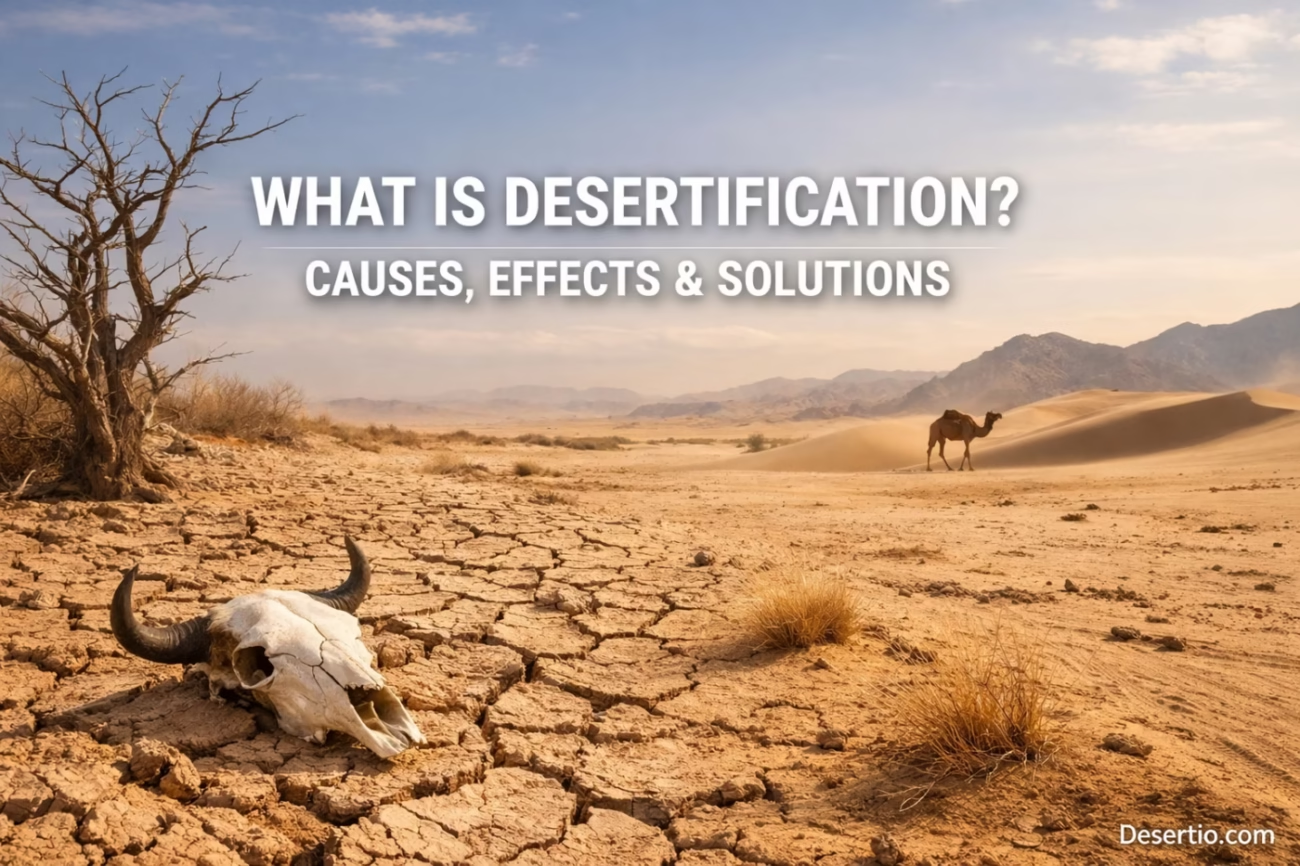
Desertification does not simply mean that a famous sand desert keeps spreading outward like a spill on a map. In scientific use, it means land degradation in drylands—arid, semi-arid, and dry sub-humid areas—where soil, vegetation, and water cycles lose their ability to support steady biological productivity. That change can look subtle at first: thinner grass cover, harder soil, patchier shrubs, more runoff after rain. Then it compounds. Today, the scale is global: up to 40% of the world’s land is degraded, drylands cover roughly 41% of the land surface, and at least 100 million hectares of healthy, productive land are being degraded each year. In other words, this is not a niche topic for specialists. It is a practical question about how land keeps working—or stops working.
- What Desertification Really Means
- The Dryland Settings Where It Develops
- How Productive Land Starts to Fail
- Main Causes of Desertification
- Climate Variability and Rising Heat
- Overgrazing and Loss of Ground Cover
- Unsustainable Farming and Bare-Soil Cultivation
- Irrigation Mismanagement and Salinity Build-Up
- Vegetation Removal, Wood Harvesting, and Water Stress
- What Desertification Does to Soil, Water, and Vegetation
- Regions and Landscapes Most Exposed
- People Also Ask About Desertification
- Is Desertification the Same as Drought?
- Is Desertification Caused Only by Climate Change?
- Can Desertification Be Reversed?
- How Does Desertification Affect Food and Water Systems?
- What Are the Most Reliable Signs That Desertification Has Started?
- Solutions That Actually Help Land Recover
- Why Land Restoration Is Getting More Attention Now
What this looks like on the ground: a field that absorbs less rain, a grazing area that recovers more slowly, an irrigated plot that turns saline, or a dryland valley where topsoil begins to move with every strong wind. The land is still there. Its function is what changes.
- Vegetation cover drops, so roots no longer hold soil firmly.
- Topsoil erodes through wind or runoff, often faster than it can reform.
- Soil structure weakens, creating crusting, compaction, and poor infiltration.
- Soil chemistry shifts, especially where salinity and alkalinity rise.
- Water becomes less effective because rain runs off quickly instead of soaking in.
What Desertification Really Means
Desertification is a process, not a landscape label. A steppe, savannah, shrubland, dry forest edge, or rain-fed farming zone can all experience it. That is why the simplest explanation—“land turning into desert”—misses part of the story. The issue is less about dunes marching forward and more about productive dryland systems losing resilience.
In practice, the process shows up when soil organic matter declines, ground cover breaks apart, runoff rises, and plant recovery slows after heat or low-rainfall periods. Sometimes the change is visible. Sometimes it hides in the numbers first: lower infiltration, weaker yields, lower biomass, or higher salinity. Quietly, bit by bit, the land becomes harder to manage.
One technical point matters here. Desertification is formally tied to drylands, which are usually identified by an aridity index—average annual precipitation divided by potential evapotranspiration. Once that ratio drops low enough, water limitation becomes a defining ecological force. And then management decisions matter a lot more than many people expect.
| Dryland Band | Aridity Index Range | What It Usually Means on the Ground |
|---|---|---|
| Arid | 0.05–0.20 | Very limited moisture, sparse vegetation, high evaporation pressure |
| Semi-Arid | 0.20–0.50 | Strong rainfall variability, grasslands and mixed farming under stress |
| Dry Sub-Humid | 0.50–0.65 | Seasonal moisture is higher, but degradation can accelerate quickly after cover loss |
Hyper-arid deserts already exist as deserts, so they are generally not the core legal scope of desertification under the UN convention. The vulnerable belt sits around them—and beyond them—in drylands where ecosystems still function, but can degrade fast when pressure rises.
The Dryland Settings Where It Develops
Drylands are not empty margins. Far from it. They include rangelands, dry farming zones, scrublands, open woodlands, Mediterranean-type landscapes, alluvial plains, and irrigation-dependent agricultural belts. Some support grazing. Some support cereals and pulses. Some hold seasonal wetlands and river corridors that keep whole regions alive during dry months.
Because drylands operate with narrow moisture margins, even modest shifts in surface cover, soil structure, or water use can trigger outsized effects. A humid landscape can sometimes absorb bad management for a while. A dryland usually cannot. That is the crux.
Globally, areas most often discussed in connection with desertification include the Sahel, parts of the Mediterranean basin, Central Asia, northwestern India, northern China and Mongolia, northeastern Brazil, interior Australia, and dry regions of the southwestern United States and northern Mexico. The exact drivers vary, but the pattern is familiar: low moisture, fragile soils, and mounting pressure on land and water.
How Productive Land Starts to Fail
Most degraded drylands do not collapse all at once. First, vegetation becomes patchy. Then bare ground expands between plants. The exposed soil heats up faster, loses moisture faster, and receives the full force of wind and intense rain bursts. Once topsoil starts moving, recovery becomes slower—and more expensive.
Soil erosion is one major pathway. Wind removes fine particles and organic matter from bare surfaces, while runoff cuts rills and gullies after short, sharp storms. Another pathway is soil crusting and compaction. When the surface seals, rainfall cannot infiltrate well, so even a useful shower becomes less useful. The field gets water, yet the root zone gets less of it.
Then there is salinization, a technical issue that is often underexplained in general articles. In dry climates, irrigation water can leave salts behind as it evaporates. With weak drainage or repeated over-irrigation, salts accumulate in the root zone and plant performance drops. This matters more than it may seem: current FAO assessments estimate that salt-affected soils cover about 10.7% of global land area, and around 10% of irrigated cropland is affected by salinity. In some regions, salinity is not a side issue at all. It is the issue.
Organic matter decline is another turning point. When plant residues are removed, overgrazed, or burned off too often, the soil loses the sponge-like qualities that help it hold water, cycle nutrients, and support microbial life. The field may still look workable for a while. Underneath, though, the system is thinning out.
Main Causes of Desertification
Climate Variability and Rising Heat
Drylands always live with rainfall swings, but higher heat changes the balance further by increasing evaporation and plant water stress. Even where total rainfall does not collapse, hotter conditions can reduce effective moisture. In plain terms, the same rain does less work. These shifts reflect broader desert climate dynamics that control evaporation, heat stress, and rainfall effectiveness across many dryland systems. IPCC assessments also show that land degradation is both affected by climate change and capable of feeding back into it through reduced carbon uptake and weaker land function.
Overgrazing and Loss of Ground Cover
Grazing itself is not the problem. Continuous pressure without recovery time is. When animals repeatedly remove fresh growth before plants rebuild root reserves, vegetation cover thins, palatable species decline, and bare soil expands. In dry years, that threshold arrives faster. Much faster, sometimes.
- Reduced leaf cover means less shade and faster surface drying.
- Lower root biomass weakens soil structure and aggregate stability.
- Trampling pressure can compact soil and reduce infiltration.
- Species composition shifts toward tougher but less productive plants.
Unsustainable Farming and Bare-Soil Cultivation
Repeated tillage, weak residue cover, poor crop rotation, and farming on vulnerable slopes can all accelerate degradation. So can nutrient mining—harvesting biomass year after year without replacing enough organic matter or essential nutrients. The result is not just lower output. It is a simpler, more fragile soil system.
Irrigation Mismanagement and Salinity Build-Up
In drylands, irrigation can be transformative. It can also go wrong. Where drainage is poor, groundwater is shallow, or water quality is mineral-rich, evaporation pulls salts upward and concentrates them near the surface. FAO notes that salinization can take up to 1.5 million hectares of farmland out of production each year. So yes—water can save a dryland field, but badly managed water can also degrade it.
Vegetation Removal, Wood Harvesting, and Water Stress
When shrubs, trees, windbreaks, and perennial cover are stripped away, the land loses protection from heat, runoff, and erosion. Add groundwater overuse to that picture, and the system becomes even tighter. Springs weaken, shallow-rooted vegetation declines, and surface temperatures rise. A hard cycle to break, unless land and water are managed together.
What Desertification Does to Soil, Water, and Vegetation
The first losses are often physical. Topsoil gets thinner, surface sealing increases, and the land captures less rain. Then come the ecological effects: poorer plant establishment, lower biomass, fewer perennial species, and more erratic recovery after dry spells. Landscapes can still look “open” and natural from far away while functioning much less effectively up close.
| System Change | What Happens | Why It Matters |
|---|---|---|
| Soil Structure Declines | Crusting, compaction, weaker aggregates | Rain infiltrates less and runoff rises |
| Organic Matter Falls | Less biological activity and weaker nutrient cycling | Soil holds less water and supports less growth |
| Vegetation Becomes Patchy | Bare ground expands between plants | Wind and water erosion intensify |
| Salinity Increases | Salt accumulates near roots or surface | Crop choice narrows and yields weaken |
| Hydrology Shifts | More runoff, less infiltration, flashier flow | Land becomes less reliable after rainfall |
There are also biodiversity effects. Dryland ecosystems depend on specialized plants, soil organisms, pollinators, and grazing webs that cope with water scarcity. When habitat structure simplifies, biodiversity often simplifies with it. Not always dramatically. Sometimes just enough to reduce resilience, which is the detail that matters.
And then dust increases. Bare, disturbed soil is far easier for wind to lift and move. That affects roads, settlements, reservoirs, crops, and visibility. It is not merely an aesthetic issue. It is a surface stability issue.
Regions and Landscapes Most Exposed
Desertification risk rises where three things overlap: water limitation, land-use pressure, and weak recovery time. That is why risk is high in semi-arid grazing belts, dry croplands with exposed soil, irrigation districts with drainage problems, and peri-urban drylands where vegetation is steadily removed.
- Rain-fed dry farming zones are exposed when cover crops, residues, and rotations are weak.
- Rangelands are exposed when grazing stays heavy through poor recovery periods.
- Irrigated basins are exposed when salts accumulate and groundwater tables rise.
- Dryland river corridors are exposed when upstream extraction reduces ecological flow.
- Mediterranean-type landscapes are exposed where heat, episodic rain, and cover loss interact.
Scale matters here. A single overused field can degrade. So can a whole watershed. The pattern changes, but the mechanism is familiar: less cover, less infiltration, less resilience.
People Also Ask About Desertification
Is Desertification the Same as Drought?
No. Drought is a temporary climate event; desertification is a longer-term process of land degradation in drylands. A drought can trigger or accelerate the process, especially where land is already stressed, but the two terms are not interchangeable.
Is Desertification Caused Only by Climate Change?
No again. Climate change can intensify heat stress, aridity, and rainfall variability, but land management remains a decisive driver. Overgrazing, repeated bare-soil tillage, vegetation clearing, groundwater overuse, and salinity build-up can all push drylands toward degradation even before larger climate trends are added to the picture.
Can Desertification Be Reversed?
Often, yes—especially when action starts early. Vegetation recovery, soil cover, erosion control, improved grazing timing, water harvesting, agroforestry, and salinity management can all help restore land function. But not every stage is equally reversible. Once topsoil is badly lost, or salinity becomes severe, recovery takes longer and costs more. Early intervention is simply smarter.
How Does Desertification Affect Food and Water Systems?
It reduces the land’s efficiency. Fields store less moisture, pastures regrow more slowly, and irrigation becomes less productive where salinity rises. So the issue is not only “less rain” or “less land.” It is less useful land per unit of water, which is a very different—and more technical—problem.
What Are the Most Reliable Signs That Desertification Has Started?
Watch for expanding bare ground, weaker infiltration after rain, surface crusting, rills and gullies, declining perennial cover, more dust movement, and rising soil salinity in irrigated zones. Satellite monitoring now helps track these changes, but field signs still matter. A lot, actually.
Solutions That Actually Help Land Recover
The most effective responses do not rely on a single fix. Not tree planting alone, not irrigation alone, not fencing alone. Desertification is a systems problem, so recovery works best when soil, water, vegetation, and management are treated together.
- Keep soil covered: mulches, residues, cover crops, and perennial strips reduce erosion and heat stress.
- Disturb soil less: minimum tillage and controlled traffic help preserve structure and organic matter.
- Slow water down: contour bunds, terraces, check dams, swales, and infiltration basins help rainfall soak in.
- Manage grazing adaptively: recovery periods, adjusted stocking, and seasonal movement protect root systems.
- Use water precisely: drip systems, drainage upgrades, and salinity monitoring improve irrigation efficiency.
- Rebuild vegetation strategically: native grasses, shrubs, shelterbelts, and agroforestry improve surface stability.
- Support land users: secure tenure, advisory services, local knowledge, and better monitoring increase adoption.
There is solid economic logic here too. Every US$1 invested in land restoration is estimated to generate roughly US$7 to US$30 in returns through stronger ecosystem services and more reliable land performance. That helps explain why restoration has moved from a narrow conservation topic into mainstream land, water, and agricultural planning.
One more point, because it is often skipped: restoration is not always about planting trees. In some drylands, the better answer is grass cover, managed grazing recovery, salinity control, flood-spread irrigation, or protecting ephemeral streams and wetlands. Good restoration matches the ecology. Always.
Why Land Restoration Is Getting More Attention Now
Recent international work has pushed desertification much closer to the center of environmental planning. The 2024 UN desertification conference in Riyadh put land restoration and drought resilience firmly in the global spotlight, while the 2025 Desertification and Drought Day theme—“Restore the Land. Unlock the Opportunities”—framed restoration not as damage control, but as a practical development strategy.
That shift is visible in real projects. UNEP and FAO’s 2024 World Restoration Flagships highlighted initiatives across Africa, Latin America, the Mediterranean, and South Asia that are expected to restore nearly 40 million hectares and create around 500,000 jobs. The message is clear enough: degraded land is not only a warning sign. Managed well, it is also a recovery opportunity.
So when people ask, “What is desertification?” the best answer is broader than a textbook definition. It is the gradual breakdown of dryland function—soil structure, vegetation cover, water retention, productivity, and resilience. Yet the reverse is also true. With careful land management, well-designed restoration, and realistic technical choices, drylands can recover more than many assume. Not instantly. Still, meaningfully.
