| Official Name | Colorado Desert |
| Type | Subtropical desert (arid scrubland) |
| Location | Southeastern California, USA; extends into northwestern Baja California, Mexico |
| Total Area | ~28,000 km² (approx. 7 million acres) |
| Elevation Range | −69 m to ~900 m (below sea level at Salton Sea to low mountain edges) |
| Average Summer High | 42–47°C (108–117°F) |
| Average Winter Low (Night) | 2–8°C (35–46°F) |
| Annual Rainfall | Less than 76 mm (3 inches) per year |
| Major Subdivisions | Salton Trough, Borrego Valley, Imperial Valley |
| Bordering Desert | Mojave Desert (north), Sonoran Desert (east) |
| Dominant Vegetation | Creosote bush, ocotillo, smoke tree, palo verde |
| Key Protected Areas | Anza-Borrego Desert State Park, Joshua Tree National Park (partial) |
| Largest Inland Body of Water | Salton Sea (~970 km²) |
| Named After | Colorado River |
The Colorado Desert sits at an extraordinary crossroads of geology, ecology, and human history — and it is often overshadowed by its more famous neighbor, the Mojave. Yet this low-lying subtropical desert, stretching across the southeastern corner of California and dipping into Baja California, Mexico, holds some of North America’s most extreme landscapes. Temperatures that exceed 47°C in summer. A lake that sits below sea level. Ancient palm oases tucked between sand dunes. It is, in almost every sense, a place of contradictions.
- Colorado Desert: Location and Map View
- How Big Is the Colorado Desert?
- Formation: How This Desert Came to Be
- Temperature: Fire by Day, Chill by Night
- Temperature Extremes at a Glance
- Flora: Desert Plants That Refuse to Quit
- Fauna: Life in the Heat
- Human Life: Who Lives Here?
- The Salton Sea: An Ecological Crisis in Slow Motion
- Neighboring Deserts: The Broader Desert Context
- Protected Areas and Conservation
- Colorado Desert: Key Ecological Facts
- A Desert Defined by Extremes
Colorado Desert: Location and Map View
How Big Is the Colorado Desert?
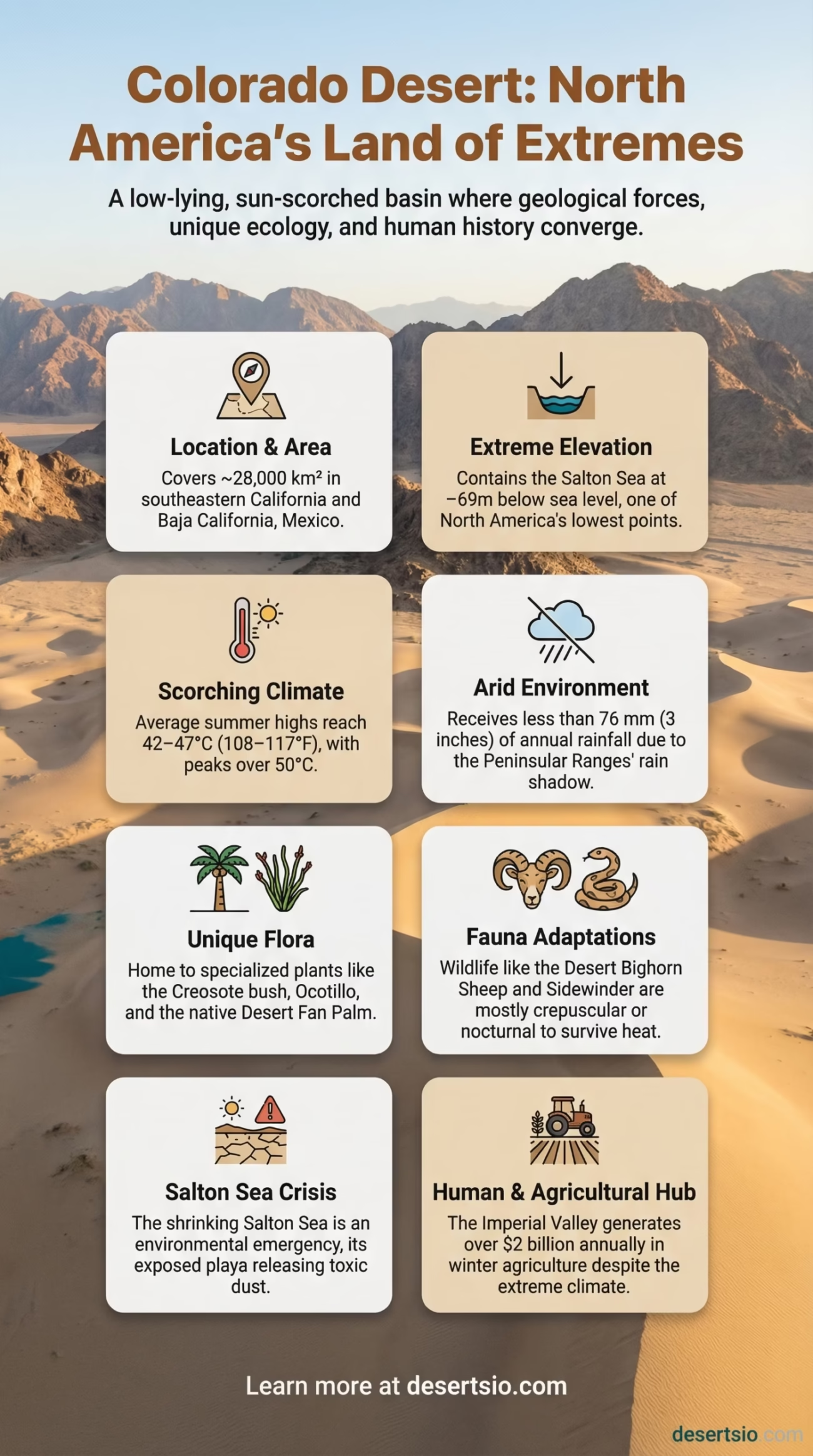
Covering approximately 28,000 square kilometers (roughly 7 million acres), the Colorado Desert is a substantial landmass — larger than the entire country of Israel, for perspective. It spans from the San Bernardino Mountains in the north down to the Gulf of California, with the Colorado River forming its eastern boundary. Much of this terrain dips well below sea level; the Salton Sea, the desert’s most iconic inland water body, sits at −69 meters below sea level, making it one of the lowest points in North America.
Geographically, the desert is often described as the western extension of the Sonoran Desert — a classification that reflects shared climate patterns, plant communities, and ecological rhythms. Some researchers treat it as a distinct desert unit; others fold it into the broader Sonoran system. Either way, its identity is unmistakably its own.
Formation: How This Desert Came to Be
The Colorado Desert’s origin is deeply tied to tectonics — specifically, the movement of the Pacific and North American plates along the San Andreas Fault system. As these plates shifted over millions of years, the land between the Peninsular Ranges and the Colorado River basin subsided, forming the Salton Trough — a long, narrow depression that is the structural heart of the Colorado Desert.
The Colorado River itself played a major role. Historically, the river repeatedly flooded this trough, filling it with sediment and, at times, creating massive inland lakes (most notably ancient Lake Cahuilla, which was five times the size of today’s Salton Sea at its peak). Over geological time, the combination of tectonic subsidence, river dynamics, and the rain-shadow effect created by the Peninsular Ranges dried and shaped the landscape into the hyper-arid environment we see today.
The rain shadow is critical here. Moisture-laden Pacific air rises over the mountains, cools, and drops its precipitation on the western slopes — leaving the Colorado Desert with annual rainfall of less than 76 mm, sometimes as low as 25 mm in the driest zones. Essentially, the mountains starve the desert of rain.
Temperature: Fire by Day, Chill by Night
Summer here is not subtle. The Colorado Desert regularly records some of the highest air temperatures in the Western Hemisphere. Palm Springs, located at the desert’s northern edge, averages July highs of 43°C (109°F). The Imperial Valley regularly pushes past 47°C (117°F) during peak heatwaves. In 2020, parts of the region recorded temperatures approaching 50°C — consistent with broader trends of intensifying desert heat across the American Southwest.
Nights, however, tell a different story. Winter nights especially — temperatures can drop to 2–5°C (35–41°F), particularly in the open valleys and low-lying basins. That diurnal temperature swing of 30°C or more within a single 24-hour cycle is characteristic of arid environments, where the lack of humidity and cloud cover allows heat to radiate away rapidly after sunset. Desert residents know this well; a jacket that felt absurd at noon feels essential by 10 p.m.
Temperature Extremes at a Glance
- Hottest recorded summer high: ~53°C (127°F) in isolated valley areas during extreme events
- Average summer daytime high: 42–47°C (108–117°F)
- Average winter daytime high: 18–24°C (65–75°F)
- Average winter nighttime low: 2–8°C (35–46°F)
- Diurnal range: Up to 30–35°C difference between day and night
Flora: Desert Plants That Refuse to Quit
The Colorado Desert’s plant life is not sparse — it is specialized. Every species here has evolved an exact strategy for surviving extreme heat and minimal water. The creosote bush (Larrea tridentata) dominates vast stretches of the lower desert, covering the landscape in a way that can seem monotonous until you notice how meticulously spaced each plant is — they chemically inhibit competition through toxins released from their roots.
Other notable species include:
- Ocotillo (Fouquieria splendens) — tall, whip-like stems that sprout leaves only after rainfall
- Smoke tree (Psorothamnus spinosus) — found almost exclusively in sandy desert washes; appears to float like smoke from a distance
- Palo verde — photosynthesizes through its green bark, not just leaves
- Desert fan palm (Washingtonia filifera) — the only palm tree native to the western United States, found in natural oases throughout the region
- Desert lavender, brittlebush, and various cactus species, including cholla and barrel cactus
Spring wildflower blooms — when they happen — are legendary. After rare wet winters, the desert floor can erupt in blankets of sand verbena, desert sunflower, and phacelia, drawing visitors from across California. The 2023 and 2024 bloom seasons, amplified by above-average winter rains linked to El Niño patterns, brought renewed attention to the Colorado Desert’s botanical diversity.
Fauna: Life in the Heat
The animal life here is equally adapted, though you’ll often miss it entirely if you visit during midday. Most species are crepuscular or nocturnal — active at dawn, dusk, or through the night when temperatures are survivable.
The desert bighorn sheep (Ovis canadensis nelsoni) roam the rocky slopes of Anza-Borrego. The Peninsular pronghorn — a critically endangered subspecies — persists in small numbers in Baja California’s extension of this desert zone. Roadrunners, Gambel’s quail, and burrowing owls are among the more visible bird species. And the desert supports an impressive array of reptiles: the desert tortoise, several species of rattlesnake (including the Sidewinder), and the chuckwalla lizard, which inflates its body to wedge itself into rock crevices as a defense mechanism.
And then there are the fish. Yes, fish. The Salton Sea — formed by accident in 1905 when an irrigation canal broke and flooded the basin for two years — hosts tilapia and corvina, though the sea’s rising salinity levels (now saltier than the Pacific Ocean at ~50 parts per thousand) have drastically reduced fish populations. The ecological crisis unfolding at the Salton Sea is one of the most pressing environmental stories in the American Southwest right now.
Human Life: Who Lives Here?
The Colorado Desert has been inhabited for at least 10,000 years. The Cahuilla people are the most historically prominent Indigenous group — they developed sophisticated knowledge of the desert’s resources, harvesting mesquite pods, hunting game, and cultivating crops near natural springs. Their name for the Salton basin, Cahuilla Sea or simply their ancestral homeland, reflects a deep connection to this terrain that long predates European contact.
Other Indigenous groups, including the Kumeyaay, Chemehuevi, and Quechan nations, also have deep territorial ties to different parts of the Colorado Desert and the surrounding region. Several tribal nations maintain reservations in and around the desert today, and many are actively engaged in land management, water rights advocacy, and cultural preservation.
Modern human presence is concentrated in a few key areas. Palm Springs — population approximately 48,000 — functions as the cultural and tourism hub of the northern Colorado Desert. The Imperial Valley, despite being one of the hottest agricultural zones in North America, produces enormous quantities of winter vegetables (lettuce, broccoli, carrots) thanks to an elaborate system of canals drawing from the Colorado River. The valley generates over $2 billion in agricultural output annually.
The Salton Sea: An Ecological Crisis in Slow Motion
No discussion of the Colorado Desert is complete without the Salton Sea. It covers approximately 970 square kilometers and was once one of California’s most popular recreational destinations in the 1950s and 1960s. Today, it is at the center of an environmental emergency. As water inflows decrease — largely due to reduced agricultural runoff following water conservation agreements — the sea is shrinking. The exposed lakebed (playa) releases toxic dust laden with selenium, arsenic, and pesticide residue, contributing to some of the worst air quality metrics in California, particularly affecting communities in the Imperial and Coachella valleys.
California’s Salton Sea Management Program has allocated over $220 million through 2033 for habitat restoration and dust suppression. Progress has been slow, and the challenges are immense. The Salton Sea is not just an environmental issue — it is a public health issue, deeply tied to questions of environmental justice for the predominantly low-income communities living nearby.
Neighboring Deserts: The Broader Desert Context
The Colorado Desert does not exist in isolation. It is part of a broader desert mosaic in the American Southwest and northwestern Mexico. Understanding its neighbors helps clarify what makes it distinct.
| Desert | Location | Key Difference from Colorado Desert |
| Mojave Desert | Southern California, Nevada | Higher elevation, cooler temperatures, Joshua trees dominant |
| Sonoran Desert | Arizona, Sonora (Mexico) | Bimodal rainfall (summer + winter), saguaro cactus icon |
| Chihuahuan Desert | Texas, New Mexico, Chihuahua | Higher elevation, summer-dominant rainfall, grassland edges |
| Baja Desert | Baja California Peninsula | Coastal influence, cirio (boojum) trees, more fog moisture |
The Colorado Desert shares its northern boundary with the Mojave Desert — and the transition zone between the two, visible in the gradual shift from creosote scrub to Joshua tree woodland, is one of the more quietly spectacular ecological gradients in the region. Joshua Tree National Park, in fact, straddles both deserts, showcasing this transition in a single accessible landscape.
Compared to the Sonoran Desert, the Colorado Desert receives significantly less rainfall and lacks the summer monsoon moisture that gives the Sonoran its double-season character. The Sonoran’s famous saguaro cactus does not grow in the Colorado Desert — the winters here are occasionally cold enough to damage or kill them. That one degree of climatic difference shapes entirely different ecosystems.
Protected Areas and Conservation
Anza-Borrego Desert State Park is the largest state park in California, covering over 600,000 acres within the Colorado Desert. It protects vast sweeps of badlands, palm oases, slot canyons, and sand dunes — and it is renowned for its dark skies and spring wildflower displays. The park draws approximately 500,000 visitors annually, a number that has been climbing steadily as interest in desert tourism grows.
Beyond Anza-Borrego, the desert is home to portions of Joshua Tree National Park, Salton Sea State Recreation Area, and numerous Bureau of Land Management areas designated for off-highway vehicle use, wildlife habitat, and renewable energy development. The desert’s sun exposure has made it a prime target for large-scale solar energy projects — with both opportunity and controversy attached, particularly around impacts on desert tortoise habitat.
Colorado Desert: Key Ecological Facts
- Annual rainfall: 25–76 mm depending on location
- Native palm oases: Over 150 natural fan palm oases in the region
- Desert bighorn sheep population: Estimated 900–1,100 individuals in Anza-Borrego
- Salton Sea surface salinity: ~50 g/L (saltier than the Pacific)
- Solar energy capacity: Coachella and Imperial valleys host some of the largest solar farms in the US, with total installed capacity exceeding 3,000 MW
- Imperial Valley agriculture: Produces over $2 billion in crops annually, feeding much of North America during winter months
A Desert Defined by Extremes
The Colorado Desert defies easy categorization. It is ancient and actively changing. It is one of North America’s most inhospitable environments — and also one of its most productive agricultural zones. It harbors critically endangered wildlife and hosts millions of annual visitors. And its biggest body of water is simultaneously a dying ecosystem and a public health emergency.
What makes this desert worth understanding is not just its physical extremity. It is the way it concentrates so many of the defining challenges of the 21st century — water scarcity, climate adaptation, Indigenous land rights, renewable energy, biodiversity loss — into one low-lying, sun-scorched basin. The Colorado Desert is not a footnote to the American landscape. It is one of its most revealing chapters.
