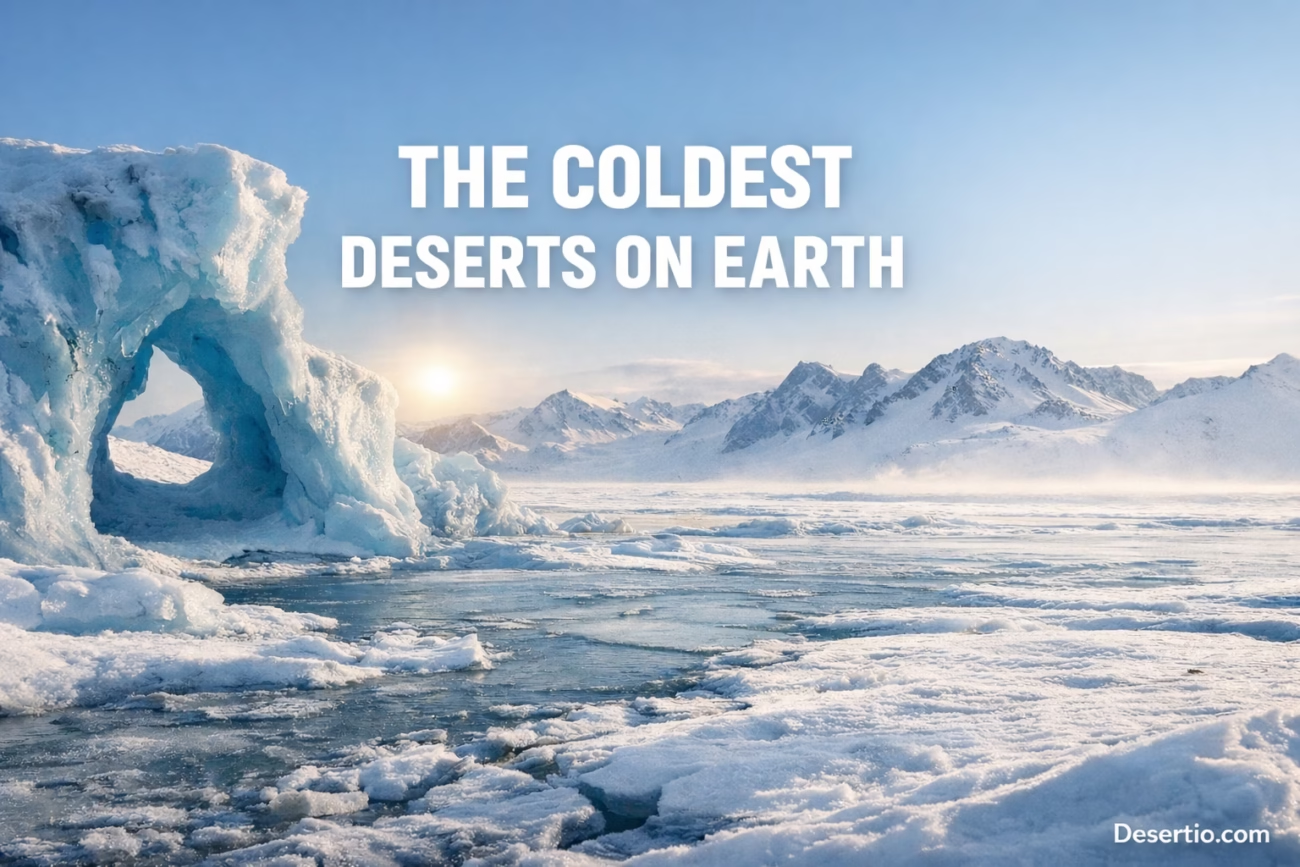
Cold deserts flip the usual desert stereotype on its head. Instead of blazing dunes, think crunchy snow, glassy ice, and air so dry it feels like it has been filtered twice. A desert is mainly defined by how little precipitation a desert climate receives, not by heat. That one detail explains why some of the coldest places on Earth also count as deserts.
- What Makes a Desert Cold?
- How Scientists Recognize a Cold Desert
- Polar Cold Deserts
- Continental and High-Altitude Cold Deserts
- Meet the Coldest Desert Realms
- Antarctic Desert
- Arctic Polar Desert
- Gobi Desert
- Patagonian Desert
- Great Basin Desert
- Ladakh Cold Desert
- Landforms That Define Cold Deserts
- The Desert Paradox: Snow Everywhere, Water Nowhere
- Life in Cold Deserts
- Plants
- Animals
- Micro Life
- Why These Places Stay So Dry
- How Scientists Study Cold Deserts
What Makes a Desert Cold?
A cold desert forms when the atmosphere struggles to deliver moisture and the ground struggles to keep warmth. Cold air holds less water vapor, so even when it “snows,” the totals can be tiny. Add persistent high pressure, distance from oceans, or mountains that wring storms dry, and you get landscapes that are dry enough to qualify as desert while staying chilly for most of the year.
- Latitude: Polar regions receive low-angle sunlight, so heating is weak and seasonal.
- Altitude: High plateaus and basins cool rapidly; thin air loses heat fast at night.
- Rain shadows: Mountains force moist air to rise and drop precipitation before it reaches the far side.
- Continental interiors: Far from the sea, air masses arrive with very little moisture left to give.
- Persistent winds: Dry winds can sweep snow away and keep surfaces exposed and parched.
How Scientists Recognize a Cold Desert
In plain terms, deserts are places where precipitation is scarce year after year. A widely used rule of thumb is about 250 mm (10 in) or less of precipitation annually, often much less in the coldest cores. Polar deserts push this to the extreme: broad areas can sit under very low snowfall totals because storms rarely penetrate far inland and the air is naturally moisture-starved.
Polar Cold Deserts
These are the heavyweight champions of cold and dryness. You’ll see vast ice sheets, bare rock, and wind-sculpted snow. The hallmark is chronic moisture shortage paired with summers that stay cool.
Continental and High-Altitude Cold Deserts
These sit far from oceans or behind mountains. They can swing from scorching sun to freezing night in a single day. Their signature is big temperature range with low yearly precipitation.
Meet the Coldest Desert Realms
Antarctic Desert
Antarctica is a desert on a colossal scale. Across much of the high interior, average annual precipitation is often below about 50 mm (liquid-water equivalent), falling mostly as fine, dry snow. The cold is not just “winter cold.” Large areas of the interior stay below freezing even in summer, and the combination of low moisture and persistent winds creates an environment that feels like a frozen version of extreme aridity.
One of the most desert-like corners is the McMurdo Dry Valleys, where bare ground, salt-crusted soils, and carved rock surfaces show what happens when water is almost always locked up. Even without sand seas, the landscape still reads as “desert” because the limiting factor is moisture, not temperature.
Arctic Polar Desert
The Arctic includes true polar-desert zones, especially across parts of the Canadian Arctic Archipelago and the central Arctic Ocean region, where annual precipitation can be 250 mm or less, and in some northern ecozones commonly around 100–200 mm. Summers are short and cool, so melting is limited; the ground stays dominated by permafrost and thin active layers that thaw briefly.
Instead of dunes, you often see gravel plains, fractured rock, and patterned ground—natural mosaics created by freeze-thaw cycles. The scenery can look like a tiled courtyard made by winter itself, with polygon shapes and subtle ridges tracing ice movement beneath the surface.
Gobi Desert
The Gobi is famous for its harsh continental swing. Winter can bite hard, and published climate summaries note average January lows that can reach around −40°C in parts of the region. Precipitation varies widely by subregion, from very low totals in the driest west to higher—but still desert-level—amounts in the northeast. What many people miss is that much of the Gobi is not a dune ocean; it is dominated by rocky plains, desert pavement, and wide basins.
Because cold air is dense and dry, the Gobi often feels “clear-edged,” like the horizon has been sharpened. Plants and animals here lean on timing: rapid growth after brief moisture, then long stretches of waiting.
Patagonian Desert
Patagonia’s desert character is shaped by the Andes: moist air drops rain and snow on the western slopes, leaving the eastern side in a dry rain shadow. Many central areas record under about 200 mm of precipitation per year. Temperatures are generally cool, and winds are a defining feature, giving the landscape a clean, open look—wide skies over steppe, gravel, and low shrubs.
Patagonia often reads more like a “stone-and-scrub desert” than a sand desert. The ground can look like a natural gravel walkway, with tough little plants spaced like careful punctuation across the plain.
Great Basin Desert
The Great Basin is a classic North American cold desert shaped by basin-and-range topography and internal drainage. Britannica summaries commonly cite annual rainfall of roughly 150–300 mm across the basin, supporting sparse desert or semidesert vegetation. Winters can be snowy, especially at higher elevations, and nights cool quickly in the clear, dry air, giving you that high-desert snap.
Salt flats and playas show up where water has nowhere to go and evaporates away, leaving minerals behind. It’s a reminder that deserts can be built as much by missing rivers as by missing rain.
Ladakh Cold Desert
Ladakh is often described as a cold desert because it sits in the rain shadow of major mountain ranges, keeping annual precipitation very low—Britannica notes averages on the order of around 80 mm annually in many areas. High elevation adds intense sunlight by day and rapid cooling by night, so the climate can feel like a bright lamp over an ice-cool floor.
The terrain blends dry slopes, broad valleys, and rugged high ground. Vegetation concentrates where meltwater and streams allow it, creating pockets of green that feel earned rather than guaranteed.
| Cold Desert Region | Main Type | Typical Annual Precipitation | Signature Look |
|---|---|---|---|
| Antarctic Desert | Polar | Often under ~50 mm (interior, water equivalent) | Ice plateau, dry valleys, wind-sculpted snow |
| Arctic Polar Desert | Polar | Commonly ≤250 mm; some northern zones ~100–200 mm | Gravel plains, patterned ground, permafrost polygons |
| Gobi Desert | Continental Cold Desert | Varies by area; often desert-low totals (tens to a couple hundred mm) | Rocky basins, desert pavement, scattered dunes |
| Patagonian Desert | Cold Desert / Steppe Edge | Often under ~200 mm in drier central zones | Wind-shaped steppe, gravel, low shrubs |
| Great Basin Desert | High Desert (Cold Desert) | Roughly 150–300 mm in many areas | Playas, salt flats, sagebrush basins, snowy ranges |
| Ladakh Cold Desert | High-Altitude Rain Shadow | Often around ~80–100 mm in many localities | High valleys, dry slopes, meltwater oases |
Landforms That Define Cold Deserts
Cold deserts build their own architecture. Water freezes, expands, and shifts soil like a slow-motion sculptor. Wind then polishes and rearranges what the cold has prepared, leaving surfaces that can look sandblasted even when sand is scarce.
- Patterned ground: Freeze-thaw cycles sort stones into circles and polygons, like nature’s neatest mosaic.
- Desert pavement: Wind removes fine particles, leaving a tight layer of stones that protects what sits beneath.
- Ventifacts: Rocks etched by wind-driven grit, often with sharp edges and flat faces.
- Salt crusts: Minerals left behind when small amounts of water evaporate from closed basins.
- Dunes in cold settings: Yes, they exist—especially where loose sand is available and winds are consistent.
The Desert Paradox: Snow Everywhere, Water Nowhere
In cold deserts, “wet” often means frozen. Snow can sit for long periods without turning into usable liquid water, and a surprising amount can vanish straight into the air through sublimation. That’s why places packed with ice can still behave like deserts: the moisture is present, but it’s not accessible in a way that supports continuous growth.
Life in Cold Deserts
Life here is less about abundance and more about precision. Organisms make the most of short summers, sheltered microhabitats, and tiny bursts of meltwater. You’ll often find the busiest biology tucked into cracks, under stones, or along brief seasonal trickles where moisture lingers just a bit longer.
Plants
- Low profiles: Cushion plants and compact shrubs reduce wind stress and conserve heat.
- Slow growth: Energy goes into survival and roots, not speed.
- Water timing: Growth pulses after melt events or rare precipitation.
Animals
- Insulation: Fur, feathers, or fat layers help manage long cold seasons.
- Behavioral timing: Activity spikes in warmer hours and seasons, then drops back.
- Efficient movement: Many species travel far between food and shelter.
Micro Life
- Cold-tolerant microbes: Some persist in soils, rock pores, and salty films.
- Dormancy: Long “pause” periods until conditions briefly improve.
- Sunlight use: In some places, light fuels tiny ecosystems even when liquid water is rare.
Cold deserts are proof that “desert” is a water story, not a heat story.
Why These Places Stay So Dry
Cold deserts don’t need blazing sun to be dry. They often run on a simple physical limit: cold air can’t carry much moisture. Add stable weather patterns that discourage storms, plus geography that blocks or drains away incoming moisture, and you get regions where precipitation arrives in tiny amounts and disappears quickly through wind, evaporation during brief warm spells, or direct ice-to-vapor loss.
- Stable high pressure: Limits cloud formation and storm frequency.
- Distance from open water: Moisture sources are far away or seasonally locked in ice.
- Mountain barriers: Force precipitation to fall before air reaches the desert interior.
- Short melt seasons: Liquid water appears briefly, then refreezes or vanishes.
How Scientists Study Cold Deserts
Because these environments change slowly, research focuses on careful measurement over time: weather stations tracking wind and snowfall, satellite observations mapping ice and surface texture, and soil or ice samples that reveal long-term patterns. The goal is to understand how energy, wind, and water interact in places where small shifts can reshape landforms, ecosystems, and the timing of melt. In cold deserts, even a thin layer of snow can matter—like a blanket that changes the entire surface temperature story.
