| Location | Northern Chile, extending into Peru, Bolivia, and Argentina |
| Total Area | ~105,000 km² (core region); up to 360,000 km² (broader region) |
| Type | Cold coastal desert (hyperarid) |
| Average Elevation | 2,000–5,000 m (6,560–16,400 ft) above sea level |
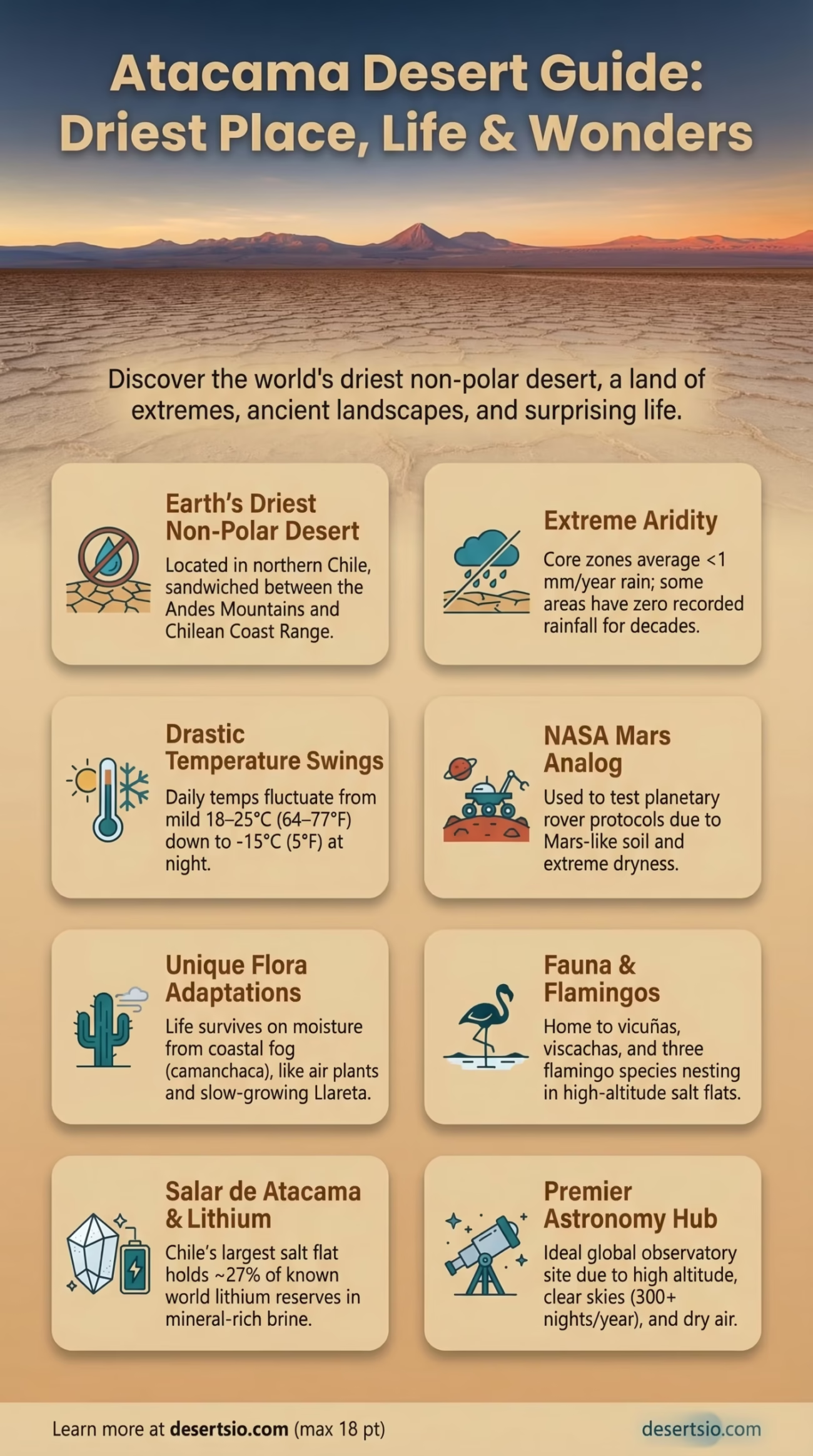
| Annual Precipitation | Less than 1 mm/year in core zones; some areas have recorded zero rainfall for decades |
| Daytime Temperature | 18–25°C (64–77°F) on average |
| Nighttime Temperature | Can drop to -15°C (5°F) at high altitudes |
| Driest Recorded Spot | Arica, Chile — avg. 0.76 mm rain per year |
| Bordering Features | Andes Mountains (east), Pacific Ocean (west), Atacama Plateau |
| Notable Subregions | Salar de Atacama, Valle de la Luna, El Tatio Geysers, Altiplano |
| Population | Sparse; indigenous Atacameño (Lickanantay) communities, mining towns |
| Key Resources | Copper, lithium, sodium nitrate, iodine |
| NASA Use | Mars analog research site — soil and atmospheric conditions mimic Mars |
The Atacama Desert holds a record that most deserts cannot come close to matching — it is widely recognized as the driest non-polar desert on Earth. Stretching along South America’s Pacific coast, primarily through northern Chile, this vast hyperarid landscape sits sandwiched between two of the continent’s most dramatic geographic features: the Andes Mountains to the east and the Chilean Coast Range to the west. These two barriers create what scientists call a double rain shadow effect, blocking moisture from both directions simultaneously. The result? A landscape so dry that some weather stations in the core Atacama have recorded no measurable rainfall for over 400 consecutive months.
- How Did the Atacama Form?
- Atacama Desert Location and Map View
- How Big Is the Atacama?
- Temperature: Surprisingly Harsh Swings
- Flora and Fauna: Life in the Extreme
- Human Life in the Atacama
- Lithium, Copper, and the Resource Reality
- The Atacama as a Scientific Laboratory
- Nearby Deserts and Regional Context
- The Atacama’s Rapidly Changing Circumstances
- Atacama Desert: Key Scientific Terms
- El Tatio and the Geothermal Zone
- Salar de Atacama: A Salt Flat Like No Other
How Did the Atacama Form?
The Atacama’s origin is no single dramatic event — it has been drying out for roughly 150 million years, making it one of the oldest deserts on the planet. Several overlapping geological and atmospheric forces drove this transformation.
First, the Humboldt Current — a cold Pacific Ocean current — chills the air above the ocean surface, suppressing evaporation and preventing clouds from carrying moisture inland. Second, the Andes act as an enormous wall, blocking wet Amazonian air from the east. Third, the region sits in a persistent subtropical high-pressure zone, which pushes air downward and inhibits cloud formation.
And together, these factors have been reinforcing each other for millions of years. The Atacama was already hyperarid by the time early humans arrived in South America — it didn’t become a desert. It always was one.
Atacama Desert Location and Map View
How Big Is the Atacama?
Depending on how boundaries are drawn, the Atacama covers between 105,000 km² (core hyperarid zone) and roughly 360,000 km² when the broader surrounding plateau and transition zones are included. To put that in context — the core Atacama alone is larger than the entire United Kingdom, which covers approximately 243,000 km². Even by conservative estimates, the Atacama dwarfs many European nations.
At elevations mostly between 2,000 and 4,000 meters, this is also one of the highest-elevation deserts in the world — not just the driest. The combination of altitude, aridity, and atmospheric clarity makes it a different kind of extreme environment than a typical sand-dune desert.
Temperature: Surprisingly Harsh Swings
People often assume desert means heat. The Atacama challenges that assumption hard. During the day, temperatures in lower-elevation zones typically range between 18°C and 25°C (64–77°F) — comfortable, even mild. But at night, especially at high-altitude sections near the Altiplano, temperatures can plunge to -15°C (5°F) or lower. That’s a daily swing of up to 40°C in some locations.
This isn’t just uncomfortable — it’s geologically active. Repeated freeze-thaw cycles over millennia have cracked and shaped the rock formations, creating the eerily sculpted terrain the desert is famous for. Valle de la Luna (Valley of the Moon), near San Pedro de Atacama, is perhaps the most dramatic example: jagged salt formations and eroded clay ridges that look less like Earth and more like a planetary surface rendered in film.
Flora and Fauna: Life in the Extreme
Life, it turns out, finds a way — even here. The Atacama supports a surprising range of organisms, though adapted in ways that seem almost improbable.
Plant life in the Atacama includes:
- Tillandsia (air plants) — survive entirely on moisture from coastal fog, with no soil contact required
- Llareta (Azorella compacta) — a dense, cushion-like plant that grows at elevations above 3,000 m; it grows just 1.5 cm per year and some living specimens are over 3,000 years old
- Cacti species such as Eulychnia and Copiapoa, clustered near the coast where fog is more frequent
- Queñoa trees (Polylepis), found at altitudes exceeding 4,500 m along the Andean fringes
Once every several years — when rare rainfall events occur — the desert transforms briefly into something almost unrecognizable. This phenomenon, locally called the “desierto florido” (flowering desert), sees the previously barren ground erupt in dense carpets of wildflowers. It’s been documented more intensely in recent years, possibly linked to shifting climate patterns — a detail researchers are watching closely.
Animal life is sparse but real:
- Vicuña — a wild relative of the llama, roaming the high-altitude Altiplano in herds
- Andean flamingos — three species nest around the salt flats, particularly Salar de Atacama
- Viscachas — rabbit-like rodents often seen perched on rocky outcrops
- Various lizard species, including Liolaemus genus — cold-adapted and found at remarkable elevations
- Andean condors — spotted soaring above the Andean border zones
Microbial life in the soil is another story entirely. NASA researchers have found perchlorate-resistant bacteria living inside rocks in the Atacama — organisms that survive by extracting moisture from minerals. That discovery directly informed the search for life on Mars.
Human Life in the Atacama
People have lived in and around the Atacama for at least 10,000 years. The indigenous Atacameño people — also known as the Lickanantay — developed sustainable societies in this environment long before modern infrastructure made it viable for outsiders. They built irrigation systems called qochas and acequias to channel snowmelt from the Andes into small agricultural plots in oases like San Pedro de Atacama.
Today, around 1 million people live in the broader Atacama region, concentrated in coastal cities like Antofagasta and Iquique, and mining hubs scattered across the interior. San Pedro de Atacama itself has a population of roughly 10,000 but receives hundreds of thousands of visitors annually — drawn by astrotourism, salt flats, and geothermal fields.
Indigenous Lickanantay communities continue to maintain cultural presence in the region, with active land rights negotiations ongoing regarding lithium extraction on ancestral territories.
Lithium, Copper, and the Resource Reality
The Atacama sits on top of extraordinary mineral wealth. The Salar de Atacama salt flat alone contains roughly 27% of the world’s known lithium reserves — a figure that has made this desert geopolitically significant in the age of electric vehicles and battery technology. Chile is currently the world’s second-largest lithium producer, and demand is accelerating fast.
Copper has been mined in the Atacama for centuries. The Chuquicamata open-pit copper mine — one of the largest by volume in the world — has been operational since 1910 and sits at over 2,800 meters elevation. In 2023, Chile produced approximately 5.3 million metric tons of copper, much of it from Atacama-region mines.
This mineral abundance creates real tension. Water is the desert’s most precious resource, and lithium extraction requires enormous volumes of it — directly competing with local communities and fragile ecosystems. This tension between resource development and environmental sustainability is one of the most actively debated issues in South American environmental policy today.
The Atacama as a Scientific Laboratory
Few places on Earth serve science the way the Atacama does. The combination of extreme aridity, high altitude, thin atmosphere, and minimal light pollution has made it the premier site for astronomical observation on the planet.
- The ALMA Observatory (Atacama Large Millimeter/submillimeter Array), located at 5,000 m elevation, is the world’s most powerful radio telescope array — a collaboration involving 66 high-precision antennas
- The Very Large Telescope (VLT) at Cerro Paranal operates in the Atacama and has captured some of the deepest images of the observable universe
- The upcoming Extremely Large Telescope (ELT), under construction at Cerro Armazones (3,046 m), will be the largest optical telescope ever built when completed around 2028
- NASA’s Mars analog studies in the Atacama have directly shaped protocols for the Perseverance rover mission
The skies above the Atacama are genuinely extraordinary — over 300 clear nights per year in the core observatory zones. And that’s not a marketing line. It’s a measured atmospheric fact that scientists depend on.
Nearby Deserts and Regional Context
The Atacama doesn’t exist in isolation — it’s part of a broader pattern of arid landscapes along South America’s western edge and beyond.
To the north, the Sechura Desert of coastal Peru shares many of the same fog-belt characteristics as the Atacama, also shaped by the Humboldt Current. It’s far less extreme but geologically related. Further into the Andes and eastward, the Puna de Atacama (the high plateau shared between Argentina and Chile) transitions into the drier reaches of the Argentine Monte Desert.
Comparisons are frequently drawn between the Atacama and the Namib Desert of southwestern Africa — another cold coastal desert shaped by an upwelling ocean current (the Benguela Current, equivalent to the Humboldt). Both deserts feature coastal fog systems, unique endemic species, and hyperarid cores surrounded by more biodiverse transition zones. The Namib, however, is older — estimated at 55–80 million years — making it potentially the oldest desert on Earth, while the Atacama’s hyperarid phase is more conservatively dated at around 3 million years (though broader aridity stretches back far longer).
| Feature | Atacama Desert | Namib Desert |
| Location | Chile / South America | Namibia / Southern Africa |
| Type | Cold coastal / hyperarid | Cold coastal / hyperarid |
| Area | ~105,000–360,000 km² | ~81,000 km² |
| Ocean Current | Humboldt Current | Benguela Current |
| Annual Rainfall | <1 mm (core) | 2–200 mm (varies) |
| Estimated Age | ~150 million years (aridity onset) | ~55–80 million years |
| Key Feature | Lithium reserves, astronomical observatories | Tall dunes (Sossusvlei), fog-adapted life |
The Atacama’s Rapidly Changing Circumstances
Climate science is now paying close attention to the Atacama — not just because it’s a useful Mars analog, but because its own stability is shifting. A 2023 study published in the journal Nature Climate Change flagged that precipitation patterns across the hyperarid core appear to be changing at a rate inconsistent with long-term historical norms. The desierto florido events (flowering desert blooms) have become more frequent since 2015 — beautiful, yes, but also a signal of unusual climatic disturbance.
Meanwhile, water depletion from mining and municipal use is measurably reducing the water table in several Atacama basins. The Lickanantay communities near Salar de Atacama have formally raised concerns about ancestral water sources drying up — a situation that environmental bodies across South America are monitoring with increasing urgency.
Atacama Desert: Key Scientific Terms
Hyperarid: A climate classification where annual rainfall is consistently below 25 mm, with extreme variability. The Atacama core receives less than 1 mm.
Double Rain Shadow: When two mountain ranges block precipitation from both sides of a region — the specific mechanism at work in the Atacama.
Camanchaca: The dense coastal fog system of the Atacama, formed by cold Humboldt Current air meeting warmer land masses. It’s a critical water source for both plants and some indigenous communities who use fog-catching nets.
Altiplano: The high-altitude plateau bordering the Atacama’s eastern edge, shared between Chile, Bolivia, Peru, and Argentina — home to volcanoes, salt lakes, and flamingo populations.
El Tatio and the Geothermal Zone
At 4,320 meters above sea level, El Tatio is the largest geyser field in the Southern Hemisphere and the third largest in the world. Over 80 active geysers erupt here — most dramatically at dawn, when steam clouds rise against freezing air in dense, theatrical plumes. The geothermal activity is driven by the volcanic arc of the central Andes, where magma chambers sit relatively close to the surface.
The site also has scientific significance beyond spectacle: its extreme conditions — heat, acidity, and mineral-rich water — host thermophilic microorganisms studied for both pharmaceutical research and astrobiology. Life at El Tatio operates at the edge of what chemistry allows.
Salar de Atacama: A Salt Flat Like No Other
The Salar de Atacama is the largest salt flat in Chile — covering approximately 3,000 km² — and one of the most economically significant landscapes anywhere in the world right now. Beneath its hard, white crust lies a brine solution extraordinarily rich in lithium and potassium. The salt flat forms part of a closed basin with no outlet to the sea; water flows in from the Andes and simply evaporates, leaving minerals behind over millions of years.
Three species of flamingo — the Chilean, Andean, and James’s flamingo — breed around its shallow lagoons, feeding on algae and invertebrates in the highly saline water. It’s an unexpected image: pink birds nesting beside industrial lithium extraction infrastructure. That image, in many ways, captures the essential tension of the modern Atacama.
