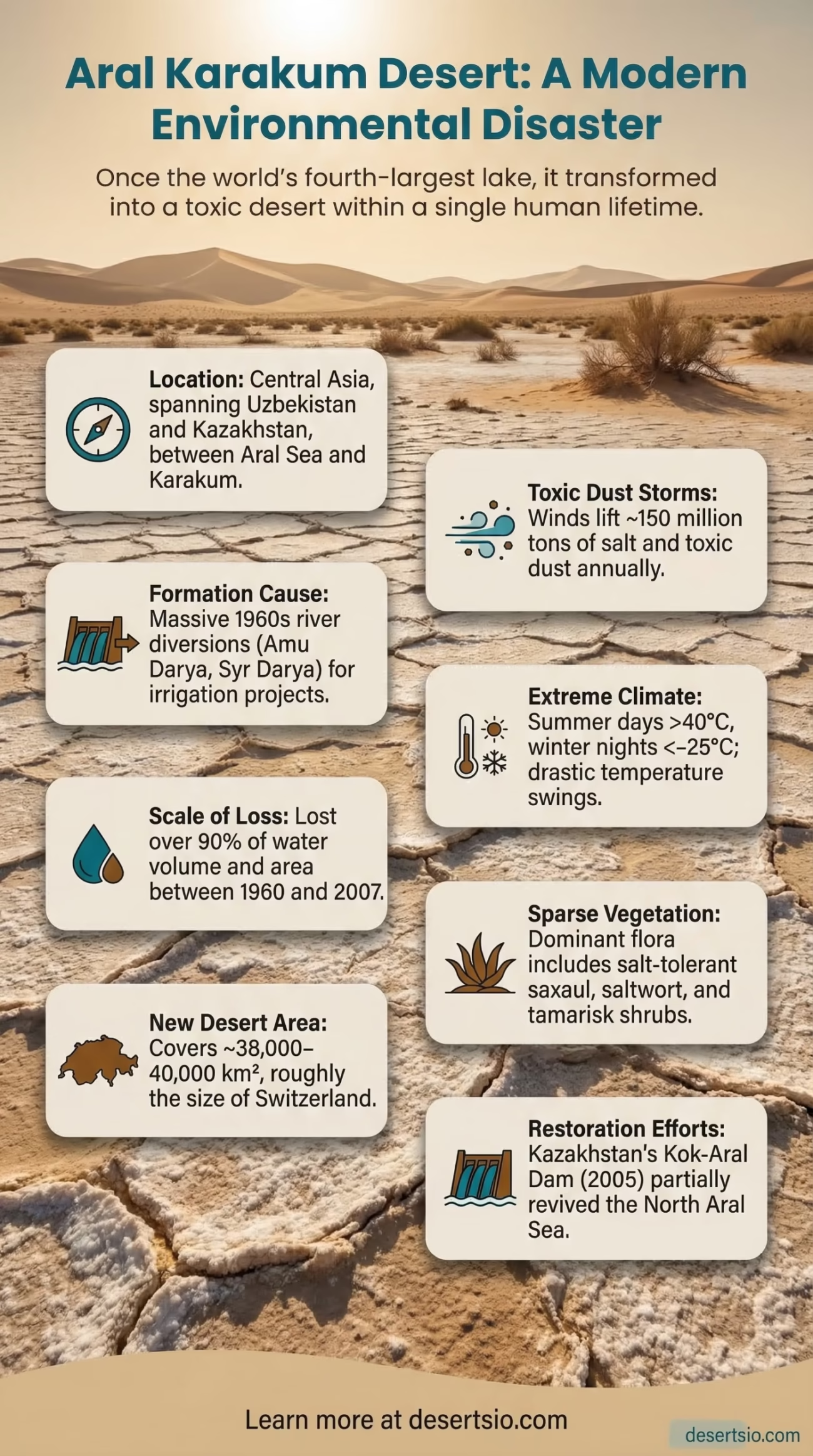
| Location | Central Asia — between the Aral Sea basin and the Karakum Desert, spanning Uzbekistan and Kazakhstan |
| Area | Approximately 38,000–40,000 km² (14,700–15,400 sq mi) — roughly the size of Switzerland |
| Type | Sandy desert / anthropogenic desertification zone |
| Elevation | 53 m below sea level (former Aral Sea bed) to ~200 m above sea level |
| Average Daytime Temperature | Summer: 40–45°C (104–113°F) / Winter: −20 to −25°C (−4 to −13°F) |
| Average Nighttime Temperature | Summer nights: 20–25°C / Winter nights: −25 to −30°C |
| Annual Precipitation | Less than 100 mm/year (under 4 inches) |
| Primary Formation Cause | Diversion of Amu Darya and Syr Darya rivers beginning in the 1960s |
| Salt Crust Composition | Up to 150 million tons of salt and toxic dust deposited annually across the region |
| Water Loss | Aral Sea lost over 90% of its water volume between 1960 and 2007 |
| Dominant Vegetation | Sparse saxaul (Haloxylon), saltwort (Salsola), tamarisk (Tamarix) |
| Human Population | Severely reduced; some remaining communities in Moynaq (Uzbekistan) and Aralsk (Kazakhstan) |
| UNESCO Status | Recognized as one of the world’s worst environmental disasters |
| Current Restoration Efforts | North Aral Sea (Kazakhstan side) partially recovering due to Kok-Aral Dam (built 2005) |
The Aral Karakum Desert is not a desert in the traditional sense — it was not always there. What exists today is the exposed seabed of what was once the fourth-largest lake in the world, now transformed into one of the most dramatic examples of human-induced desertification ever recorded. Within a single human lifetime, an inland sea evaporated. What remained was salt, dust, and silence.
- Aral Karakum Desert Location and Map View
- Formation: How a Sea Became a Desert
- How Big Is It — And What Does That Actually Mean?
- Temperature: A Desert of Extremes
- The Salt Dust Problem
- Flora and Fauna: Life in an Unlikely Place
- Human Life: Who Still Lives Here?
- The North Aral: A Recovery Story Worth Noting
- North Aral (Kazakhstan)
- South Aral (Uzbekistan)
- Neighboring Deserts: Context Within Central Asia
- Current and Ongoing Efforts
- Desert Glossary: Key Terms
- Technical Data: What the Numbers Show
The term “Aral Karakum” — sometimes written as Aralkum — refers specifically to the newly formed desert that emerged from the dried-out floor of the Aral Sea. Karakum translates roughly as “black sand” in Turkic languages, a name shared with the massive Karakum Desert of Turkmenistan to the south. But the Aral Karakum is its own distinct phenomenon: younger, saltier, and far more toxic than its neighbor.
Aral Karakum Desert Location and Map View
Formation: How a Sea Became a Desert
The Aral Sea once covered around 68,000 km² — an enormous body of water fed by two major rivers, the Amu Darya (flowing from Tajikistan and Afghanistan) and the Syr Darya (originating in Kyrgyzstan). In the 1960s, large-scale Soviet irrigation projects began diverting these rivers to feed cotton and wheat fields across the Central Asian steppe. The logic was straightforward: maximize agricultural output from arid land.
The consequence was not foreseen — or perhaps not taken seriously enough. With its two main water sources redirected, the Aral Sea began to shrink. Slowly at first. Then rapidly. By the 1980s, satellite images already showed a sea splitting into two separate bodies. By 2007, the lake had lost more than 90% of its volume. The southern basin essentially ceased to exist as a functioning lake.
What was exposed beneath the retreating water was a flat, mineral-rich lakebed — now baked by extreme heat, scoured by wind, and encrusted with salt. This is the Aral Karakum: a desert formed not by geological time but by decades of engineering decisions. It is one of the youngest deserts on Earth.
How Big Is It — And What Does That Actually Mean?
The Aral Karakum currently covers approximately 38,000–40,000 km². To put that in perspective, it is roughly the size of Switzerland — or larger than the entire country of the Netherlands and Belgium combined. And it did not exist before 1960. That scale of land transformation within a few decades is almost without parallel in modern environmental history.
Unlike ancient deserts formed over millennia, this one grew within living memory. Fishermen who worked the Aral Sea as children watched it disappear during their own lifetimes. Former port towns like Moynaq in Uzbekistan and Aralsk in Kazakhstan — once thriving fishing communities — found themselves stranded dozens of kilometers from any water.
Temperature: A Desert of Extremes
The climate of the Aral Karakum is brutally continental. There is no moderating water body anymore — the lake that once softened temperature swings is gone. Summer daytime temperatures regularly exceed 40–45°C (104–113°F), while winter nights can plummet to −25 to −30°C (−13 to −22°F). The diurnal (day-night) range in summer alone can reach 20–25°C, dropping from scorching afternoon heat to surprisingly cool, almost cold nights.
Annual precipitation barely reaches 100 mm/year — less than London gets in an average month. Wind is a defining feature of the landscape. Dust storms carrying salt and pesticide residues from the former lakebed are common, sometimes traveling hundreds of kilometers before depositing their toxic load.
The Salt Dust Problem
The Aral Karakum is not just a sandy desert. Its surface is heavily contaminated with salt, pesticides, and heavy metals — residues from decades of Soviet-era agricultural runoff that accumulated on the lakebed. Winds lift an estimated 150 million tons of salt and toxic dust per year, creating a regional public health crisis. Communities across Uzbekistan and Kazakhstan report elevated rates of respiratory illness, anemia, and kidney disease. The dust has been detected as far as the Himalayan glaciers and Arctic ice cores.
Flora and Fauna: Life in an Unlikely Place
Survival here demands adaptation at an extreme level. The Aral Karakum is not completely barren — nature, as it tends to do, finds a way. But what grows and lives here is sparse, specialized, and often salt-tolerant to a remarkable degree.
Dominant plant species include:
- Saxaul (Haloxylon ammodendron) — a deep-rooted, drought-hardy tree critical for stabilizing sand and salt crusts
- Saltwort (Salsola spp.) — one of the first colonizers on exposed lakebed, tolerating extreme salinity
- Tamarisk (Tamarix spp.) — a shrub that can excrete salt through its leaves, thriving where most plants collapse
- Kalidium and Suaeda species — halophytic plants found along the saltiest zones of the former shoreline
Fauna is thin but present. Saiga antelopes — a critically endangered species native to Central Asian steppes — occasionally move through the edges of the desert. Migratory birds still pass overhead, though they no longer find the wetland habitat they once did. Reptiles, particularly lizards and snakes adapted to dry, saline conditions, have claimed parts of the lakebed as their own. The former sea’s fishery — which once produced 40,000–50,000 tons of fish annually — is, on the southern side, essentially gone.
Human Life: Who Still Lives Here?
The people of the Aral region are among the most resilient — and most overlooked — in Central Asia. Moynaq, once a bustling Uzbek fishing port with a canning industry that exported fish across the Soviet Union, now sits roughly 150 km from the nearest water. The ships that used to dock there are rusting in the desert sand — a graveyard of metal hulls that has become one of Central Asia’s most photographed landscapes.
Population in these communities has declined sharply. Moynaq’s population dropped from roughly 40,000 at its peak to around 5,000–7,000 today. Young people left. Older residents stayed, often with no other option. Those who remain face serious health challenges linked to the salt and dust contamination — healthcare infrastructure in the region is limited, and access to clean water is difficult.
There are no nomadic tribes living within the desert itself. The conditions are simply too hostile. But the Karakalpaks — an indigenous Turkic people — have inhabited the surrounding region for centuries, and their cultural identity is deeply tied to the Aral Sea. Karakalpakstan, an autonomous republic within Uzbekistan, bears the weight of this environmental crisis more than any other area.
The North Aral: A Recovery Story Worth Noting
Not everything here points to decline. In 2005, Kazakhstan completed the Kok-Aral Dam — an 87-km dike built to separate the northern section of the Aral Sea from the southern basin and allow it to refill from the Syr Darya. The results surprised many scientists.
Within a few years, the North Aral Sea’s water level rose by several meters. Salinity dropped. Fish returned. By the early 2010s, commercial fishing had resumed in the north. The town of Aralsk, once left stranded, began to see the water approaching again. It is a partial recovery — the southern basin remains a desert — but it demonstrates that targeted intervention can, at least in some cases, reverse desertification driven by water loss.
North Aral (Kazakhstan)
Kok-Aral Dam built in 2005. Water levels rose 3–4 meters within years. Salinity fell from 40 g/L to below 10 g/L. Fish stocks partially restored. Commercial fishing resumed.
South Aral (Uzbekistan)
Largely dried. No significant recovery. The Aral Karakum desert occupies this area. Moynaq remains stranded. Saxaul planting programs underway but slow.
Neighboring Deserts: Context Within Central Asia
The Aral Karakum does not sit in geographic isolation. Central Asia is home to several major desert systems, and understanding how they relate to each other helps clarify the scale of aridity across the region.
- Karakum Desert (Turkmenistan) — covering approximately 350,000 km², this is one of the largest sandy deserts in the world. The name is shared but the origin is entirely different — ancient, wind-sculpted, and geologically old. The Aral Karakum is essentially its younger, man-made sibling to the north.
- Kyzylkum Desert — stretching across Uzbekistan and Kazakhstan, this 298,000 km² desert lies directly between the two former Aral Sea rivers. It is ancient and sandy, and its southeastern edge nearly borders the Aral Karakum. The two zones are increasingly merging in some areas.
- Ustyurt Plateau — a vast, flat tableland desert between the Aral Sea and the Caspian Sea, characterized by clay and chalk rather than sand. Arid and largely uninhabited.
If you compare the Aral Karakum to other human-influenced desert zones worldwide, the Atacama’s expansion zones in South America or the southern fringe of the Sahara (Sahel region) come to mind. All share desertification driven partly by human activity — but the Aral situation is uniquely rapid and uniquely reversible in at least some portions.
Current and Ongoing Efforts
Uzbekistan has launched large-scale saxaul tree-planting campaigns on the former lakebed, aiming to stabilize the surface and reduce the toxic dust storms. By 2023, the Uzbek government reported planting saxaul across more than 1.7 million hectares of the exposed seabed — a project still ongoing and supported by international environmental organizations.
And the global conversation around the Aral Sea has grown louder. Climate discussions increasingly reference the Aral Karakum as a warning — a case study in what large-scale water mismanagement can produce within decades. The UN’s Special Programme for the Economies of Central Asia (SPECA) and the International Fund for Saving the Aral Sea (IFAS) continue coordinating regional responses.
The Aral Karakum is also becoming — strangely — a subject of scientific interest for researchers studying rapid ecosystem formation. A desert that formed in 50 years gives scientists a rare window into how plant communities establish themselves on bare, hostile substrates. What colonizes first? How does soil chemistry change? The answers have implications far beyond Central Asia.
Desert Glossary: Key Terms
Aralkum — The scientific/geographic name used for the Aral Karakum Desert, referring specifically to the exposed lakebed of the former Aral Sea.
Halophyte — A plant adapted to grow in saline, salt-heavy soils; the dominant vegetation type across the Aral Karakum.
Anthropogenic Desertification — Desert formation caused by human activity rather than natural climate shifts; the defining characteristic of the Aral Karakum.
Diurnal Range — The difference between daytime high and nighttime low temperatures; extreme in the Aral Karakum due to the loss of the sea’s moderating effect.
Technical Data: What the Numbers Show
| Aral Sea Area (1960) | ~68,000 km² |
| Aral Sea Area (2007) | ~10,000 km² (south basin: ~2,000 km²) |
| Water Volume Lost | Over 1,000 km³ — more than 90% of original volume |
| Salinity Increase | From ~10 g/L (1960) to over 100 g/L (2000s, south basin) |
| New Desert Area Formed | ~38,000–40,000 km² (Aral Karakum) |
| Annual Dust/Salt Emission | ~150 million tons per year |
| Saxaul Planted (Uzbekistan) | Over 1.7 million hectares by 2023 |
| North Aral Salinity (post-dam) | Dropped from ~40 g/L to below 10 g/L |
| North Aral Water Level Rise | +3–4 meters above pre-dam level |
| Former Annual Fish Catch | 40,000–50,000 tons/year (pre-1960s) |
These figures are not abstractions. Each number represents a measurable environmental shift — one that reshaped the climate of a region, displaced hundreds of thousands of people, and redrew the map of Central Asia. The Aral Karakum is the most precisely documented case of a desert being born within a single human generation.
And perhaps that is what makes it so important. Other deserts tell stories of geological eras. This one tells the story of choices made in the 20th century — and what happens when a water system is pushed past its limits. Whether partial recovery continues in the north, or whether the southern basin remains a salt flat for centuries, the Aral Karakum will continue to be one of the most studied and sobering landscapes on Earth.
{
“@context”: “https://schema.org”,
“@graph”: [
{
“@type”: “Organization”,
“@id”: “https://desertio.com/#publisher”,
“name”: “DESERTIO”,
“url”: “https://desertio.com”
},
{
“@type”: [“Landform”, “Place”],
“@id”: “https://desertio.com/aral-karakum-desert/#aralKarakumDesert”,
“name”: “Aral Karakum Desert”,
“alternateName”: [
“Aral Karakum”,
“Арал қарақұмы”,
“Priaral Karakum”
],
“description”: “The Aral Karakum Desert is a sandy desert in Kazakhstan northeast of the Aral Sea, covering about 40,000 square kilometers and known for flat terrain, low rainfall, dust storms and cold-desert conditions.”,
“image”: {
“@id”: “https://desertio.com/aral-karakum-desert/#aralKarakumHero”
},
“geo”: {
“@id”: “https://desertio.com/aral-karakum-desert/#aralKarakumGeo”
},
“additionalProperty”: {
“@type”: “PropertyValue”,
“name”: “Köppen climate classification”,
“value”: “BWk”
},
“url”: “https://desertio.com/aral-karakum-desert/”
},
{
“@type”: “GeoCoordinates”,
“@id”: “https://desertio.com/aral-karakum-desert/#aralKarakumGeo”,
“latitude”: 46.6883,
“longitude”: 63.0192
},
{
“@type”: “GeoShape”,
“@id”: “https://desertio.com/aral-karakum-desert/#aralKarakumShape”,
“box”: “45.8 61.0 47.8 65.0”,
“addressCountry”: [“KZ”]
},
{
“@type”: “TouristDestination”,
“@id”: “https://desertio.com/aral-karakum-desert/#aralKarakumDestination”,
“name”: “Aral Karakum Desert”,
“description”: “A remote desert landscape in Kazakhstan near the Aral Sea, noted for sandy ridges, salt lakes, the Syr Darya corridor and the wider environmental history of the Aral region.”,
“geo”: {
“@id”: “https://desertio.com/aral-karakum-desert/#aralKarakumGeo”
},
“includesAttraction”: [
{
“@id”: “https://desertio.com/aral-karakum-desert/#northAralSea”
},
{
“@id”: “https://desertio.com/aral-karakum-desert/#lakeZhaksykylysh”
},
{
“@id”: “https://desertio.com/aral-karakum-desert/#syrDarya”
}
]
},
{
“@type”: “TouristAttraction”,
“@id”: “https://desertio.com/aral-karakum-desert/#northAralSea”,
“name”: “North Aral Sea”,
“description”: “The surviving northern basin of the former Aral Sea in Kazakhstan, fed by the Syr Darya and an important landmark on the western side of the broader Aral Karakum region.”
},
{
“@type”: “TouristAttraction”,
“@id”: “https://desertio.com/aral-karakum-desert/#lakeZhaksykylysh”,
“name”: “Lake Zhaksykylysh”,
“description”: “A salt lake cluster in the western Aral Karakum about 30 kilometers northeast of the Aral Sea, known for seasonal shrinkage and long-standing salt extraction.”
},
{
“@type”: “TouristAttraction”,
“@id”: “https://desertio.com/aral-karakum-desert/#syrDarya”,
“name”: “Syr Darya River”,
“description”: “The major river forming the southern boundary of the Aral Karakum Desert and the main watercourse shaping the surrounding Aral Sea region.”
},
{
“@type”: “ImageObject”,
“@id”: “https://desertio.com/aral-karakum-desert/#aralKarakumHero”,
“url”: “https://desertio.com/wp-content/uploads/2026/03/Aral-Karakum-Desert-Kazakhstan-Map-Size-Climate-Animals-Facts-infographic-scaled.avif”,
“caption”: “Aral Karakum Desert infographic showing location, size, climate and landscape”,
“inLanguage”: “en-GB”,
“copyrightHolder”: {
“@id”: “https://desertio.com/#publisher”
}
},
{
“@type”: “Dataset”,
“@id”: “https://desertio.com/aral-karakum-desert/#aralKarakumDataset”,
“name”: “Aral Karakum Desert Climate and Geography Data”,
“description”: “Compiled table of Aral Karakum Desert size, climate, elevation, terrain and ecological data cited in the Aral Karakum guide.”,
“creator”: {
“@id”: “https://desertio.com/#publisher”
},
“spatialCoverage”: {
“@id”: “https://desertio.com/aral-karakum-desert/#aralKarakumDesert”
},
“variableMeasured”: [
{
“@type”: “PropertyValue”,
“name”: “Total Area”
},
{
“@type”: “PropertyValue”,
“name”: “Average Annual Rainfall”
},
{
“@type”: “PropertyValue”,
“name”: “Typical Summer Daytime Temperature”
},
{
“@type”: “PropertyValue”,
“name”: “Typical Winter Night Temperature”
},
{
“@type”: “PropertyValue”,
“name”: “Lowest Recorded Temperature”
},
{
“@type”: “PropertyValue”,
“name”: “Highest Recorded Temperature”
},
{
“@type”: “PropertyValue”,
“name”: “Elevation Range”
},
{
“@type”: “PropertyValue”,
“name”: “Maximum Dune Height”
}
],
“license”: “https://creativecommons.org/licenses/by/4.0/”
},
{
“@type”: “FAQPage”,
“@id”: “https://desertio.com/aral-karakum-desert/#aralKarakumFAQ”,
“mainEntity”: [
{
“@type”: “Question”,
“name”: “Where is the Aral Karakum Desert located?”,
“acceptedAnswer”: {
“@type”: “Answer”,
“text”: “The Aral Karakum Desert is located in Kazakhstan, northeast of the Aral Sea. Most of it lies in the Aral and Kazaly districts of Kyzylorda Region, with smaller extensions into Aktobe and Karaganda regions.”
}
},
{
“@type”: “Question”,
“name”: “How big is the Aral Karakum Desert?”,
“acceptedAnswer”: {
“@type”: “Answer”,
“text”: “The Aral Karakum covers about 40,000 square kilometers (15,000 square miles).”
}
},
{
“@type”: “Question”,
“name”: “Is the Aral Karakum the same as the Aralkum Desert?”,
“acceptedAnswer”: {
“@type”: “Answer”,
“text”: “No. The Aral Karakum is a distinct desert in Kazakhstan near the Aral Sea, while the Aralkum is the newer desert that formed on the dried seabed of the shrinking Aral Sea.”
}
},
{
“@type”: “Question”,
“name”: “What river borders the Aral Karakum Desert?”,
“acceptedAnswer”: {
“@type”: “Answer”,
“text”: “The Syr Darya River forms the southern boundary of the Aral Karakum Desert.”
}
},
{
“@type”: “Question”,
“name”: “How much rain falls in the Aral Karakum Desert?”,
“acceptedAnswer”: {
“@type”: “Answer”,
“text”: “Annual precipitation in the Aral Karakum is around 120 millimeters (4.7 inches), making it a very dry desert environment.”
}
},
{
“@type”: “Question”,
“name”: “How hot and cold does the Aral Karakum Desert get?”,
“acceptedAnswer”: {
“@type”: “Answer”,
“text”: “Summer daytime temperatures usually range from 30 to 35 degrees Celsius and can reach 43 degrees Celsius. In winter, daytime temperatures are often between minus 5 and 10 degrees Celsius, while nights can drop to around minus 25 degrees Celsius, with recorded lows of minus 42 degrees Celsius.”
}
},
{
“@type”: “Question”,
“name”: “What is the landscape like in the Aral Karakum Desert?”,
“acceptedAnswer”: {
“@type”: “Answer”,
“text”: “The Aral Karakum is mostly flat and low-lying, generally between 55 and 118 meters above sea level, with sandy terrain and dunes that can reach about 25 meters in height.”
}
},
{
“@type”: “Question”,
“name”: “Which plants and animals live in the Aral Karakum Desert?”,
“acceptedAnswer”: {
“@type”: “Answer”,
“text”: “Vegetation is sparse and includes grasses, wormwood, fescue, saxaul, tamarisk and other drought-tolerant species. Animals reported from the wider region include saiga, corsac fox, wolves, rodents and desert birds.”
}
}
]
}
]
}
