| Location | Tuscany (Toscana), Central Italy |
| Coordinates | 43°10′N 11°20′E |
| Area | Approx. 20,000–22,000 hectares (200–220 km²) |
| Elevation | 300–500 m (984–1,640 ft) above sea level |
| Type | Semi-arid badlands / sub-desert landscape |
| Climate Zone | Mediterranean semi-arid (BSk/Csa transition) |
| Annual Precipitation | Approx. 600–700 mm/year (highly seasonal) |
| Average Summer Temperature | Daytime: 36–40°C / Nighttime: 16–20°C |
| Average Winter Temperature | Daytime: 8–12°C / Nighttime: 0–4°C (frost possible) |
| Dominant Soil Type | Pliocene marine clay (Biancane formations) |
| Primary Vegetation | Sparse Mediterranean scrub, Artemisia, Salicornia |
| Protected Status | Partially within Crete Senesi natural landscape zone |
| Nearest Major City | Siena (~40 km north) |
| Known For | Biancane clay formations, moonscape terrain, Etruscan heritage |
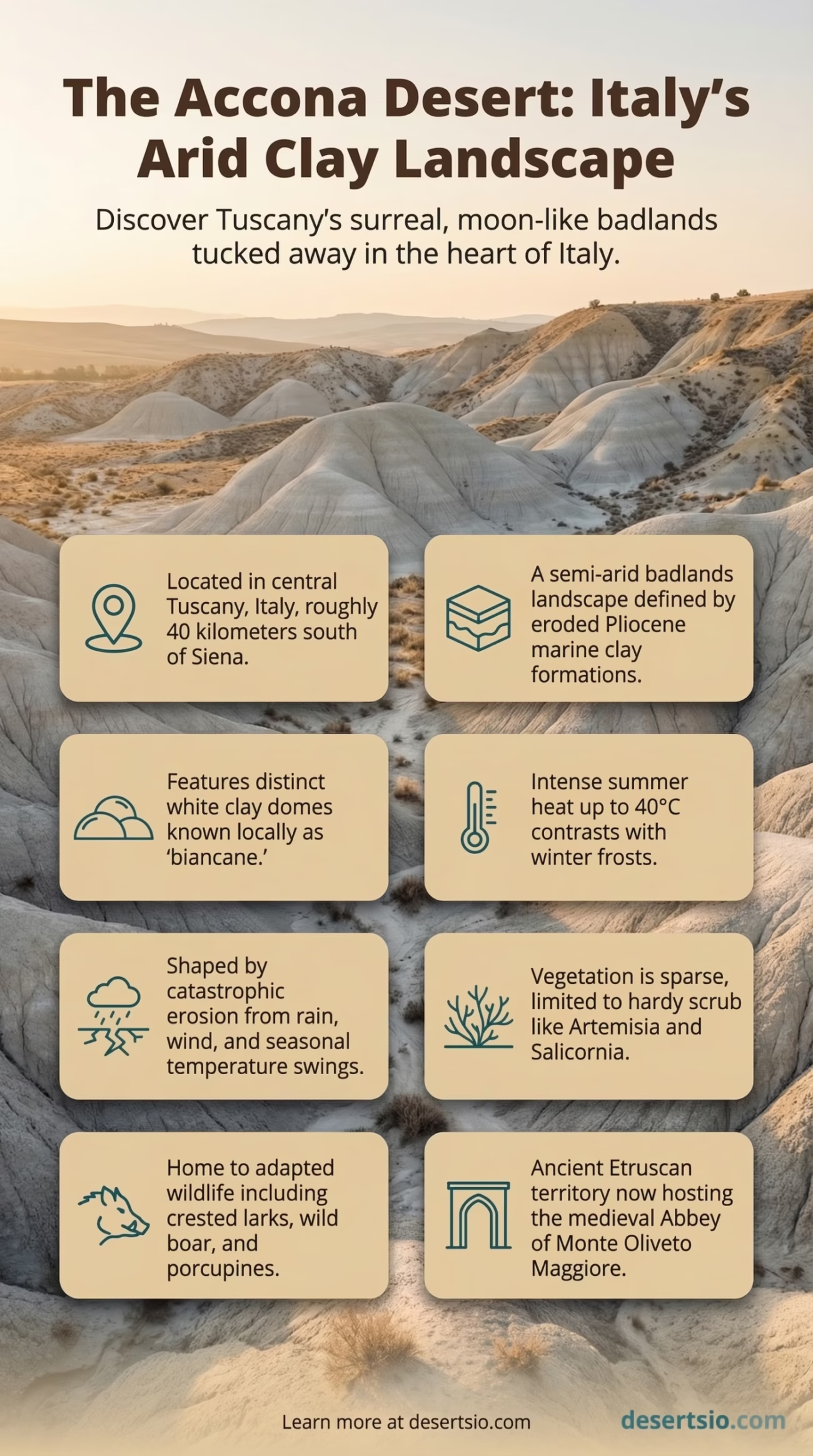
Tucked into the rolling hills of Tuscany, roughly 40 kilometers south of Siena, the Accona Desert catches most people completely off guard. Italy is not a country you typically associate with arid, barren terrain — and yet here it is. A landscape so stripped and pale it looks like it belongs on another planet, not in the heart of one of Europe’s most celebrated regions. The Accona Desert is not a desert in the classic Saharan sense. No towering dunes, no endless sand. Instead, it is a badlands landscape shaped by ancient marine sediments and centuries of erosion, producing ghostly white clay formations that locals call biancane — a word that roughly translates to “white mounds.”
- Accona Desert Location and Map View
- What Exactly Is the Accona Desert?
- Formation: How Did This Desert Come to Be?
- How Big Is the Accona Desert?
- Temperature: The Extremes Behind the Landscape
- Flora and Fauna: Life at the Edge
- Human Life and History in the Accona
- The Biancane and Calanchi — A Glossary of the Terrain
- Desertification Concerns and Climate Pressures
- Nearby Deserts and Comparable Landscapes
- Why the Accona Desert Matters Beyond Tourism
Accona Desert Location and Map View
What Exactly Is the Accona Desert?
The Accona Desert sits within the broader Crete Senesi area — a subregion of southern Tuscany known for its surreal, undulating terrain. The landscape here looks sculpted rather than natural. Rolling grey-white hills, deeply eroded gullies, and almost no vegetation for stretches at a time. It is technically classified as a semi-arid badlands environment, not a true hot desert, but the ecological stress and aridity of the soil produce conditions that mirror desert dynamics in striking ways.
The key geological feature is the biancane — dome-shaped mounds of Pliocene-era marine clay that have been sculpted by wind and water erosion over millennia. These formations are almost completely inhospitable to plant growth. The clay swells when wet and cracks violently when dry, making it nearly impossible for root systems to stabilize. The result? A terrain that feels genuinely deserted even while surrounded by one of the most fertile agricultural regions in Europe.
Formation: How Did This Desert Come to Be?
Around 3–5 million years ago, during the Pliocene epoch, the area now known as the Crete Senesi was submerged beneath a shallow sea. As those waters receded, thick layers of marine sediment — primarily grey-blue clay — were left behind. Over millions of years, tectonic uplift pushed this seabed above the surface. And then the real work began.
Rain, frost, and wind attacked the exposed clay relentlessly. Unlike sandstone or limestone, marine clay erodes catastrophically. Each rainfall cycle cuts deeper into the surface, creating ravines (locally called calanchi) and leaving behind the rounded biancane domes in between. The seasonal Mediterranean climate — with dry, scorching summers and intense winter rains — accelerates this cycle dramatically. There is no stabilizing vegetation dense enough to slow it down. So the erosion continues, slowly but constantly.
Deforestation during medieval agricultural expansion is also widely cited as a contributing factor. Removal of native woodland from these clay-heavy slopes exposed raw sediment to the elements at a pace that natural succession could not keep up with. The landscape today is partly natural geology, partly a centuries-long human imprint.
How Big Is the Accona Desert?
The core Accona Desert covers approximately 200–220 km² — which, for context, is slightly larger than Washington D.C. (177 km²) and roughly comparable in size to the city of Paris within its périphérique ring (105 km², though greater Paris is much larger). It is not vast by global desert standards, obviously. But within Western Europe, finding a semi-arid badlands of this scale is genuinely unusual. For a Tuscan landscape — sandwiched between vineyards, olive groves, and medieval hill towns — 200 km² of near-lifeless clay terrain is an extraordinary anomaly.
The broader Crete Senesi region, which encompasses the Accona Desert and surrounding degraded terrain, stretches across roughly 1,200 km². Not all of this qualifies as desert-like, but the ecological stress is present throughout.
Temperature: The Extremes Behind the Landscape
The Accona Desert experiences a Mediterranean semi-arid climate, but the numbers here deserve attention. Summer daytime temperatures regularly climb to 36–40°C, with recorded peaks occasionally exceeding 42°C during heat waves — something that has become more frequent in recent years as Southern Europe faces intensifying summer heat events (the 2022 and 2023 European heat waves both set new regional records across Tuscany).
Nights, though, drop sharply. A 15–20°C swing between day and night during summer months is typical. This diurnal range — large for a European inland location — further stresses the clay soil, causing expansion and contraction cycles that deepen erosion. Winters bring frost. Nighttime temperatures from December through February regularly dip to 0–4°C, occasionally below. Snow is not unheard of. The clay surface freezes and thaws repeatedly through winter, another powerful erosion mechanism that the landscape silently absorbs season after season.
Flora and Fauna: Life at the Edge
Vegetation is sparse — deliberately so, in a sense. The biancane clay simply does not permit most plant species to take hold. Yet several extremophile-adjacent species have adapted.
- Artemisia alba (white wormwood) — one of the few shrubs capable of surviving in the cracked clay margins
- Salicornia species — salt-tolerant plants that thrive in the mineral-heavy soil patches
- Stipa grass — thin, wiry grass species that colonize less eroded slopes
- Tamarix (tamarisk) — found in wetter gully floors where seasonal water collects
- Scattered Euphorbia and thorny Mediterranean scrub along the periphery
Fauna tells a more interesting story. The open, sparsely vegetated terrain makes the Accona Desert surprisingly good habitat for certain species. Crested larks, wheatears, and stone curlews nest in the open clay ground. The European hare is common. Foxes, wild boar (cinghiale — deeply embedded in Tuscan rural culture), and porcupines are regularly sighted around the desert margins. Reptiles, including the Italian wall lizard and various snake species, are well-adapted to the sun-baked terrain.
Birds of prey — kestrels, buzzards, and the occasional short-toed eagle — patrol the sky above the biancane. The lack of ground cover makes hunting easy. The desert, barren as it looks, hosts a quiet ecological community adapted precisely to these harsh conditions.
Human Life and History in the Accona
The Accona Desert is not uninhabited — far from it, historically speaking. The Etruscans settled this region extensively between the 8th and 3rd centuries BC, and traces of their presence remain throughout the Crete Senesi. Medieval abbeys and fortified settlements dot the surrounding landscape. The Abbey of Monte Oliveto Maggiore, founded in 1313, was deliberately built into the Accona badlands — the isolated, harsh terrain was considered ideal for monastic contemplation. It remains one of the most architecturally remarkable abbeys in Italy, and it sits directly within the desert zone.
Today, the human population within the core Accona area is minimal. The surrounding towns — Asciano, Buonconvento, San Giovanni d’Asso — are small, with populations ranging from roughly 1,000 to 6,000 residents. These communities are primarily agricultural, built around cereal farming, truffle hunting (the area is famed for white truffle production), and increasingly, agritourism. There are no permanent nomadic populations, no indigenous desert-dwelling communities. The land around the Accona has been farmed, grazed, and abandoned in cycles stretching back to the Roman era.
The Biancane and Calanchi — A Glossary of the Terrain
Biancane: Rounded, dome-shaped mounds of white-grey marine clay. The signature landform of the Accona Desert. Their smooth, pale surfaces support almost no vegetation.
Calanchi: Deep erosion gullies cut into the clay surface by seasonal rainfall. Often appear as sharp, branching ravines cutting between the biancane mounds. Spectacular and somewhat unnerving up close.
Crete Senesi: The wider landscape zone of which the Accona Desert forms the most extreme expression. Crete derives from the Latin and Italian word for clay (argilla creta).
Cinghiale: Wild boar — a culturally significant animal throughout Tuscany, hunted seasonally and celebrated in local cuisine. Common on the Accona margins.
Desertification Concerns and Climate Pressures
The Accona Desert exists in a broader context that is becoming harder to ignore. Southern Europe is experiencing accelerating desertification pressure — a process the European Environment Agency (EEA) has flagged as one of the most significant land degradation risks on the continent. Italy, Spain, Portugal, and Greece are all considered high-risk zones. Approximately 8% of Italy’s territory is currently classified as vulnerable to desertification, with Sardinia, Sicily, and parts of the Apennine interior most affected.
The Accona itself is a natural formation, not a product of modern desertification. But the dynamics accelerating desertification elsewhere — prolonged summer drought, intense episodic rainfall, soil degradation — mirror precisely what has shaped this landscape over millennia. It functions, in a strange way, as a preview. A natural laboratory showing what happens when clay-heavy soils lose their vegetative cover under a semi-arid climate regime.
Recent years have brought record summer temperatures to Tuscany. The summer of 2022 saw temperatures above 40°C sustained for multiple consecutive days across central Italy — conditions that stress even the best-adapted local ecosystems. For a landscape already at the edge, these events matter.
Nearby Deserts and Comparable Landscapes
The Accona does not stand entirely alone in the European context. Several comparable semi-arid and badlands landscapes exist within the broader Mediterranean region — each shaped by similar geological and climatic forces.
| Landscape | Location | Key Feature | Similarity to Accona |
| Bardenas Reales | Navarra, Spain | Clay and sandstone badlands, UNESCO Biosphere Reserve | Badlands erosion, semi-arid climate, sparse vegetation |
| Tabernas Desert | Andalusia, Spain | Only true desert in continental Europe, 280 km² | Arid terrain, calanchi-type gullies, clay-dominated soils |
| Zagoria Badlands | Epirus, Greece | Eroded clay terrain in NW Greece | Marine sediment erosion, Mediterranean semi-aridity |
| Crete Senesi (broader) | Tuscany, Italy | Agricultural landscape with desert pockets | Direct geological and climatic parent of Accona |
The Tabernas Desert in Andalusia is the most frequently cited European comparison — and it is a fair one. Tabernas covers roughly 280 km², sits at a similar elevation range, and features the same calanchi erosion patterns and near-total vegetation loss on exposed slopes. Both are products of Miocene/Pliocene marine sediments caught in a seasonal Mediterranean climate. The main difference is scale and temperature: Tabernas runs hotter and drier, with annual precipitation under 250 mm compared to Accona’s 600–700 mm. Accona is wetter — but the clay’s water-repellent, cracking behavior means rainfall contributes to erosion rather than sustaining vegetation.
Bardenas Reales in northern Spain is perhaps even more visually dramatic, with its needle-rock formations and broad semi-arid basin — but shares the same Mediterranean badlands DNA. And it achieves UNESCO Biosphere Reserve status that the Accona, for now, does not formally hold, though it sits within broader Tuscan landscape protection zones.
Why the Accona Desert Matters Beyond Tourism
There is a tendency to treat the Accona as a scenic curiosity — a photogenic anomaly wedged between Siena and the Val d’Orcia. That framing undersells it. The Accona Desert is one of the most geologically instructive landscapes in Europe. It demonstrates, in real time, how Pliocene marine sediments respond to erosion cycles — data that is directly relevant to land management in degrading semi-arid zones worldwide.
Italian geomorphologists have studied the biancane and calanchi formations extensively, and the Accona figures in academic literature on Mediterranean land degradation, paleoclimate reconstruction, and erosion modeling. The clay layers preserve microfossils from the Pliocene sea — foraminifera, small mollusks — that give researchers precise dating tools and paleoenvironmental records. And the erosion rates here are measurable and ongoing, making the Accona a live data source rather than a static relic.
The Abbey of Monte Oliveto Maggiore, the white truffle festivals of San Giovanni d’Asso, the sparse but persistent wildlife — all of it layers onto a geological story that began on a seafloor five million years ago. The Accona Desert is quiet, pale, and a little eerie. It is also, by almost any measure, one of the most scientifically and historically layered arid landscapes on the continent.
